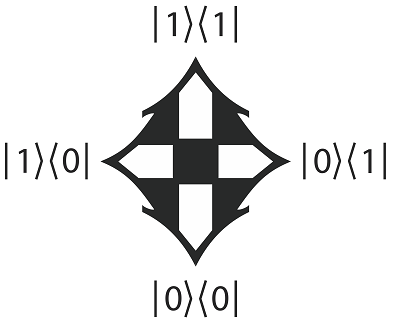

Binary Order Thinning
When does a new Boolean distinction preserve the topology of an ordered state space?
Read manuscript online Or start with the explanation below.
The mathematical question
Begin with a finite partially ordered set. A Boolean label retains some comparisons and removes others, producing a thinner order on the same states. The paper asks when the original and thinned order complexes remain closely related, and exactly where a simple answer stops working.
What the current manuscript establishes
For height-at-most-two orders and a single Boolean label, the relative boundary has a graph-incidence form. This yields an exact rooted-forest criterion for vanishing relative homology and simplicial collapse. The manuscript also gives examples showing that two simultaneous Boolean coordinates or greater height can defeat that simple criterion.
Why it matters to The MIND
This gives a carefully bounded answer to one version of “what changes when an observer gains a distinction?” It is a foundation for observation refinement and a concrete result within Logical Homology.
Current boundary
The theorem concerns finite posets under specified operations. It does not establish that a biological or artificial mind has this structure, and its height and one-bit limits should remain visible when the result is described.
Related manuscript
Binary Order Thinning of Finite Posets: Homology, Collapses, and Sharp LimitsFocused research manuscript; internally reviewed local v3. Vertex minimality through six states is computer-assisted.
Site reading copy 3 from Reviewed local v3, September 27, 2026; editorial domain, program-description, and supplement-access polish October 5, 2026. Stated results unchanged.
Read online Read the PDF Extracted text (limited equations) Download the certificate package See this manuscript's index entry