
B = Being + Becoming
Mathematical tools for states and change.
Being describes a state at a moment. Becoming asks how it changes. B-Theory studies how observations help a system distinguish states and update its model.
Tools from logic, topology, information theory, and computation. Connections to minds and self-awareness remain research questions.
Observe features of the system’s current state.
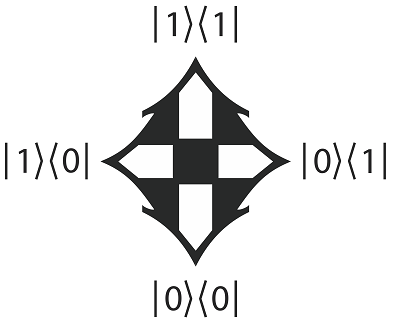
A visual metaphor for a system updating its internal self-model. Being marks the snapshots before and after; Becoming spans feedback and update.
Start here · no mathematical background needed
What can an observer tell apart?
A state is one possible situation. Here, it is a card with a colour and a shape. A test tells the observer one of those properties.
Four cards. Two possible tests.
You can see all four cards below. The observer can only read the properties you enable.
Each card is written AB: A is colour (0 = teal, 1 = gold); B is shape (0 = circle, 1 = square). So 01 is a teal square.
Before you change a test: predict which cards will still look the same to the observer.
From four cards to questions about a system’s own observations and limits.
Watch larger, with chapters and transcript2 observable groups. The observer knows the colour, but cannot tell a circle from a square.
Teal (A = 0)
00Teal circle01Teal square
Gold (A = 1)
10Gold circle11Gold square
What changed? The cards stay fixed; what changes is which cards the observer can distinguish. Adding a test can split a group. It cannot merge groups the observer could already tell apart.
The mathematics behind the example
1 bit of uncertainty remains about the full state: one more yes/no answer identifies the card.
This toy model treats all four cards as equally likely. The uncertainty is Shannon conditional entropy about the full state given the selected observations. It is not a measure of consciousness.
The groups here use complete yes/no records. The ProLT explanation also studies a different construction, where only positive answers count as observations.
Keep learning: 1. From observations to topology · 2. What changes when a new test is added
The research path
From a snapshot to a changing model
Being describes a snapshot; Becoming studies change. These research lenses overlap.
Selected work
Browse selected mathematical tools
Correspondence Matrices
A typed calculus connecting formula-valued logical operators with numeric Boolean matrices.
Explore project Expository manuscriptProLT Observation Topologies
Finite logical spaces defined by the observations available to an observer.
Explore project Research draftObservation Refinement
A mathematical model of concept differentiation when a new observation splits a finite state space.
Explore project Research noteHierarchical Concepts
Finite-resolution observation of ultrametric hierarchies and the concepts it groups together.
Explore projectFrom observation to prediction
Can the needed distinction actually be acquired?
Knowing how a system changes is not enough if its current state is hidden. The Acquirable Predictive Models technical report connects permitted tests with the distinctions needed to predict future outputs in a restricted finite model.
It also shows why timing matters: an action can make the current state certain without revealing the past, or obstruct an experiment that would succeed with the state held fixed.
Read the report onlineThe wider question
What would it take to model a mind?
The MIND connects selected mathematical results to questions about concepts, observation, and self-modeling. The programme is exploratory; each page states what its current work actually establishes.
Explore The MIND