Results and concepts
Formal means stated in a manuscript or record. Computational entries describe software or benchmark evidence. Proposed and interpretive entries describe directions or readings. Links between entries are conceptual or navigational.
Jump to a result or concept
Formal · theorem
The symmetry group of the marked operation algebra #
The binary linear normalizer of the marked operation algebra is GL₂(A) ⋊ Aut(A), of order 98,304. It is also the group of state transformations preserving the coarse A-projective measurements, and it acts on the 24 projective points as a permutation group of order 12,288.
Source · Process Closure and Restricted Conversion in a Chain-Ring Modal Model, Theorem 5.1 · Find in reader
Research lines · Chain-Ring Process Semantics
Parent concept · Modal models on the CM rotation algebra
Formal · theorem
The calculus never leaves Boolean algebra #
Starting from formula-valued logical matrices or tensors, polarity substitution, logical-state construction, XOR–AND contraction, pointwise superposition, block outer composition, support difference and signed-frame reindexing all stay inside Boolean algebra, and after valuation the numeric operations stay in 𝔽₂. No step needs real, complex or other extended scalars.
Source · Correspondence and Logical Matrices, Proposition 13.1 · Find in reader
Research lines · Correspondence Matrices
Parent concept · Correspondence and logical matrices
Formal · theorem
Exact Boolean factorization #
Every nonfalse Boolean function has a canonical finest partition of its variables into prime blocks such that the function is the conjunction of functions on those blocks. A chosen vtree representation can expose or hide those factors, and some vtree exposes all of them (Theorem 1).
Source · Structured Boolean Factorization (Vtree Alignment note), Section 1 and Theorem 1 · Find in reader
Research lines · Structured Boolean Factorization · Binary Information Bounds · CM Structural Decomposition
Related entries · Boolean normal forms and parity · Local-to-global reconstruction (gluing) · Exact binary information bounds · Flattenings, block lifts and rank separability · The historical unfolding operator and its limits
Formal · theorem
Boolean normal forms and parity #
Normal-form and algebraic-normal-form (ANF) parity descriptions of Boolean operators, used to compare representations exactly. The top ANF coefficient is a correspondence parity.
Source · Correspondence and Logical Matrices, Proposition 10.1 and Corollary 10.2 · Find in reader
Research lines · Correspondence Matrices · Structured Boolean Factorization
Related entries · Exact Boolean factorization · Boolean superposition of aligned operators · XOR–AND algebra and basis decomposition · Correspondence and logical matrices · Finite-jet rigidity of sign patterns · Recognition campaigns — advice behind exact checks
Formal · theorem
Boolean superposition of aligned operators #
Applying an outer Boolean operation pointwise to aligned logical operators, with lifting, valuation and pairing all preserving the same operation.
Source · Correspondence and Logical Matrices, Theorems 5.1, 6.6 and 6.12, Corollary 5.2 · Find in reader
Research lines · Correspondence Matrices
Parent concept · Correspondence and logical matrices
Related entries · Operand frames, signed frames and polarity · Boolean normal forms and parity · Same-frame fusion of operator tokens
Formal · theorem
Certified guards and coordinate probes #
A nonempty guard on which every score has a proved strict sign carries one exact operator and correspondence matrix. For the four-operator family three truth-table coordinate probes are necessary in the worst case.
Source · Guarded Boolean Operators, Propositions 4.1–4.3 and 5.1–5.2 · Find in reader
Research lines · Guarded Boolean Dispatch
Parent concept · Correspondence and logical matrices
Related entries · One-hot states and CM selection · Costed conflict covering
Computational · example
CM applications — policies, configurations and circuits #
Small teaching examples that use CMs for access policies, configuration models and circuit output cones. The access-policy examples are checked on every assignment; the circuit and configuration examples work through selected assignments and are not benchmarks.
Source · Correspondence Matrices: From Logic to Code, lesson 23_application; Correspondence Matrices — Advanced, lessons circuits, policy-rule-systems and configuration-models
Research lines · Correspondence Matrices
Parent concept · CM-IR — compiled CM programs
Related entries · Executable queries and acquisition cost
Formal · theorem
XOR–AND algebra and basis decomposition #
Why the calculus uses XOR with AND rather than OR with AND, and how every CM decomposes over four basis matrices.
Source · Correspondence and Logical Matrices, Remark 2.3 and Proposition 2.4 · Find in reader
Research lines · Correspondence Matrices
Parent concept · Correspondence and logical matrices
Related entries · Boolean normal forms and parity · One-hot states and CM selection · The rotation algebra and its two-party normal form
Computational · method
Execution strategies for CM programs #
Eager versus deferred evaluation, packing truth outputs into machine words, materialization boundaries, selector-width limits and parallel work.
Source · Correspondence Matrices: From Logic to Code, lesson 21_packed_outputs; Correspondence Matrices — Advanced, lessons eager-lazy, packed-words-selection, pair-aware, hybrid-partial, selector-width-limit, parallel-cm and instruction-operations-memory
Research lines · Correspondence Matrices
Parent concept · CM-IR — compiled CM programs
Formal · theorem
Flattenings, block lifts and rank separability #
An ordered row/column split of the variables lays an n-variable correspondence tensor out as a 2^p × 2^q matrix that still selects f(x) by bra–map–ket contraction, and larger operators are built from smaller blocks. For a fixed split, the GF(2) rank (not the Boolean OR rank) equals the least number of AND-products whose XOR is f, so rank at most one is exactly conjunctive separability; the value depends on the split.
Source · Correspondence and Logical Matrices, Definition 7.1, Theorems 7.3 and 8.1–8.2
- Theorem 8.2 · Correspondence and Logical Matrices, September 2026 reading copy
Research lines · Correspondence Matrices
Parent concept · Correspondence and logical matrices
Related entries · Exact Boolean factorization · Conditioning and counting on a stored decomposition · Correspondence and logical tensors · Vtree cuts and semantic primeness
Computational · method
CM-IR — compiled CM programs #
The repository's shared computation graph for CM programs, which is a different artifact from an explicit filled matrix; building the graph and materializing its outputs are separate operations. It is software, and the course checks a materialized example against an independent scalar oracle on every assignment without making a performance claim.
Source · Correspondence Matrices: From Logic to Code, lessons 19_cm_ir and 20_public_api; Correspondence Matrices — Advanced, lesson explicit-cm-vs-cm-ir
Research lines · Correspondence Matrices
Parent concept · Correspondence and logical matrices
Related entries · Fair exact comparisons and timing evidence
Formal · definition
Modal models on the CM rotation algebra #
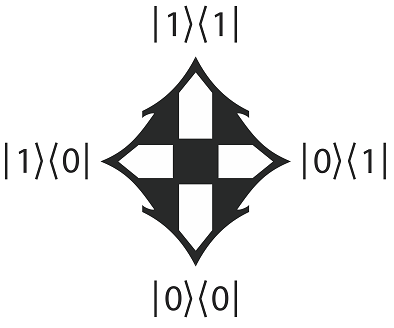
Reading the four rotational CM positions with the cyclic multiplication E_i·E_j = E_(i+j mod 4) makes four-bit patterns the sixteen-element group algebra over F₂ of the four-cycle, a chain ring, for modal-style possibility analysis. This product is neither pointwise conjunction nor the ordinary product of the original matrices, and arranging coefficients on a cycle does not by itself supply it; in the audited implementation it is the composition of the corresponding rotation operators, exactly the 16 Boolean matrices that commute with the four-cycle (Theorem 4.1). On this ring possible and impossible outcomes can be studied in the manner of modal quantum theory; the operations and readout allowed are part of each model, and none of this is physical quantum theory or a speedup claim.
Source · Boolean CM Phase Algebra, Sections 1–2 and Proposition 2.1; Correctness Audit of Boolean CM Modal Models, Theorem 4.1 · Find in reader
Research lines · CM Model Correctness Audit · Boolean CM Phase Algebra · Chain-Ring Contextuality · Chain-Ring Process Semantics · Characteristic-Two Query Bounds · Signed and Integral CM Lifts · LM–Modal Bridge
Related entries · Correspondence and logical matrices · Operand frames, signed frames and polarity
Formal · method
CM oracles and phase-path counting #
Reversible oracles and phase gates built from correspondence matrices, with an exact integer phase-count representation of circuits made from standard gates.
Source · Signed and Integral Lifts of Correspondence Matrices, Propositions 8.2, 9.1 and 10.1 · Find in reader
Research lines · Signed and Integral CM Lifts
Parent concept · Modal models on the CM rotation algebra
Formal · theorem
One-hot states and CM selection #
Once the operand axes and true-first order are fixed, the sixteen binary Boolean operators correspond one-to-one with the sixteen binary 2×2 matrices. Contracting a CM between one-hot true-first state vectors (XOR–AND) returns the operator's value at that input.
Source · Correspondence and Logical Matrices, Propositions 2.1–2.2 · Find in reader
Research lines · Correspondence Matrices
Parent concept · Correspondence and logical matrices
Related entries · XOR–AND algebra and basis decomposition · Certified guards and coordinate probes · Same-frame fusion of operator tokens
Computational · method
Sharing, CSE and canonical interning #
How repeated subexpressions are found and shared, and how to test whether CM-IR's mechanism gives any distinct transformation once both compilers are credited with the mechanisms they have in common.
Source · Correspondence Matrices — Advanced, lessons raw-ast, cse-plain-language, canonicalization-interning, cm-ir-nodes-sharing, cse-vs-cse-flat and cm-ir-vs-cse-flat-mechanism
Research lines · Correspondence Matrices
Parent concept · CM-IR — compiled CM programs
Computational · example
Compiler studies with failed utility gates #
Two completed studies failed their frozen utility gates: in the P14-PY0 dispatcher campaign exact dispatch was about 5–6% slower than direct lowering, and in the frozen synthetic pair-token confirmation direct packed evaluation was about four times faster than CM compilation. No generic runtime advantage is established.
Source · Operator-Level Boolean Computation with Correspondence Matrices, Sections 8.3–8.4
Research lines · CM Compiler Computation
Parent concept · CM-IR — compiled CM programs
Related entries · Fair exact comparisons and timing evidence · Recognition campaigns — advice behind exact checks
Formal · theorem
Conditioning and counting on a stored decomposition #
For four standard exact decompositions, fixing input variables and counting satisfying completions can be done on the stored factors alone, without rebuilding the truth table, with explicit count identities and recompression from the factors.
Source · Exact Boolean Decomposition Artifacts under Conditioning, Theorems 5.1, 6.1 and 7.1, Proposition 7.3 · Find in reader
Research lines · CM Structural Decomposition
Parent concept · Exact Boolean factorization
Related entries · Flattenings, block lifts and rank separability · Vtree cuts and semantic primeness
Formal · definition
Correspondence and logical matrices #
A typed link between formula-valued logical matrices (LMs) and numeric correspondence matrices (CMs), so symbolic and numeric forms of a Boolean operator stay in step.
Source · Correspondence and Logical Matrices, Sections 2–3
Research lines · Correspondence Matrices · Algebraic Logic · Observable Answers and Executable Queries · Guarded Boolean Dispatch · CM Compiler Computation · LM–Modal Bridge · Signed and Integral CM Lifts · Boolean CM Phase Algebra · CM Model Correctness Audit · Evolutionary CM/LM Proof Pilot
Related entries · Boolean normal forms and parity · Truth vectors and truth regions · Boolean modules and logical state vectors · Modal models on the CM rotation algebra · Executable queries and acquisition cost
Computational · example
Reproducibility audit of decomposition artifacts #
All tested methods returned identical counts. The minimum-JSON selector kept the flat representation on all 26 external outputs, while a revised selector using actual compact-binary bytes chose structured (product or rank) representations on 16 of them. No artifact pipeline had a lower estimated summed setup cost than the packed baseline at 1,000 queries, and a later direct replay, timing reconstruction from the saved payload and 128 queries, found no artifact median below packed counting on any of the 38 cases. These are reference implementations in one in-memory process on reused cases; correctness and storage formulas do not establish a speedup, and the selection depends on the encoding chosen.
Source · Exact Boolean Decomposition Artifacts under Conditioning, Sections 11.3–11.5
Research lines · CM Structural Decomposition
Parent concept · Exact Boolean factorization
Related entries · Bounded factorization search campaigns · Fair exact comparisons and timing evidence
Formal · theorem
Exact width of nilpotent-tag detectors #
With fixed constant-annihilating linear channels on nilpotent phase tags, read by literal zero/nonzero inspection, the least number of channels that separates constant from balanced truth vectors on N addresses (N even) is 1 when N ≡ 2 mod 4 and ⌈N/(2r)⌉ when 4 divides N, where r is the binary dimension of the tag ideal; recognizing constancy without the balance promise needs ⌈(N − 1)/r⌉. The detector theorem packages a known coding bound, and the exact gate boundary for square-zero interactions is also given.
Source · Boolean CM Phase Algebra, Lemma 6.2, Theorems 6.3 and 7.1, Corollary 6.4 · Find in reader
Research lines · Boolean CM Phase Algebra
Parent concept · Modal models on the CM rotation algebra
Related entries · Exact query bounds in characteristic two
Formal · theorem
Measurement update without division #
For any commutative ring and any invertible basis matrix B, the conjugated coordinate projectors are orthogonal idempotents summing to the identity. The i-th projected state is nonzero exactly when the i-th coordinate of Bψ is nonzero, and repeating the same measurement gives support only on outcome i, so a reversible-basis measurement update needs no division.
Source · Does the Symbolic LM Calculus Canonically Induce the Modal Measurement Theory?, Theorem 14.1 · Find in reader
Research lines · LM–Modal Bridge
Parent concept · Modal models on the CM rotation algebra
Formal · theorem
The bridge after enriching the scalars #
Once the chain ring is chosen and tensored with the Boolean ring of formulas, each valuation specializes canonically, and a symbolic support formula is satisfiable exactly when some valuation makes the outcome possible. The link is canonical only after that choice.
Source · Does the Symbolic LM Calculus Canonically Induce the Modal Measurement Theory?, Theorems 9.2 and 10.1, Corollary 10.2 · Find in reader
Research lines · LM–Modal Bridge
Parent concept · Modal models on the CM rotation algebra
Computational · method
Reproducible evidence and correction trails #
Binding each claim, video and benchmark to its source hash, keeping corrections visible, and stating what verification does and does not establish.
Research lines · Correspondence Matrices · Diagnosing While Repairing · Recoverable Memory Under Replacement · Binary Order Thinning · Risk-constrained solver selection · CM Model Correctness Audit · CM Compiler Computation · CM Structural Decomposition
Related entries · Fair exact comparisons and timing evidence
Computational · method
Fair exact comparisons and timing evidence #
Guards for comparing representations with matching output contracts, reading timing ratios, and why there is no universal winner. Timing results are bounded performance evidence, not a universal speed claim.
Source · Correspondence Matrices: From Logic to Code, lesson 22_fair_measurement; Correspondence Matrices — Advanced, lessons what-cm-does-not-claim, reuse-break-even, measurement-boundaries, conceptual-vs-measured, exact-comparison-protocol, b2b4-corrected, b2b4-runpod, epfl-parity, read-a-ratio, scope-boundaries and no-fastest-chart
Research lines · Correspondence Matrices · Structured Boolean Factorization
Parent concept · CM-IR — compiled CM programs
Related entries · Reproducible evidence and correction trails · CM-IR — compiled CM programs · Compiler studies with failed utility gates · Reproducibility audit of decomposition artifacts · Bounded factorization search campaigns
Formal · theorem
Conversion between chain-ring resources #
Under local filters linear over the chain ring, with finite classical feed-forward and product ancillas, one resource converts to another on one copy exactly when the target's padded Smith exponents are componentwise at least the source's. With every phase register retained, k copies yield a free d-dimensional target exactly when r₀^k ≥ d, where r₀ is the number of unit Smith factors, and allowing a coefficient-resolved disposal of a phase register changes this.
Source · Process Closure and Restricted Conversion in a Chain-Ring Modal Model, Theorems 6.1 and 8.1, Corollary 8.2 and Proposition 9.1 · Find in reader
Research lines · Chain-Ring Process Semantics
Parent concept · Modal models on the CM rotation algebra
Related entries · Smith invariants classify contextuality · Exact messages and teleportation from a chain-ring resource
Formal · theorem
How many messages one encoder orbit can carry #
For d ≥ 2 and a nonzero M ∈ Mat_d(A), when the sender uses only GL_d(A) encoders and the receiver may apply any complete binary basis decoder, the largest number of exactly distinguishable vectors that can be chosen from the encoder orbit of a resource Φ(M) is d·r_B, where r_B is the binary dimension of the row image of M. This concerns that changed decoder contract, not an A-linear codebook.
Source · Process Closure and Restricted Conversion in a Chain-Ring Modal Model, Proposition 7.1 · Find in reader
Research lines · Chain-Ring Process Semantics
Parent concept · Modal models on the CM rotation algebra
Formal · theorem
Same-frame fusion of operator tokens #
Two binary connectives written in the same ordered operand frame can be combined entrywise before their operands are evaluated, so a four-bit operator can serve as a compiler token once its frame is typed.
Source · Operator-Level Boolean Computation with Correspondence Matrices, Proposition 1 and Theorem 1 · Find in reader
Research lines · CM Compiler Computation
Parent concept · CM-IR — compiled CM programs
Related entries · Boolean superposition of aligned operators · One-hot states and CM selection
Formal · theorem
Guard degree against number of tests #
In the paper's four-operator model (AND, the two projections and XNOR), exact identification on the promised zero-free domain uses a fixed library of binary polynomial-sign tests in the original magnitude coordinates. With a total-degree cap of one, exact identification is impossible. The minimum library size is three at a cap of two or three and two at a cap of four or higher. Each polynomial in an exact two-test library has degree at least four. Reciprocal coordinates make the chamber boundaries linear, so the count depends on the coordinates chosen.
Source · Guarded Boolean Operators, Lemma 3.1 and Theorem 3.2 · Find in reader
Research lines · Guarded Boolean Dispatch
Parent concept · Correspondence and logical matrices
Related entries · Exact adaptive acquisition recurrences · Regularity and degree needed away from the walls
Formal · theorem
Boolean valuation cannot produce chain-ring amplitudes #
Every ring homomorphism from a Boolean ring into the chain ring lands in zero and one, so nilpotent and non-trivial unit amplitudes never arise from Boolean formulas directly. The logical-matrix calculus does not generate the modal measurement families, and support is not a homomorphism.
Source · Does the Symbolic LM Calculus Canonically Induce the Modal Measurement Theory?, Theorem 7.1, Corollary 7.2, Propositions 11.1 and 12.1 · Find in reader
Research lines · LM–Modal Bridge
Parent concept · Modal models on the CM rotation algebra
Related entries · Nonzero amplitudes cannot all be possible
Formal · theorem
Nonzero amplitudes cannot all be possible #
In the declared ring GF(2)[u]/(u^4), declaring every nonzero amplitude possible contradicts independent composition of events, because two nonzero nilpotent amplitudes can multiply to zero. Primitive preparations still fail to give independently factorizing outcome sets under this rule; a multiplicative possibility predicate p with p(0) = 0 and p(1) = 1 picks exactly the units.
Source · Process Closure and Restricted Conversion in a Chain-Ring Modal Model, Theorem 2.1 and Propositions 2.2–2.3 · Find in reader
Research lines · Chain-Ring Process Semantics
Parent concept · Modal models on the CM rotation algebra
Related entries · The rotation algebra and its two-party normal form · Boolean valuation cannot produce chain-ring amplitudes
Formal · theorem
Composing logical matrices through a matched frame #
Over the formula Boolean ring, the XOR–AND product of the logical matrices of X Θ Y and Y Ψ Z is the logical matrix of X Ω Z, where the CM of Ω is the product of the CMs of Θ and Ψ. This is parity-based composition through the matched middle frame Y; it is neither existential relational composition nor pointwise combination.
Source · Correspondence and Logical Matrices, Theorem 5.4 · Find in reader
Research lines · Correspondence Matrices
Parent concept · Correspondence and logical matrices
Formal · theorem
A closed binary-modal completion #
A literal contract on binary vector spaces is closed under sequential and parallel composition and conditioning, and realizes the original two-party support tables by coarse measurements. The realization does not preserve tensor composition or separability.
Source · Process Closure and Restricted Conversion in a Chain-Ring Modal Model, Proposition 3.2 and Theorem 4.1 · Find in reader
Research lines · Chain-Ring Process Semantics
Parent concept · Modal models on the CM rotation algebra
Formal · theorem
LM frame normal form and valuation #
Every binary formula-valued logical matrix factors through an involutive frame matrix, so the CM can be recovered from the LM inside the formula ring. A valuation sends the LM to the CM with rows and columns reversed according to the values of X and Y. The all-true valuation of free generators gives the CM itself. For substituted operands, joint satisfiability is required for that all-true valuation. Other valuations can also give the same matrix when it is invariant under the induced reversals.
Source · Correspondence and Logical Matrices, Theorems 3.1–3.2 · Find in reader
Research lines · Correspondence Matrices
Parent concept · Correspondence and logical matrices
Related entries · Logical pairing · Valuation commutes with logical-matrix contraction
Formal · theorem
Valuation commutes with logical-matrix contraction #
A logical matrix is a predicate-valued matrix over a Boolean ring, its pairing is matrix contraction there, and Boolean valuation commutes with products and contractions.
Source · Does the Symbolic LM Calculus Canonically Induce the Modal Measurement Theory?, Theorems 4.1 and 6.1, Proposition 5.1 · Find in reader
Research lines · LM–Modal Bridge
Parent concept · Modal models on the CM rotation algebra
Related entries · LM frame normal form and valuation · Logical pairing
Formal · theorem
Logical pairing #
Pairing formula states A and B with the logical matrix of X Θ Y gives the formula (A ⇔ X) Θ (Y ⇔ B), and valuation commutes with this pairing. The same identity holds for n-ary logical tensors, where the labelled basis pairings recover the complete truth table.
Source · Correspondence and Logical Matrices, Theorems 4.1, 4.4 and 6.15, Corollary 4.2 · Find in reader
Research lines · Correspondence Matrices
Parent concept · Correspondence and logical matrices
Related entries · LM frame normal form and valuation · Correspondence and logical tensors · Valuation commutes with logical-matrix contraction
Formal · definition
Correspondence and logical tensors #
Higher-arity versions of CMs and LMs, built by tensor construction, with a general valuation theorem. For a fixed arity, the image of the LM lift is a Boolean subalgebra isomorphic to the algebra of n-ary Boolean functions, and all-true valuation inverts the lift on it (Corollary 6.7).
Source · Correspondence and Logical Matrices, Definitions 6.1–6.2, Theorem 6.4 and Corollary 6.7 · Find in reader
Research lines · Correspondence Matrices
Parent concept · Correspondence and logical matrices
Related entries · Flattenings, block lifts and rank separability · Logical pairing
Formal · theorem
A possibilistic Bell contradiction without signalling #
For literal tensor states with complete local invertible analyzers, the set of outcomes possible for one party does not depend on the other party's setting. For the audited support-Bell table with three settings per party, no deterministic assignment reproduces the table of possible outcomes, and every no-signalling probability assignment respecting its impossible events gives probability zero to six events the table calls possible.
Source · Correctness Audit of Boolean CM Modal Models, Proposition 7.1, Theorems 7.2 and 14.1 · Find in reader
Research lines · CM Model Correctness Audit
Parent concept · Modal models on the CM rotation algebra
Related entries · Smith invariants classify contextuality
Formal · theorem
Exact query bounds in characteristic two #
Over any field of characteristic two, with finite ancillas, finite adaptive trees and complete recorded readout where every possible branch must be exactly correct, recovering a Bernstein–Vazirani secret s from f_s(x) = s·x needs at least n queries for any fixed pointwise invertible oracle interface, and n XOR-oracle queries suffice. Under the same contract one query cannot solve Deutsch, nor separate constant from balanced functions for n ≥ 2. No quantum-device advantage is inferred.
Source · Exact Bernstein–Vazirani Query Complexity, Lemma 3.1, Theorems 3.2 and 4.1–4.2 · Find in reader
Research lines · Characteristic-Two Query Bounds
Parent concept · Modal models on the CM rotation algebra
Related entries · Executable queries and acquisition cost · Exact adaptive acquisition recurrences · Exact width of nilpotent-tag detectors
Formal · theorem
Transfer, activation and no-cloning limits #
Corrected statements of what a literal Boolean-linear resource can do: when exact transfer exists, the largest exactly transferable subspace by rank, heralded activation from several copies, an obstruction in even dimension, and a linear no-cloning result. The audit records which earlier resource and readout claims were corrected.
Source · Correctness Audit of Boolean CM Modal Models, Theorems 9.1, 11.1–11.2, 12.1 and 13.1 · Find in reader
Research lines · CM Model Correctness Audit
Parent concept · Modal models on the CM rotation algebra
Related entries · Exact messages and teleportation from a chain-ring resource
Formal · theorem
The native gate algebra of the phase ring #
The phase ring's ideals and units are listed, its native binary gates are exactly the centralizer of a four-cycle, and two-branch unitaries have a complete normal form. Allowing arbitrary binary gates is a strictly larger model.
Source · Boolean CM Phase Algebra, Proposition 2.1, Theorems 3.1 and 4.2 · Find in reader
Research lines · Boolean CM Phase Algebra
Parent concept · Modal models on the CM rotation algebra
Related entries · The rotation algebra and its two-party normal form
Formal · theorem
Operator chambers of a continuous score model #
Wherever every score of a continuous family is nonzero, the scores determine one Boolean operator; the constant-operator sets partition this zero-free set, and their connected components are the operator chambers, which for merely continuous scores can be infinitely many. For the worked polynomial x + y + xy on signed positive magnitudes there are exactly four, labelled AND, the two projections and XNOR.
Source · Guarded Boolean Operators, Proposition 2.1 and Theorem 2.2 · Find in reader
Research lines · Guarded Boolean Dispatch
Parent concept · Correspondence and logical matrices
Related entries · Truth vectors and truth regions · Finite-jet rigidity of sign patterns · Boolean readout of a continuous system and its margin
Formal · theorem
Exact messages and teleportation from a chain-ring resource #
For a nonzero square d-by-d resource over a finite commutative chain ring (d ≥ 2), the orbit-coding contract of Section 2 permits exactly dh messages at optimum, where h is the multiplicity of the least Smith exponent. With the matched complete-basis support contract, this exceeds d exactly when the resource is strongly contextual. Universal exact raw-vector teleportation with a complete joint covector basis and unrestricted invertible corrections is possible exactly when the resource is invertible. The nonprimitive resource π^a I_d for 0 < a below the ring length attains d² messages but cannot teleport universally. Under the stated contracts, for a primitive resource the maximum message count is d² exactly when the resource is invertible, equivalently when universal exact raw-vector teleportation is possible (Corollary 4.6).
Source · Contextuality and Exact Information Resources over Finite Chain Rings, Theorems 4.2 and 4.4, Corollaries 4.3 and 4.5–4.6 · Find in reader
Research lines · Chain-Ring Contextuality
Parent concept · Modal models on the CM rotation algebra
Related entries · Transfer, activation and no-cloning limits · Conversion between chain-ring resources
Formal · theorem
What a persistent decomposition must retain #
A histogram that answers one query is not a persistent index, and a state answering every conditioned count must distinguish functions. A deterministic zero-error verifier with only individual value-query access to the source must query every assignment on the all-zero source to verify that it matches a zero-function artifact. This holds even if the source's truth matrix has GF(2) rank at most one across a fixed cut. Decomposing afresh after conditioning can give more factors than the retained list.
Source · Exact Boolean Decomposition Artifacts under Conditioning, Propositions 9.1–9.3 and Example 9.4 · Find in reader
Research lines · CM Structural Decomposition
Parent concept · Exact Boolean factorization
Related entries · Streaming memory costs more than terminal bits
Formal · theorem
Rank against prototype dictionaries #
Bounds relating binary rank to the number of cofactor prototypes up to complement at a fixed cut, with an example where a rank payload is exponentially smaller than the prototype dictionary.
Source · Exact Boolean Decomposition Artifacts under Conditioning, Theorem 8.1 and Proposition 8.2 · Find in reader
Research lines · CM Structural Decomposition
Parent concept · Exact Boolean factorization
Computational · method
Recognition campaigns — advice behind exact checks #
Learned or ranked advice that proposes a representation while an exact check keeps correctness. The campaigns record transfer, screening and abstention costs without claiming a runtime win.
Source · Correspondence Matrices — Advanced, lessons recognition-question, recognition-c2, recognition-c3-c5, recognition-c6, recognition-c9-c11, recognition-c12-c16, recognition-c17-c20, recognition-c21-c22, recognition-c23, recognition-d-tasks, recognition-d8, recognition-d9, recognition-d10 and recognition-e1-e2
Research lines · Correspondence Matrices · Structured Boolean Factorization
Parent concept · CM-IR — compiled CM programs
Related entries · Bounded factorization search campaigns · Boolean normal forms and parity · Compiler studies with failed utility gates · A SAT study where risk-constrained selection picks the exact solver
Formal · theorem
The rotation algebra and its two-party normal form #
The binary 4×4 matrices commuting with the CM rotation are exactly the sixteen XOR combinations of its powers, a chain ring isomorphic to F2[u]/(u⁴). In the shared-module model (tensor over that ring), every two-party matrix is equivalent to exactly one diag(N^a, N^b), 15 classes, and two nonzero preparations can tensor to zero, so declaring every nonzero vector independently preparable is not closed; in the literal binary model the same product is nonzero.
Source · Correctness Audit of Boolean CM Modal Models, Theorems 4.1 and 5.1, Proposition 5.2 · Find in reader
Research lines · CM Model Correctness Audit
Parent concept · Modal models on the CM rotation algebra
Related entries · XOR–AND algebra and basis decomposition · Nonzero amplitudes cannot all be possible · The native gate algebra of the phase ring
Formal · theorem
Which weighted selectors preserve Boolean structure #
A weighted XOR selector is a unital Boolean-algebra homomorphism, preserving every Boolean term operation, exactly when its weights are pairwise disjoint and XOR to one, that is, form a partition of unity.
Source · Correspondence and Logical Matrices, Theorem 4.5 · Find in reader
Research lines · Correspondence Matrices
Parent concept · Correspondence and logical matrices
Formal · theorem
Operand frames, signed frames and polarity #
Swapping operands transposes a CM, negating an input reverses its rows or columns, and negating the output complements every entry. Input permutations and negations together form the signed-permutation group, which commutes with pointwise composition (the formula-valued version needs the matching variable relabelling), and LM tensors are exactly the polarity-equivariant formula tensors; output complement is a separate symmetry.
Source · Correspondence and Logical Matrices, Section 2.4, Theorems 6.9 and 9.1–9.2 · Find in reader
Research lines · Correspondence Matrices
Parent concept · Correspondence and logical matrices
Related entries · Symmetry, group actions and quotients · Boolean superposition of aligned operators · Modal models on the CM rotation algebra · Soundness and completeness of the structural compiler fragment · What the four rotations can and cannot represent
Formal · theorem
Signed and integral lifts of CM rotation #
Lifting the four CM positions to integer counts and adding the relation that opposite positions are negatives gives the Gaussian integers, on which CM rotation induces the signed quarter-turn, and XOR then needs an explicit overlap correction. The quotient is many-to-one and loses truth-table information; its squared length is the unique positive-semidefinite, rotation-invariant quadratic form that vanishes on the kernel of the quotient and gives E₀ squared length one (without that normalization, any positive multiple would qualify). The construction changes scalars; it is not a native Boolean amplitude theory.
Source · Signed and Integral Lifts of Correspondence Matrices, Theorem 6.1, Propositions 6.2 and 7.1 · Find in reader
Research lines · Signed and Integral CM Lifts
Parent concept · Modal models on the CM rotation algebra
Formal · theorem
Smith invariants classify contextuality #
For a nonzero two-party matrix over a finite commutative chain ring, with all primitive projective local bases as settings and nonzero contraction as possibility, two Smith invariants decide the support type: one nonzero factor gives a local model, two or more with a single least exponent give logical but not strong contextuality, and a repeated least exponent gives strong contextuality. Restricted measurement families can change the label and need separate theorems.
Source · Contextuality and Exact Information Resources over Finite Chain Rings, Lemmas 3.1–3.2 and Theorem 3.3 · Find in reader
Research lines · Chain-Ring Contextuality
Parent concept · Modal models on the CM rotation algebra
Related entries · A possibilistic Bell contradiction without signalling · Conversion between chain-ring resources
Formal · theorem
Soundness and completeness of the structural compiler fragment #
The restricted compiler is sound for every pair result it admits and complete for an explicitly declared structural fragment. This is syntactic completeness for that fragment, not recognition of all equivalent formulas.
Source · Operator-Level Boolean Computation with Correspondence Matrices, Theorems 2–4 and Lemma 1 · Find in reader
Research lines · CM Compiler Computation
Parent concept · CM-IR — compiled CM programs
Related entries · Operand frames, signed frames and polarity
Formal · theorem
Symmetry, group actions and quotients #
Indices and quotients induced by symmetry, in two settings. In a full regular tree the stabilizers of complete frontiers have index (m!)^N, but the finer stabilizer is normal, so that a quotient group exists, only under the frontier condition of Theorem 1.1. For a finite transformation monoid of admitted replacements on a finite nonempty state set, choose a minimum-rank idempotent e. Every replacement permutes the classes of the least equivalence invariant under all admitted replacements that identifies each x with e(x). After a known replacement the old class can be recovered.
Source · Hierarchical Concepts, Theorem 1.1; Recoverable Memory, Theorem 3.5
- Theorem 3.5 · Recoverable Memory Under Replacement, site reading copy
- Theorem 1.1 · Hierarchical Concepts, v0.3
Research lines · Hierarchical Concepts · Recoverable Memory Under Replacement · Correspondence Matrices
Related entries · Indistinguishability and quotients · The universal permutation quotient · Operand frames, signed frames and polarity
Formal · definition
Boolean readout of a continuous system and its margin #
A continuous quantity read through a threshold gives a Boolean value; the margin is its distance from the threshold. These papers ask when the Boolean description is exact, how small the margin can become under feedback or switching, and which Boolean patterns a regular function can realize.
Source · Evolutionary CM/LM Proof Pilot, Section 2 and Theorem 3 · Find in reader
Research lines · Evolutionary CM/LM Proof Pilot · Protective Switching in Ordinal-Sum Systems · Parabolic Switching and Terminal Margins · Finite-Jet Sign Rigidity · Guarded Boolean Dispatch
Related entries · Logic under continuous change · Finite-state systems with known dynamics · Operator chambers of a continuous score model
Formal · definition
Truth vectors and truth regions #
The truth vector of a tuple of formulas at one valuation lists their truth values there, and the truth region of a formula is the set of valuations where it is true. Truth regions turn ∧, ∨ and ¬ into intersection, union and complement.
Source · Observation Topologies, Definitions 2.1–2.2 · Find in reader
Research lines · ProLT Observation Topologies · Correspondence Matrices · Algebraic Logic
Related entries · Correspondence and logical matrices · Observation-generated topology · Boolean modules and logical state vectors · When a continuous t-norm conjunction has an exact Boolean abstraction · Observable negation and Heyting implication · Operator chambers of a continuous score model
Formal · theorem
No strong contextuality with two binary settings #
With two-dimensional carriers over the two-element field and at most two complete binary settings per party, every nonzero tensor has a global assignment, for any number of parties.
Source · Contextuality and Exact Information Resources over Finite Chain Rings, Theorem 5.1 · Find in reader
Research lines · Chain-Ring Contextuality
Parent concept · Modal models on the CM rotation algebra
Formal · theorem
Coefficient-weight isometries of the phase ring #
The A-linear automorphisms of A^m that preserve the total cyclic-coordinate Hamming weight of every input are exactly the block permutations with an independent cyclic rotation in each block: m!·4^m of them, 32 when m = 2.
Source · Boolean CM Phase Algebra, Proposition 4.1 · Find in reader
Research lines · Boolean CM Phase Algebra
Parent concept · Modal models on the CM rotation algebra
Formal · theorem
What the four rotations can and cannot represent #
Rotation of a correspondence matrix is a faithful action of the four-element cyclic group, but under XOR coincident contributions cancel, and a normalized, rotation-invariant measure additive on disjoint supports must be the weight divided by four. On any number of branches, the F2[C4]-linear maps preserving total coefficient Hamming weight are exactly branch permutations with independent rotations; the paper calls these model-specific boundaries, not a general no-go for finite-field quantum analogues.
Source · Signed and Integral Lifts of Correspondence Matrices, Proposition 3.1, Theorems 4.1 and 5.1 · Find in reader
Research lines · Signed and Integral CM Lifts
Parent concept · Modal models on the CM rotation algebra
Related entries · Operand frames, signed frames and polarity