Supporting technical companion · Website reading copy · 12 November 2026
Signed and Integral Lifts of Correspondence Matrices
Edition and limits. September 27 submission revision. The successful signed construction changes scalars; it is not a native Boolean complex amplitude theory or speedup. Original bylines and dates remain as printed. This is not external peer review, priority clearance or a claim that unfinished work has become a final research paper.
Scalar-change boundaries connecting Boolean phase labels to signed and integral representations.
Download unchanged PDF · Exact source ZIP · Main TeX · Version/provenance
Scope, corrections and later evidence
Read these records before treating the preserved draft as current. They are not silently merged into it. Local-only links in the original notes are presented as references, not working website links.
Complete page-faithful online reading copy
All 30 pages are shown below, including equations, tables, figures and references. Images preserve the supplied PDF rather than attempting a mathematical transcription. They are not reflowing MathML or screen-reader-certified; the PDF, exact TeX and limited extracted text provide alternatives.
PDF page 1 of 30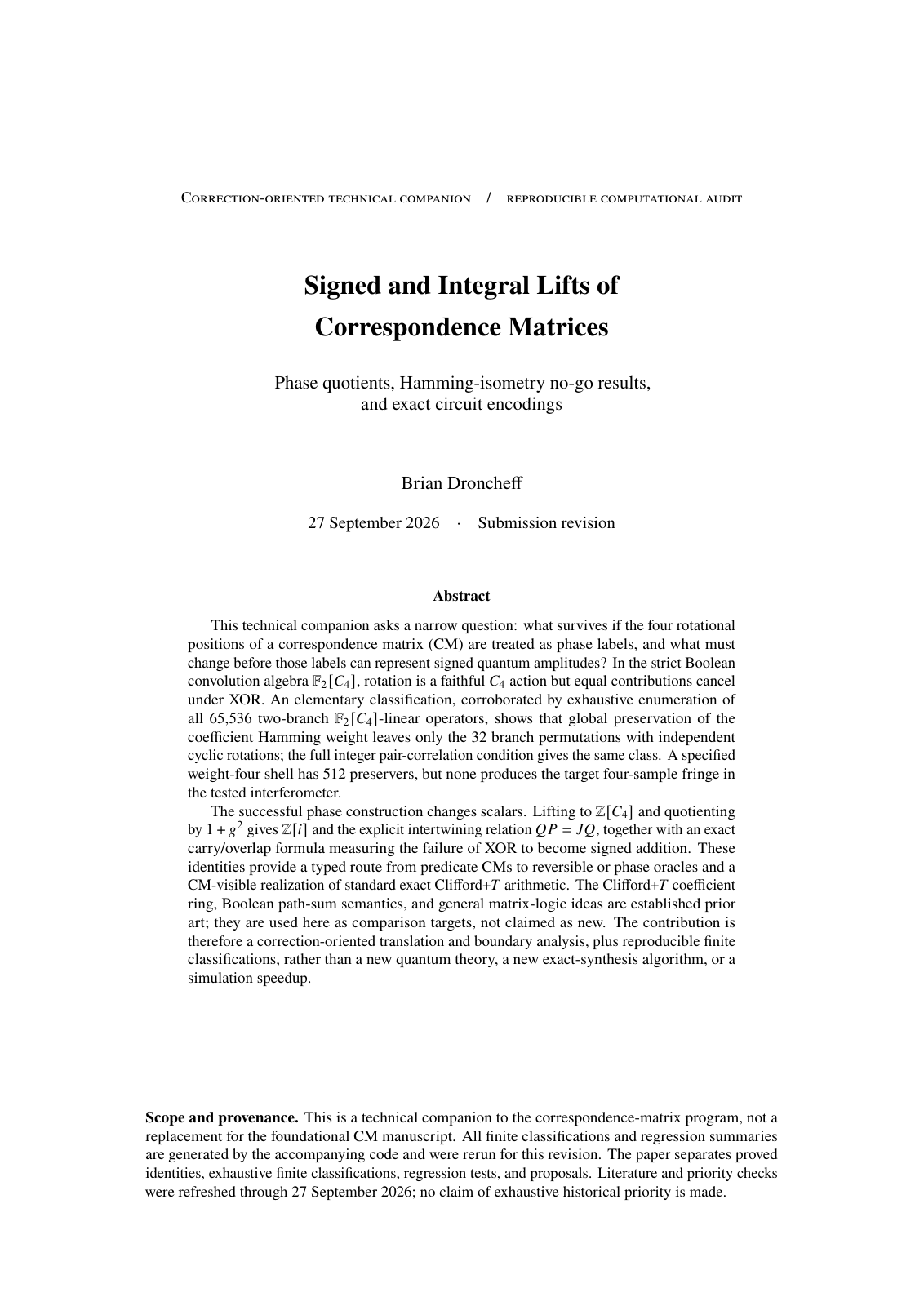 PDF page 2 of 30
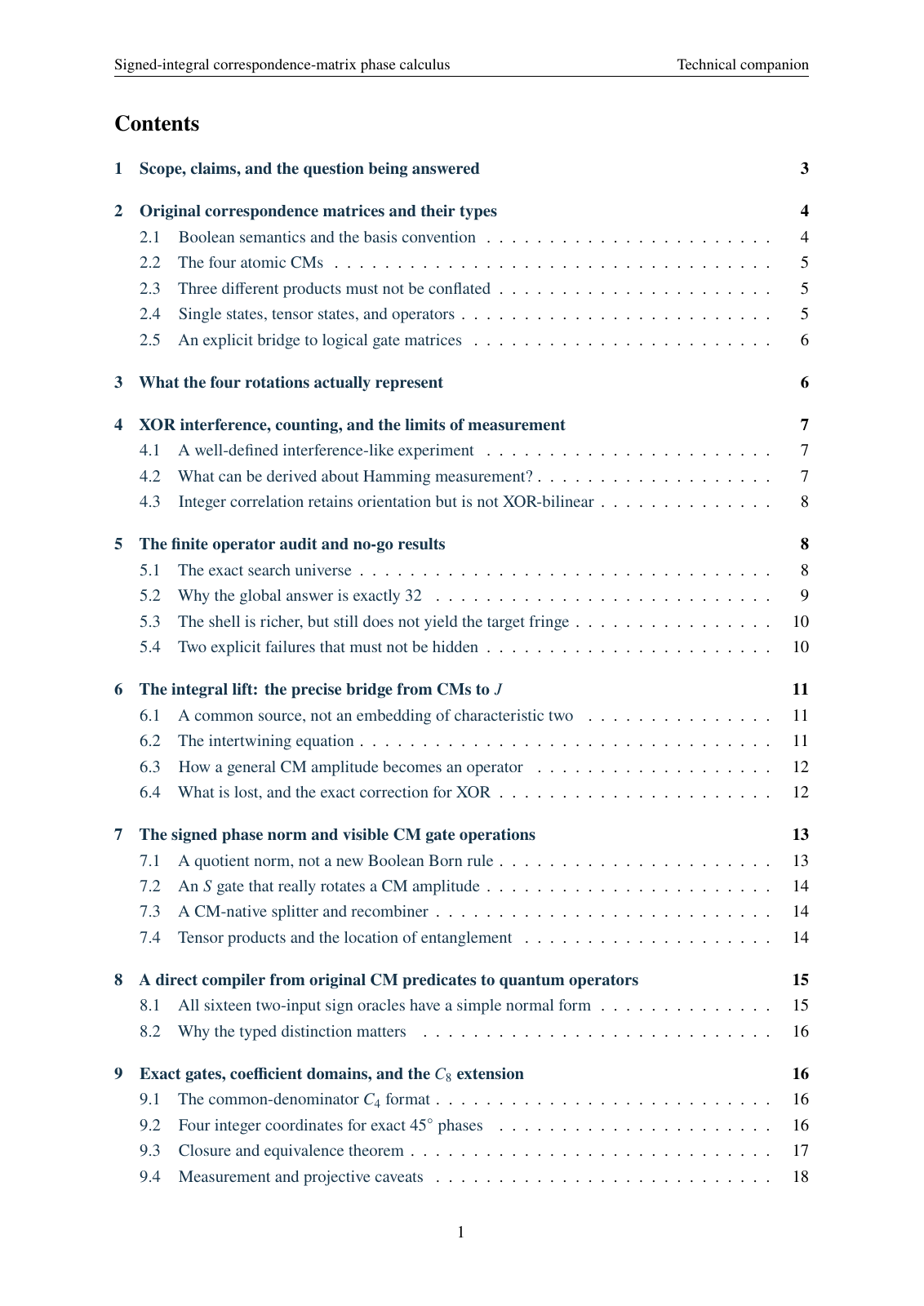 PDF page 3 of 30
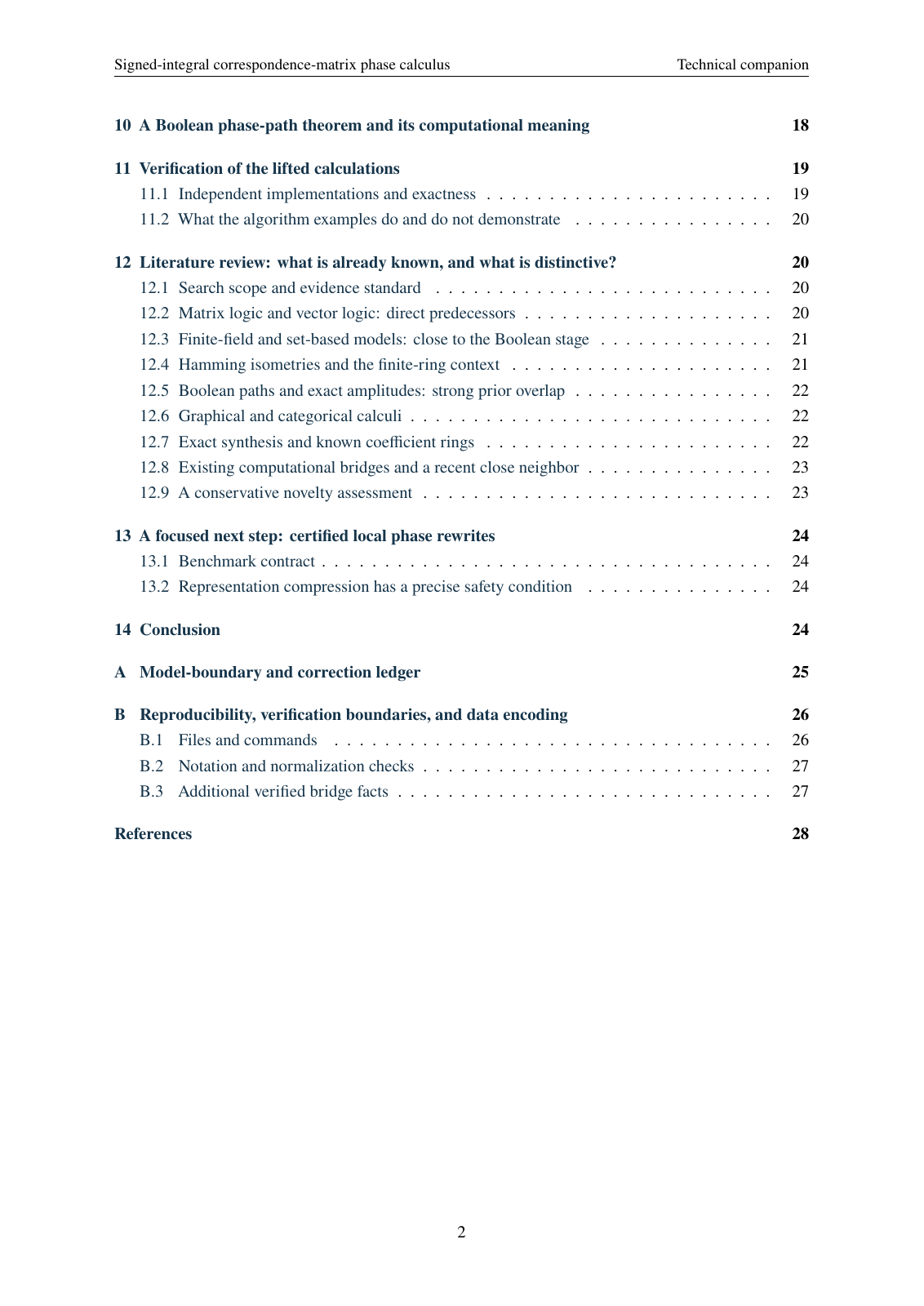 PDF page 4 of 30
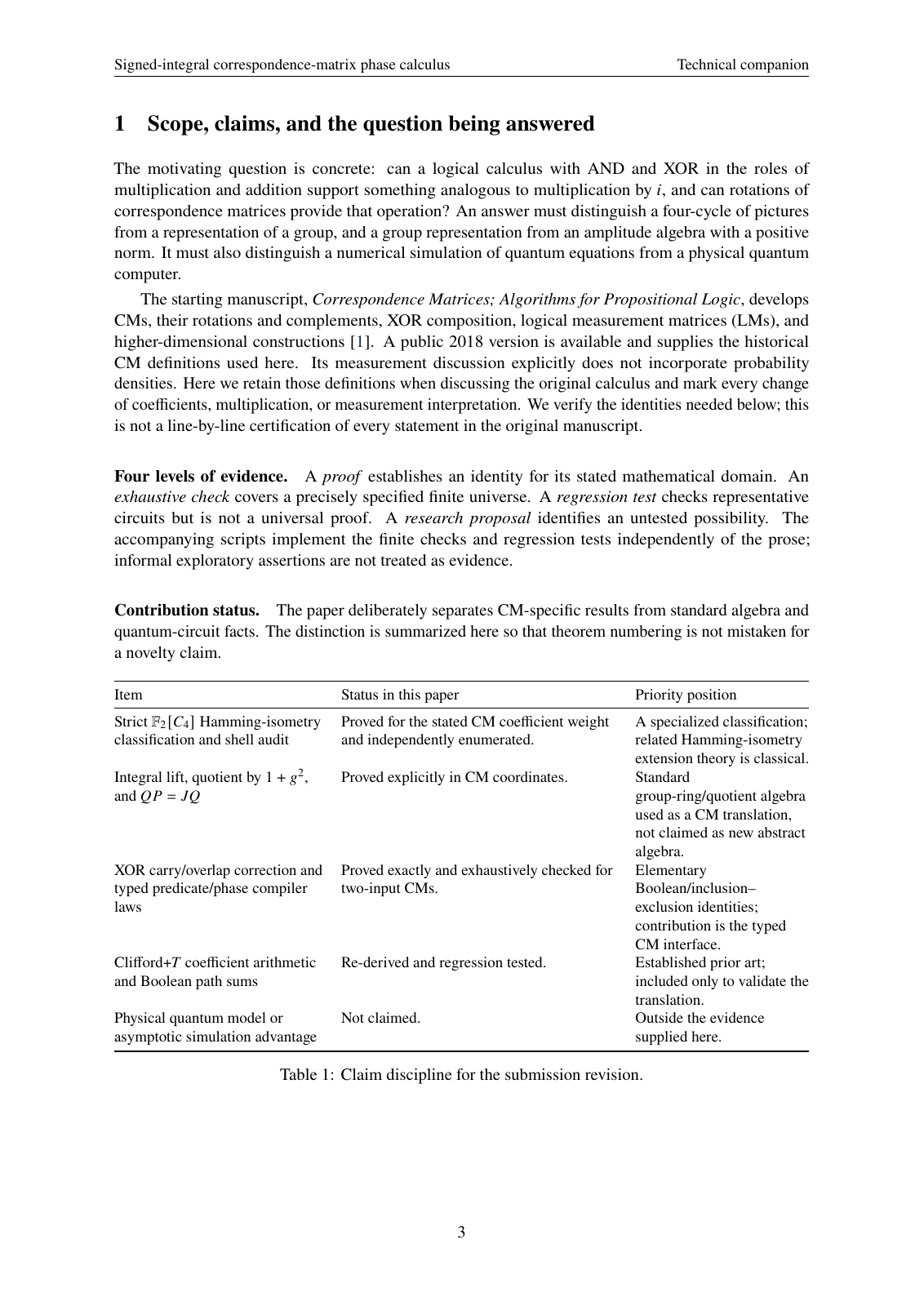 PDF page 5 of 30
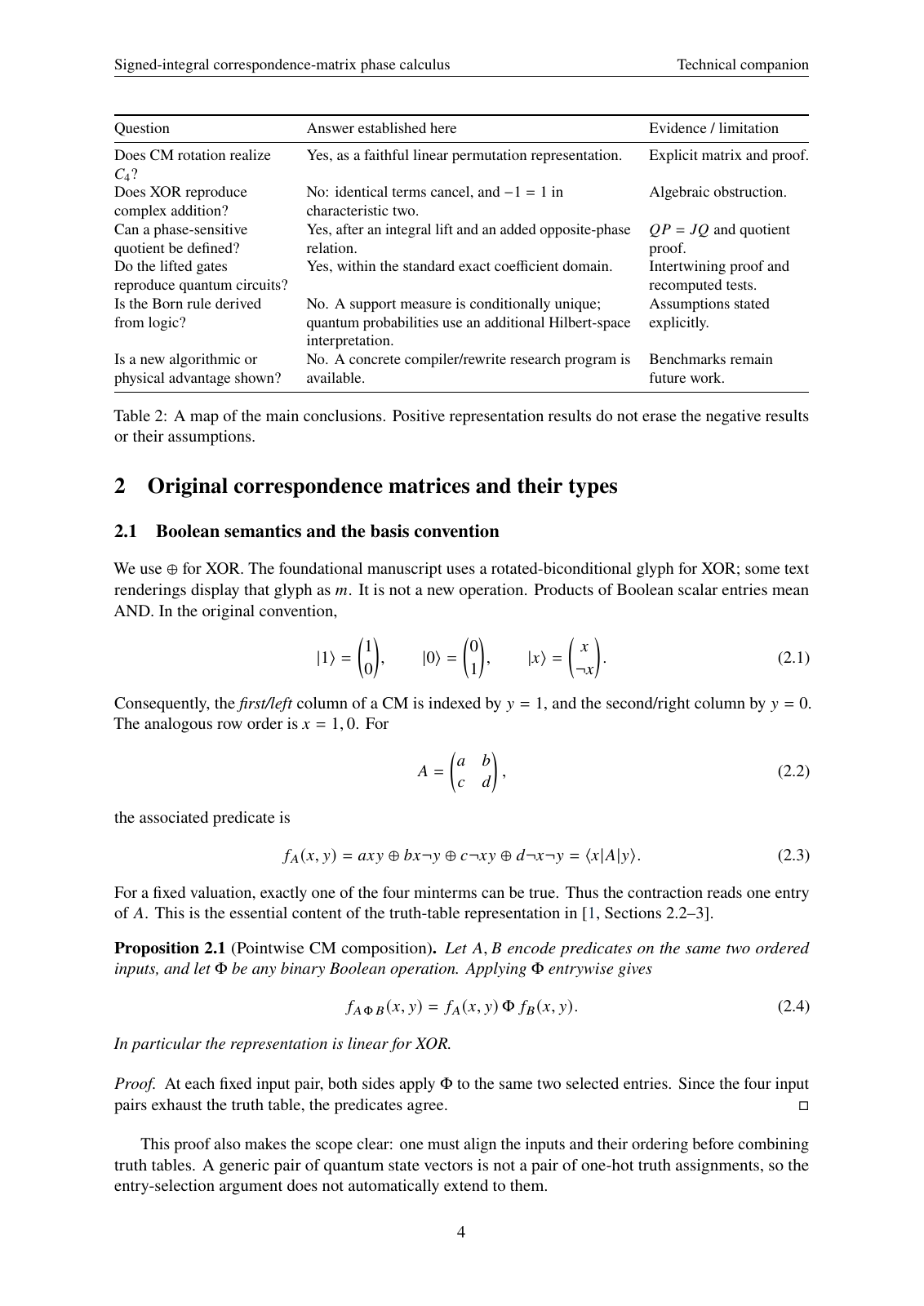 PDF page 6 of 30
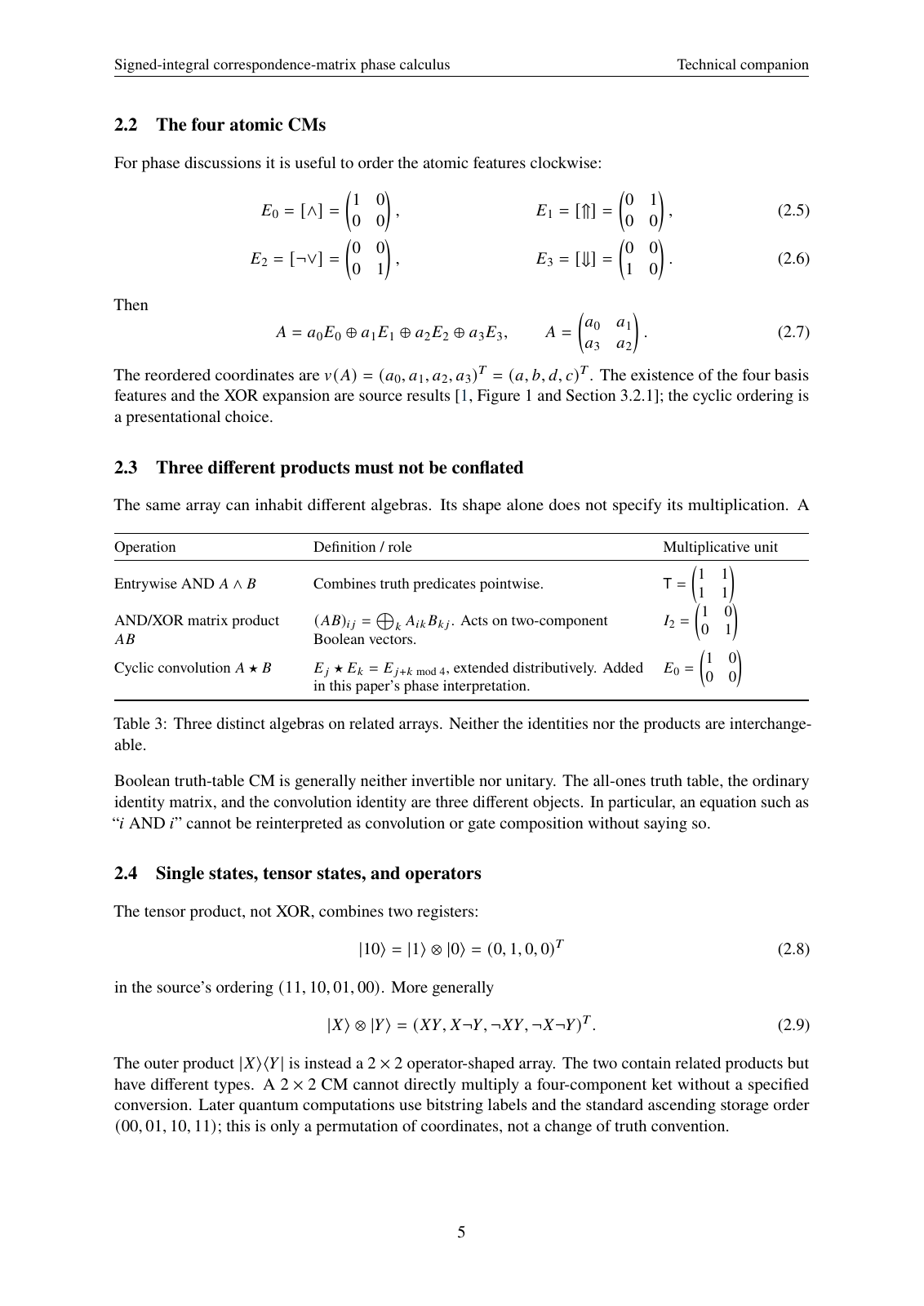 PDF page 7 of 30
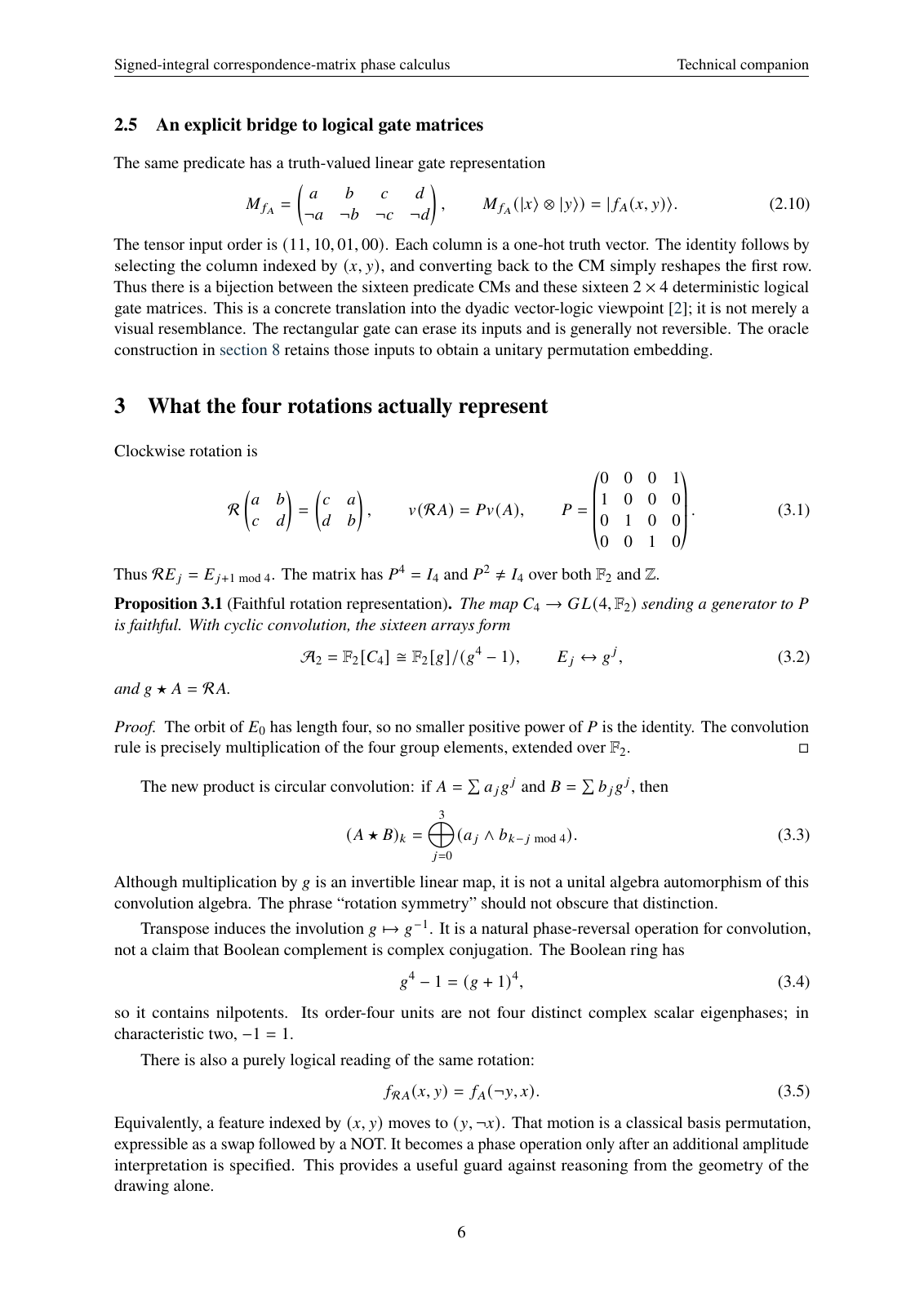 PDF page 8 of 30
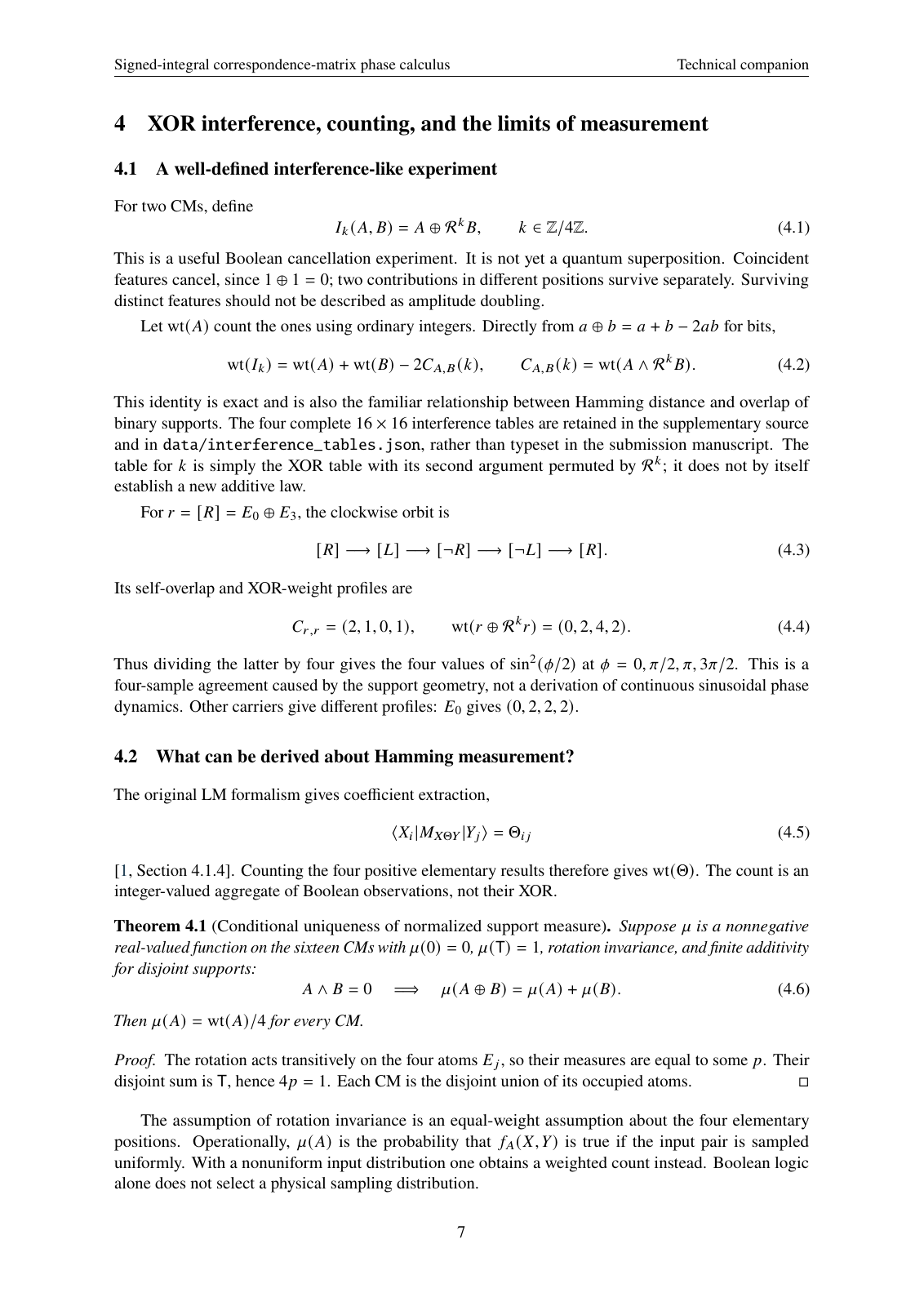 PDF page 9 of 30
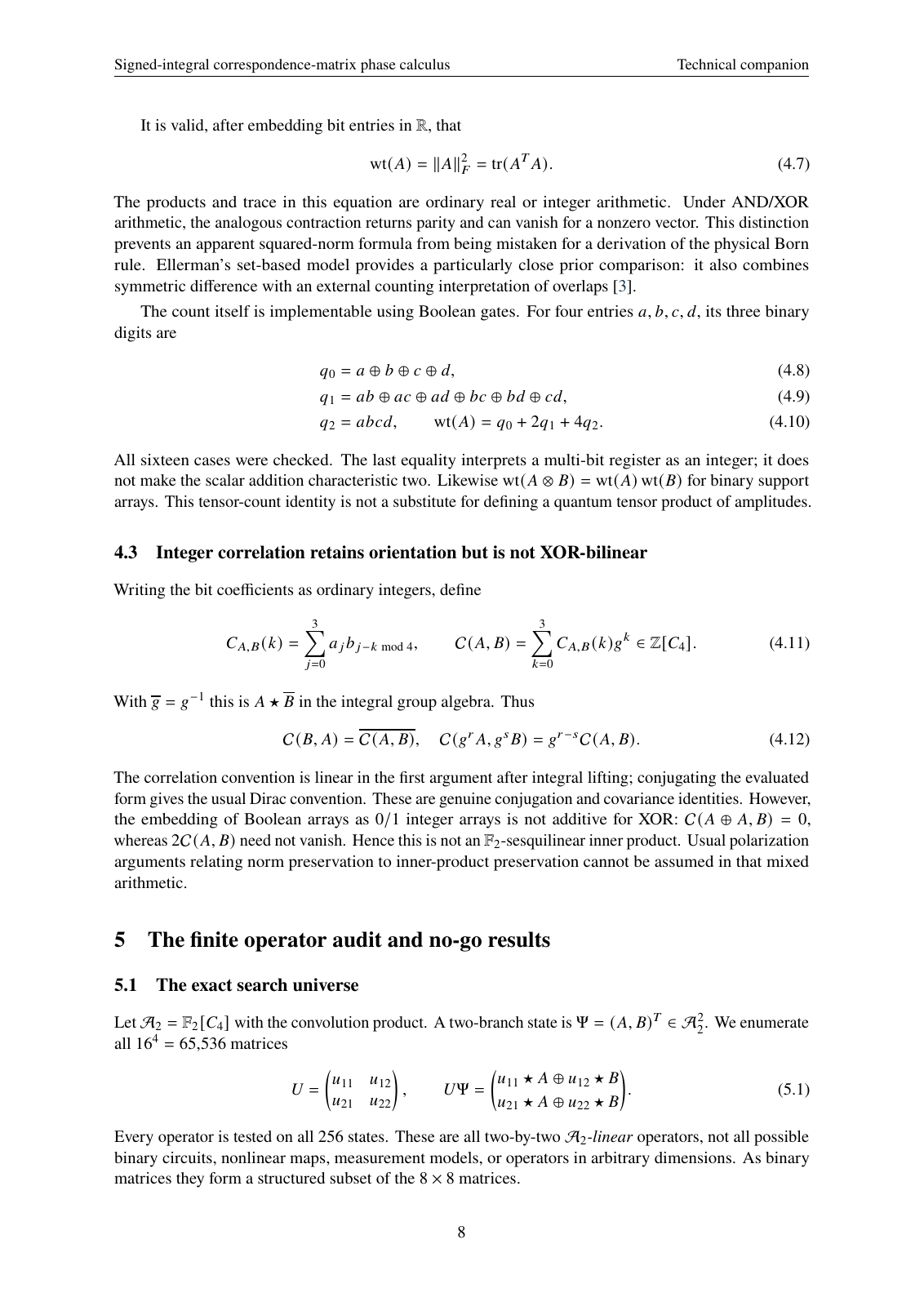 PDF page 10 of 30
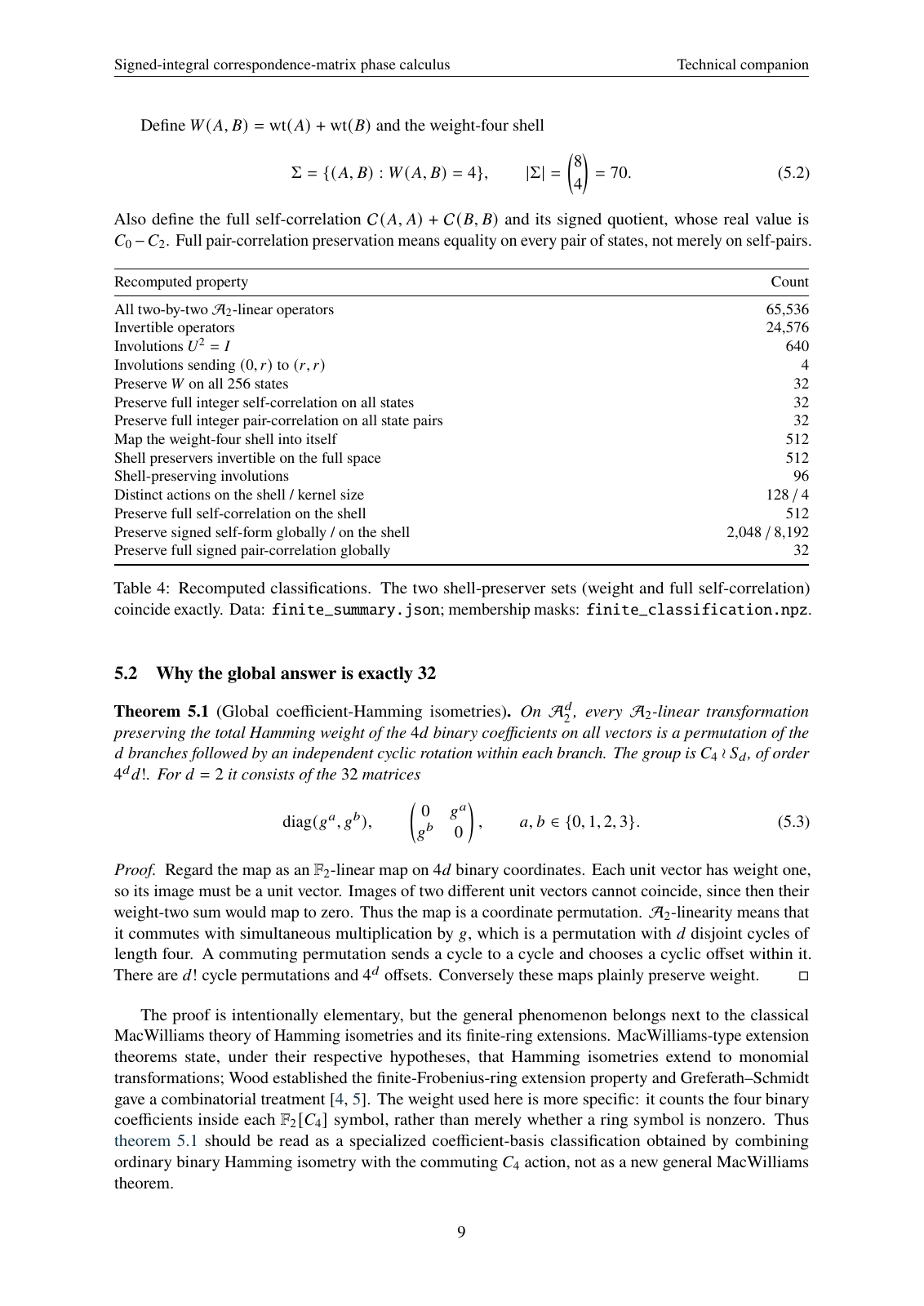 PDF page 11 of 30
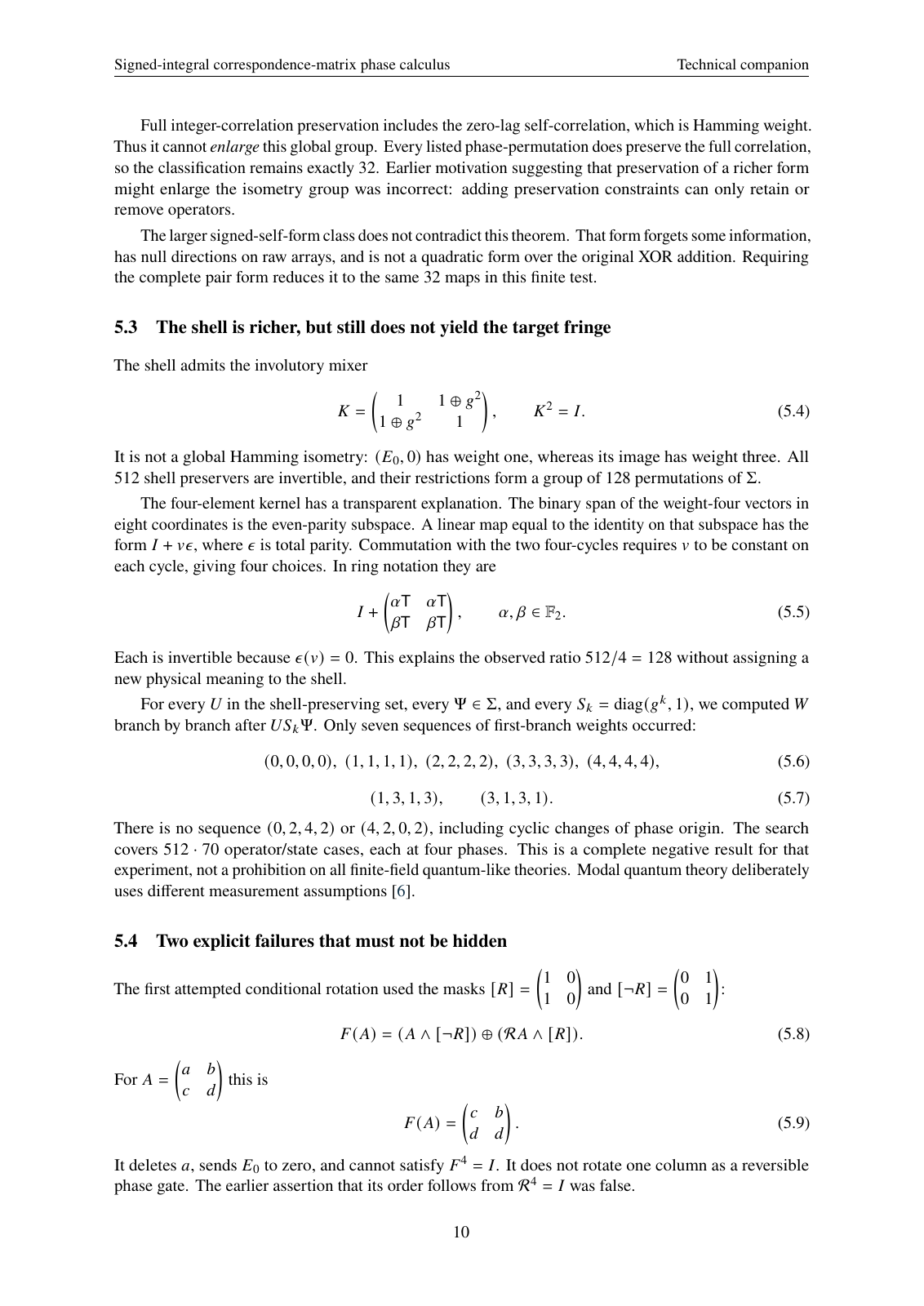 PDF page 12 of 30
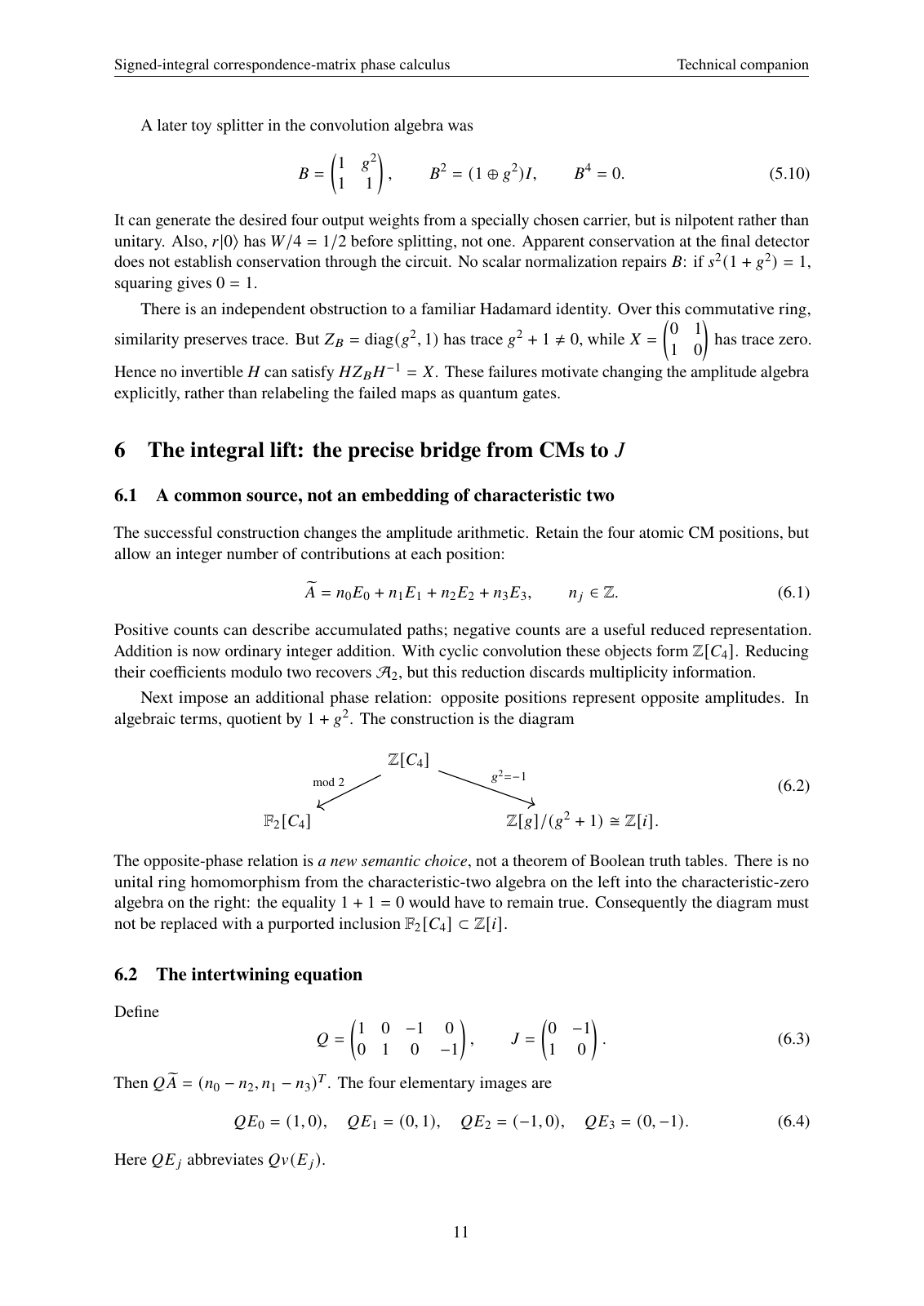 PDF page 13 of 30
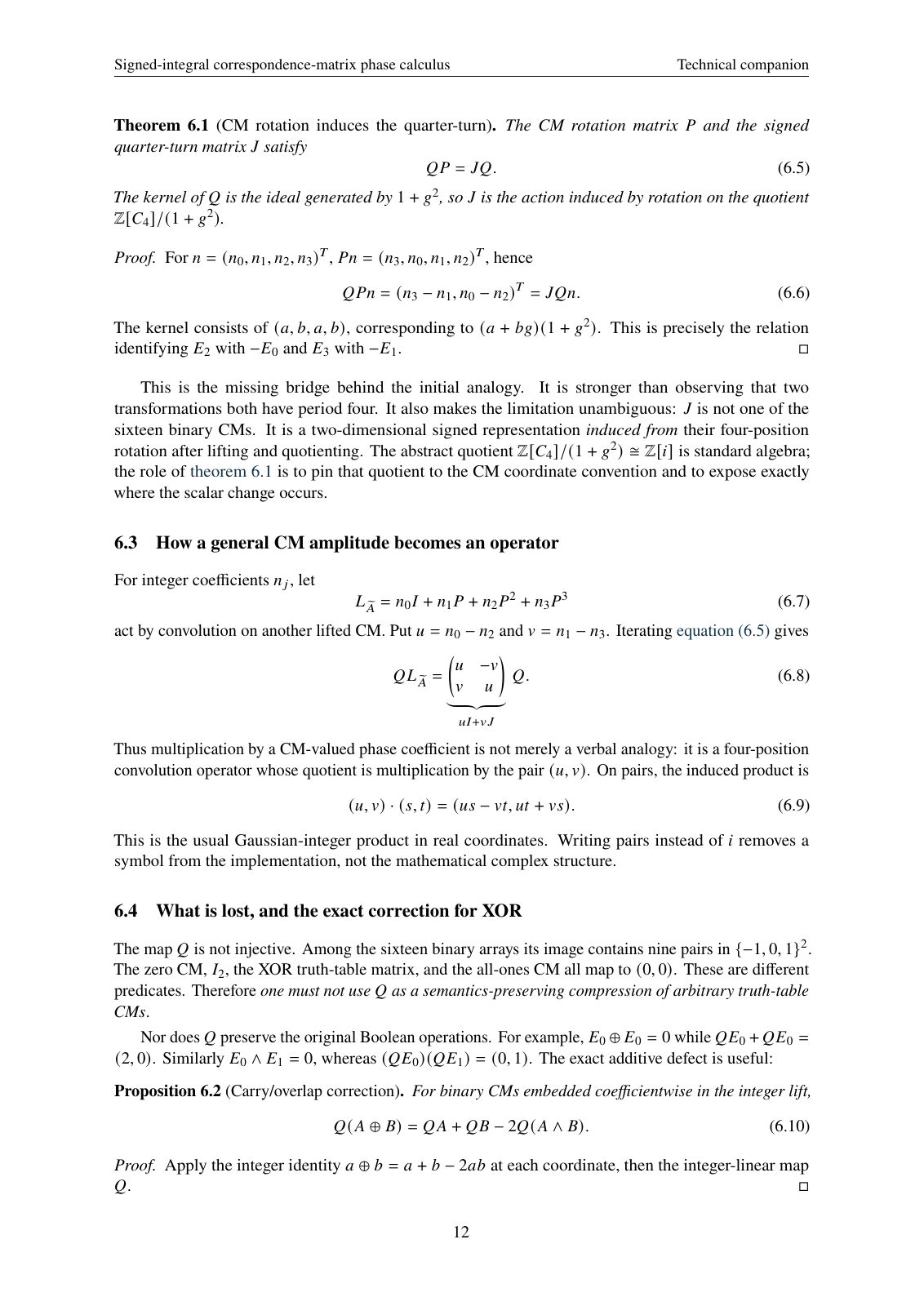 PDF page 14 of 30
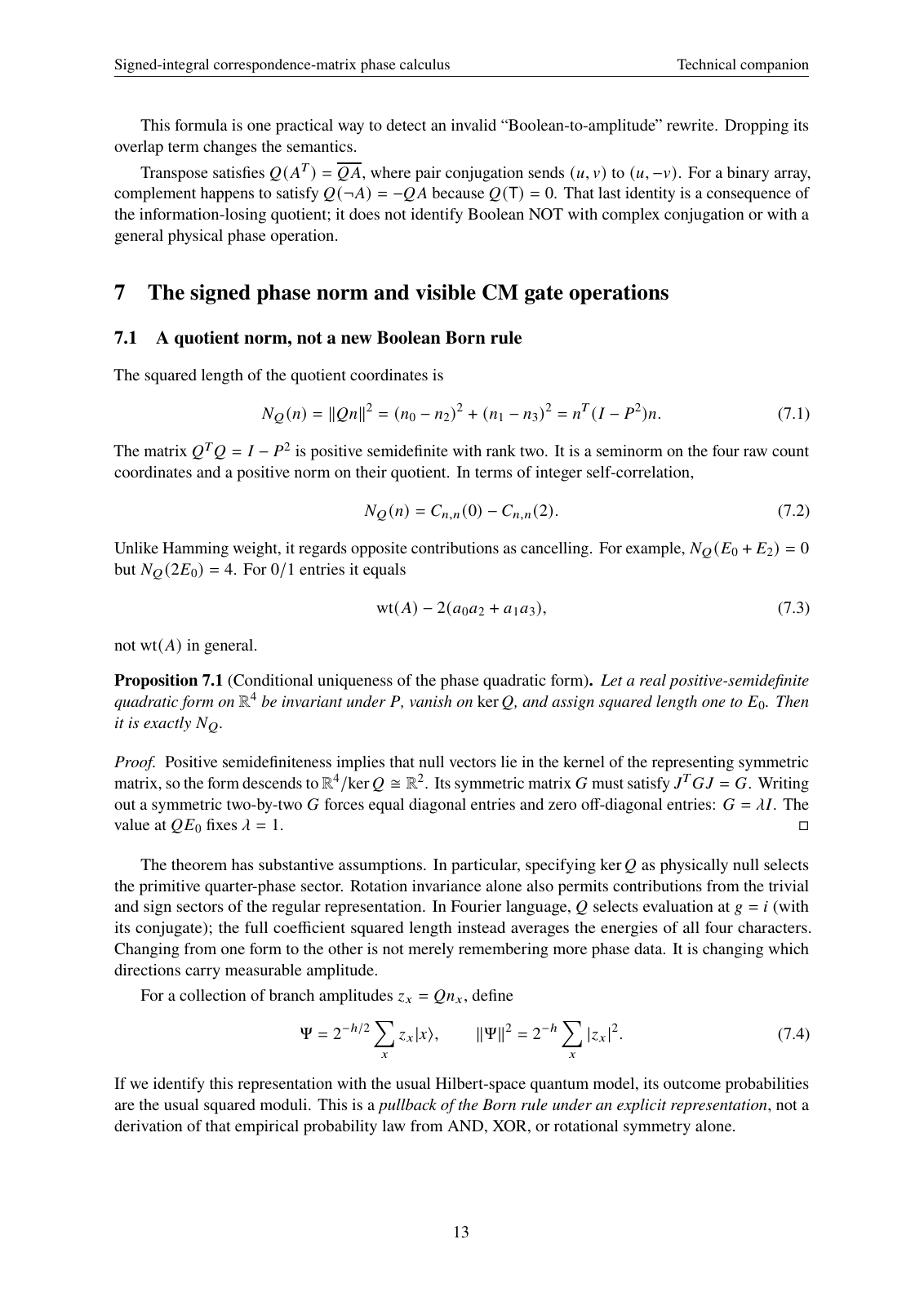 PDF page 15 of 30
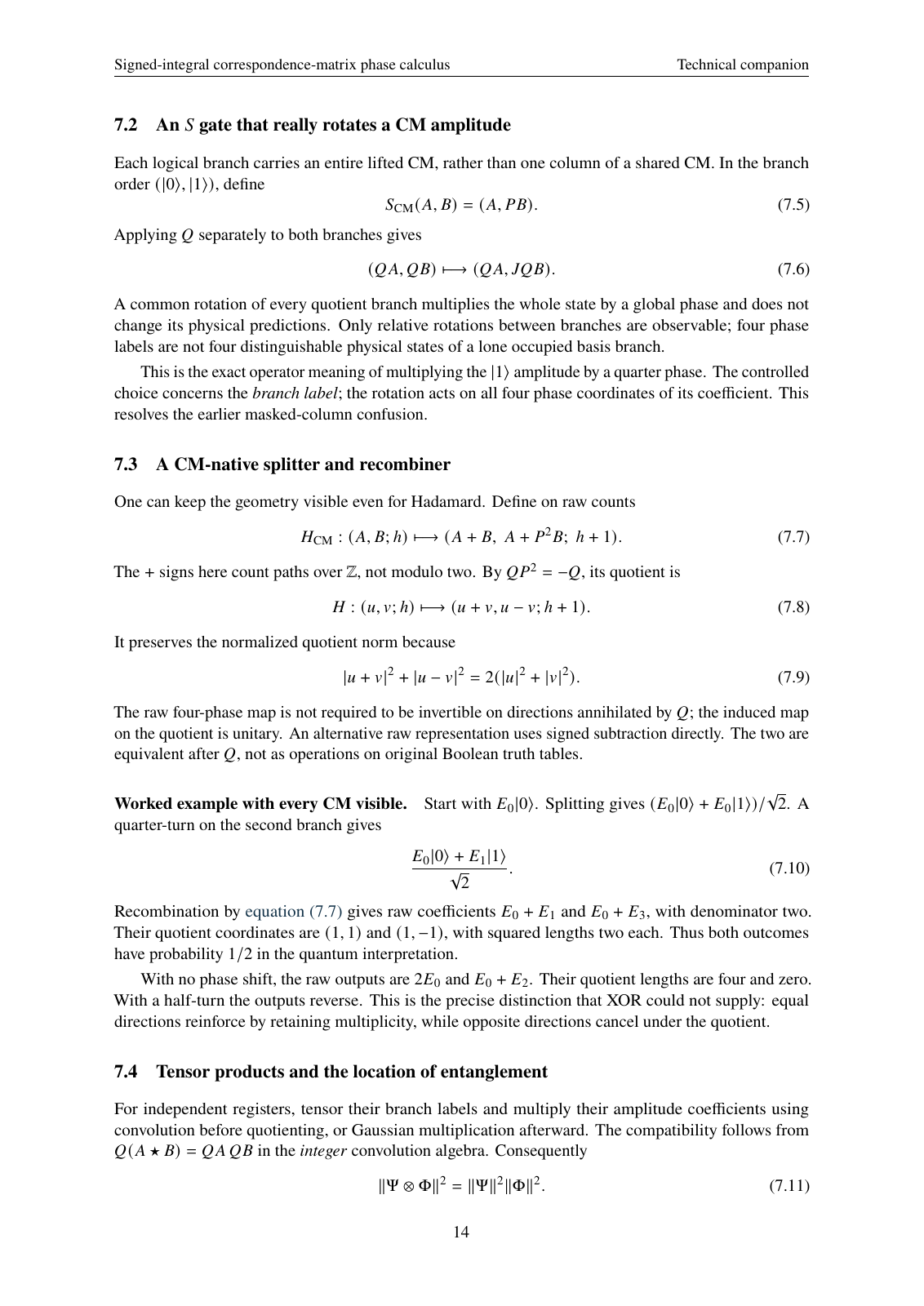 PDF page 16 of 30
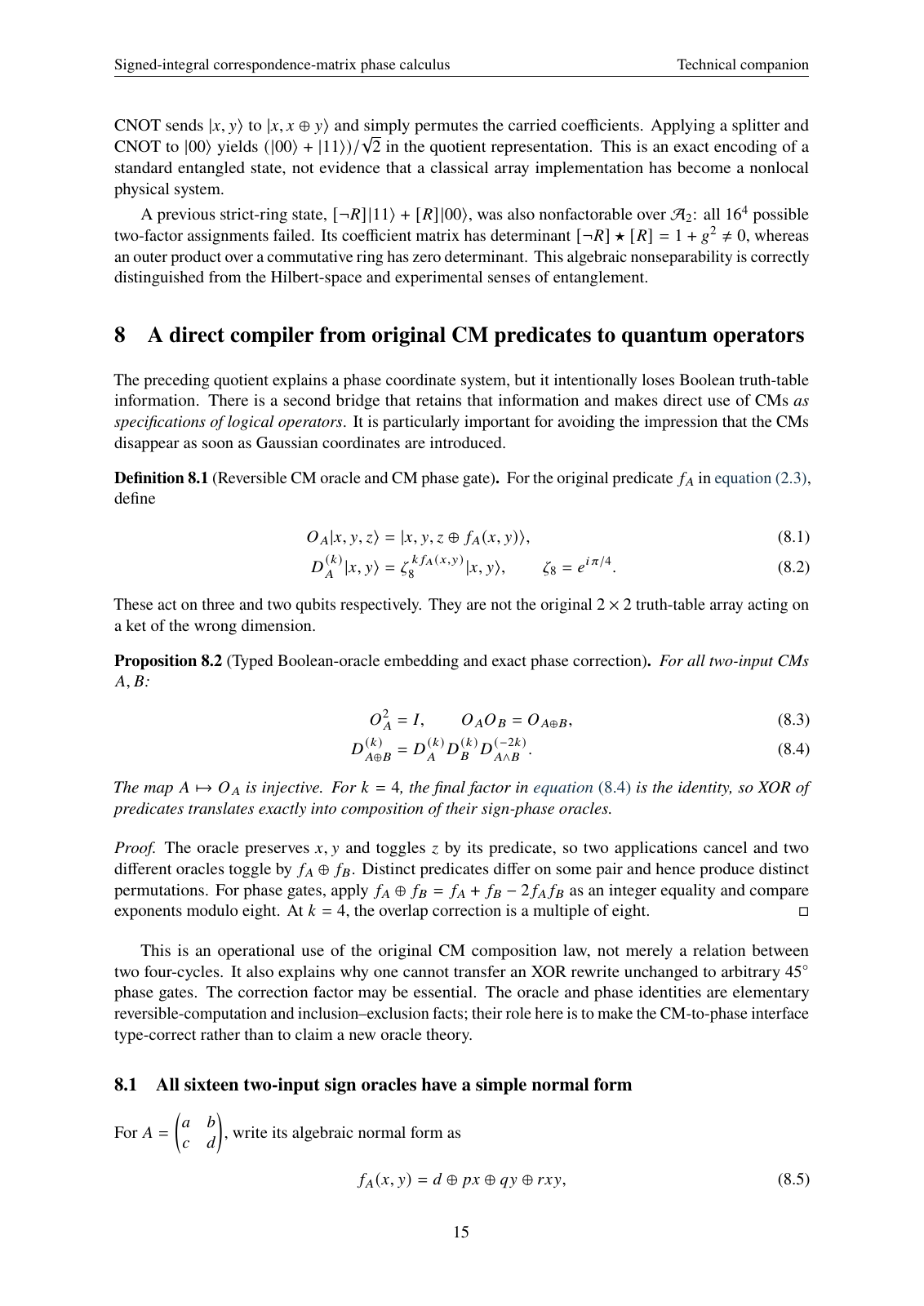 PDF page 17 of 30
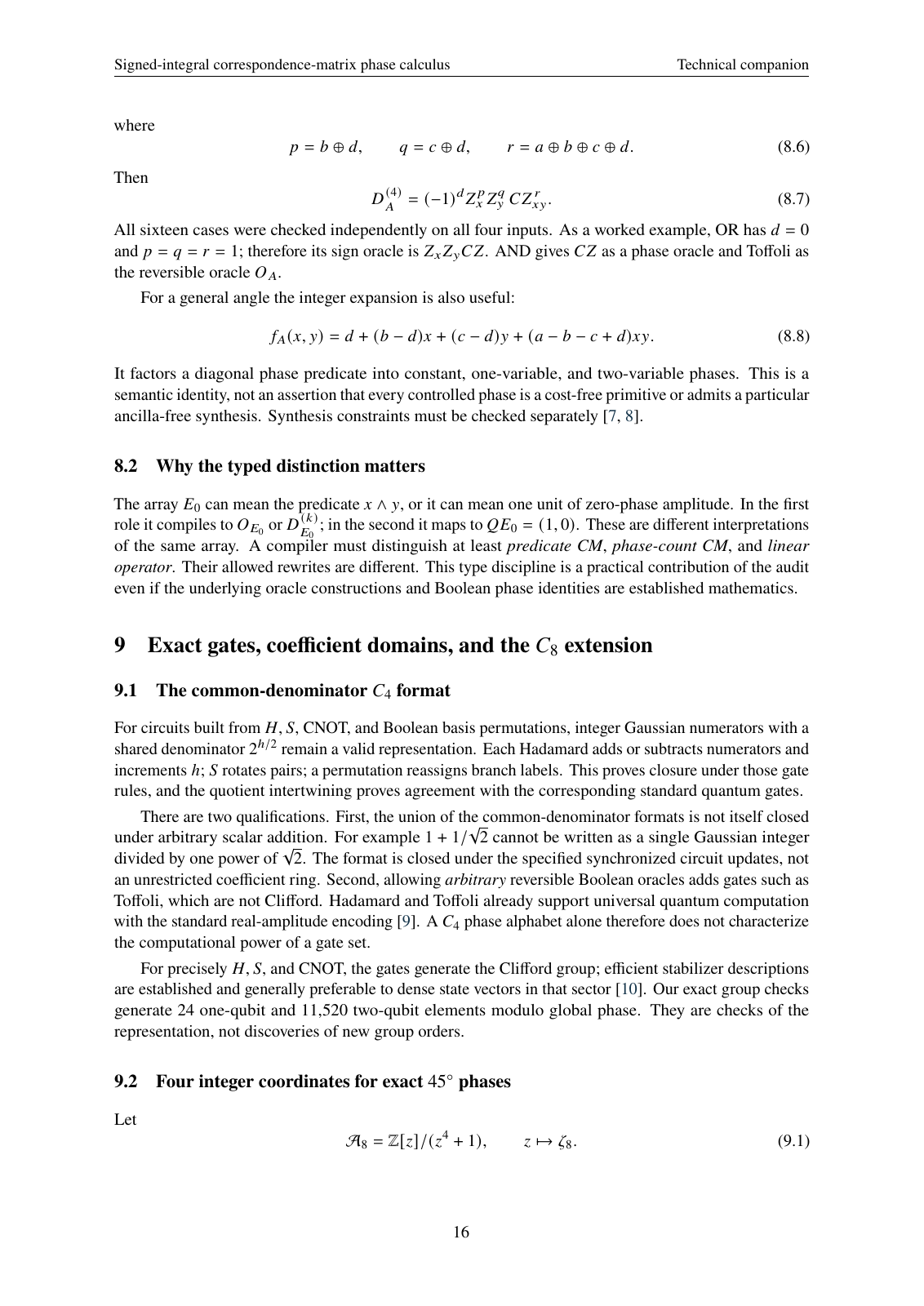 PDF page 18 of 30
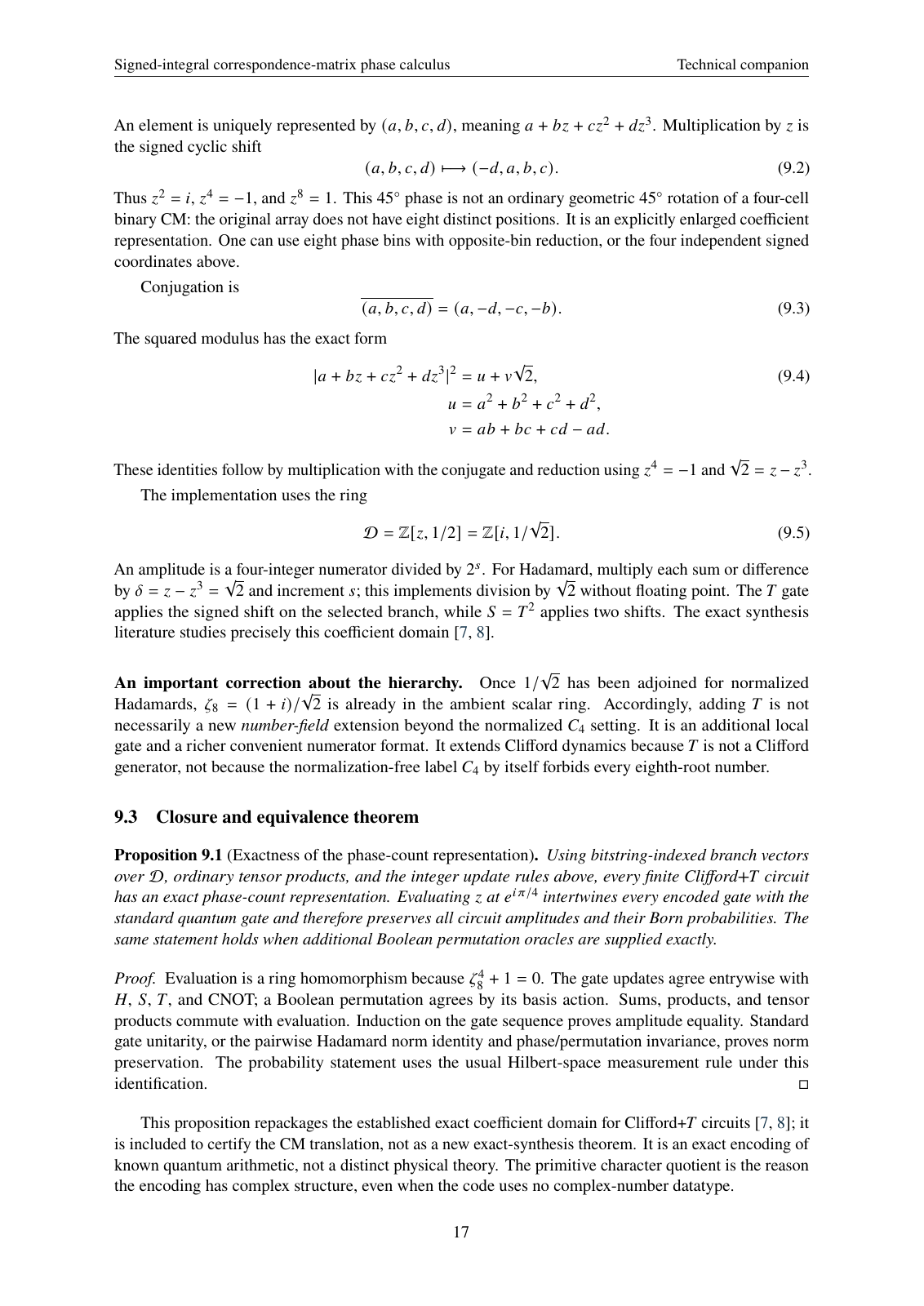 PDF page 19 of 30
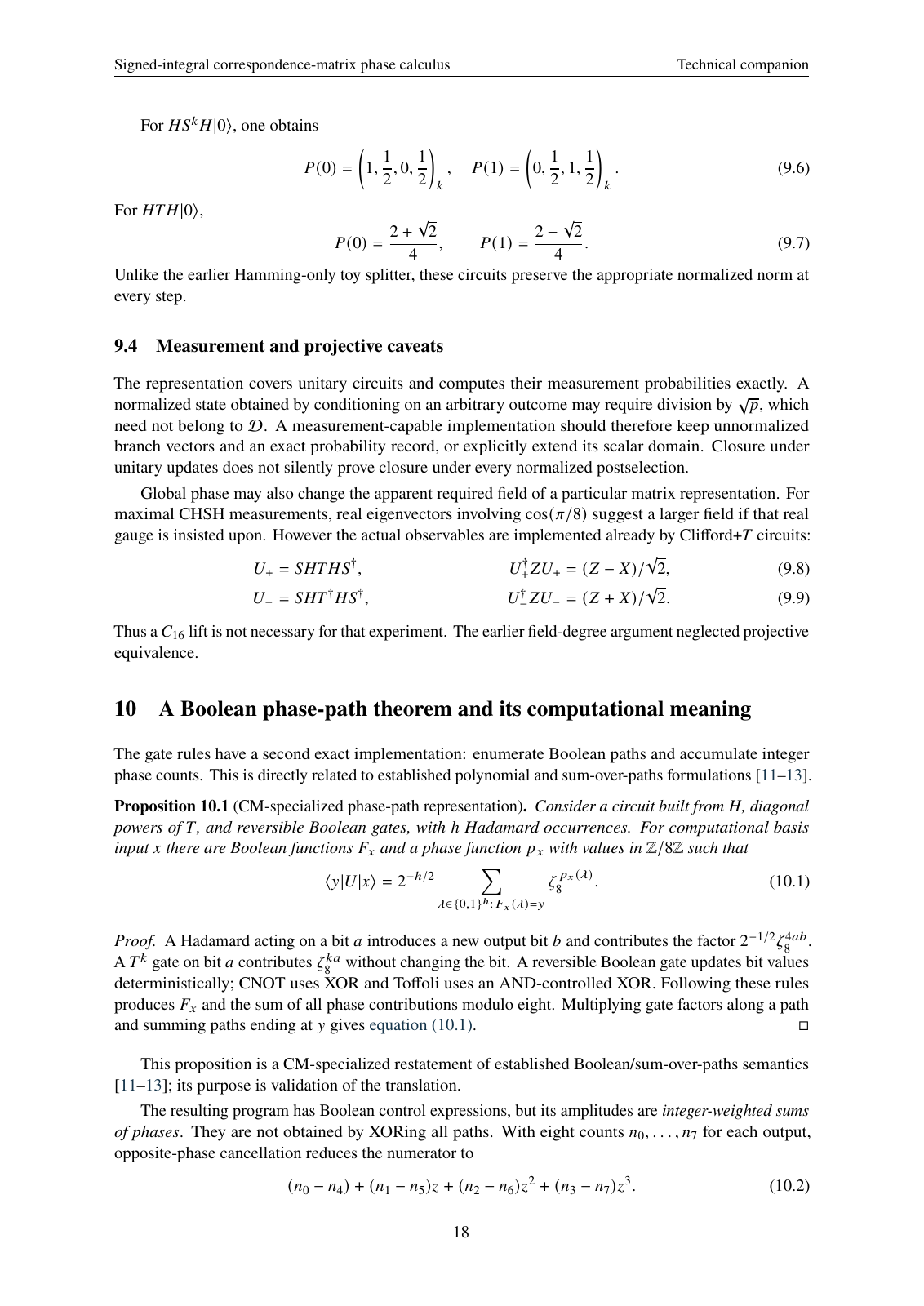 PDF page 20 of 30
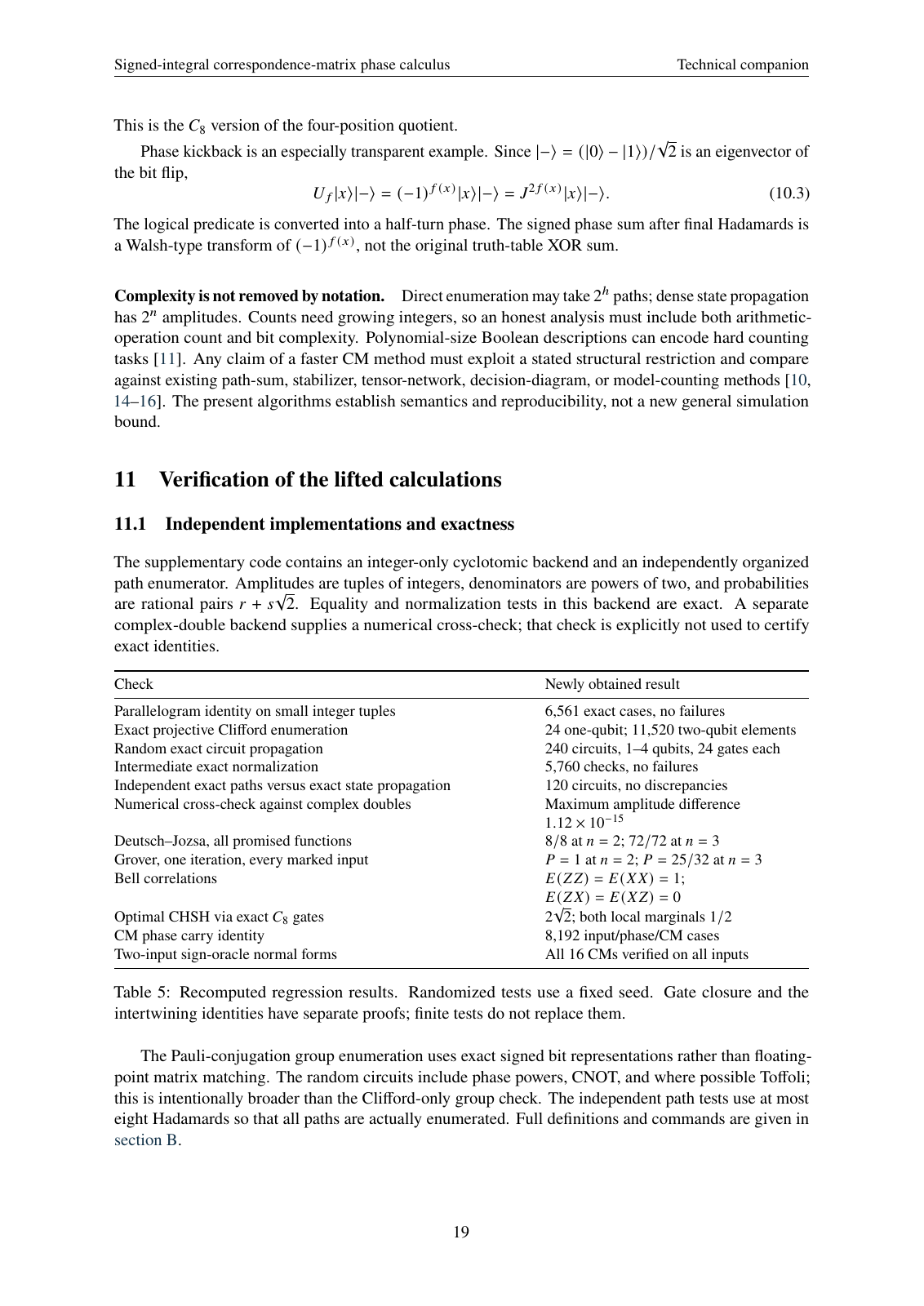 PDF page 21 of 30
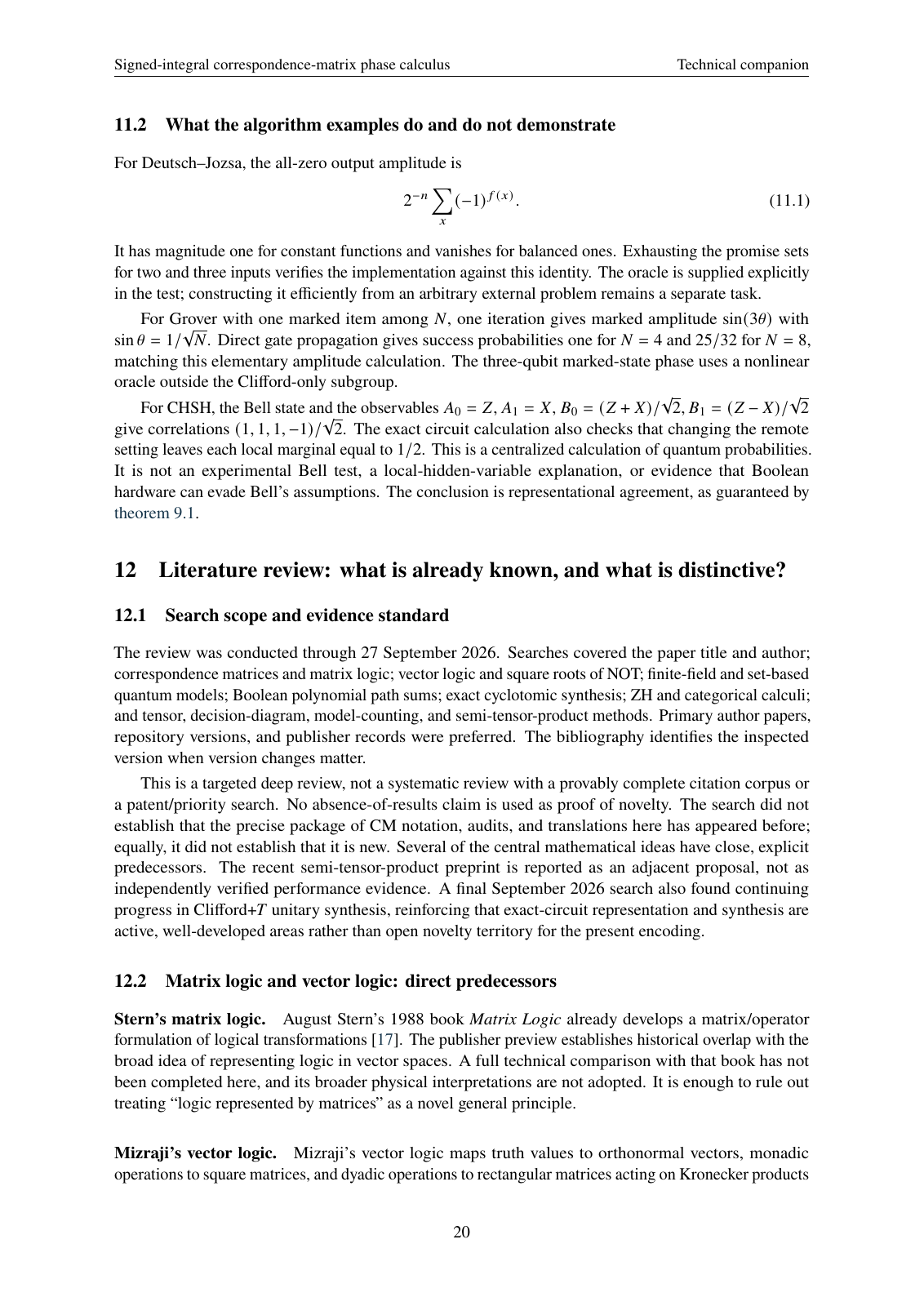 PDF page 22 of 30
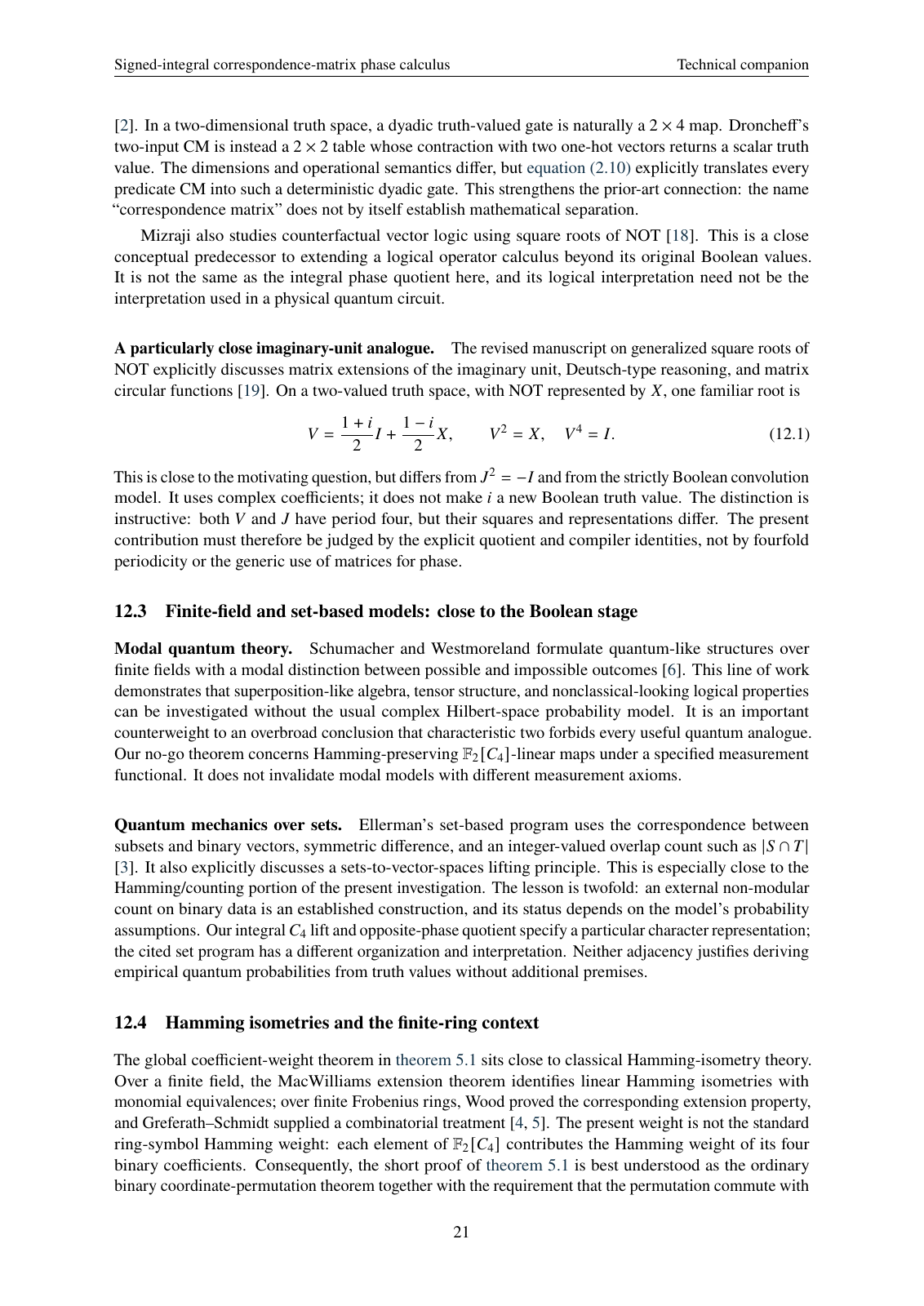 PDF page 23 of 30
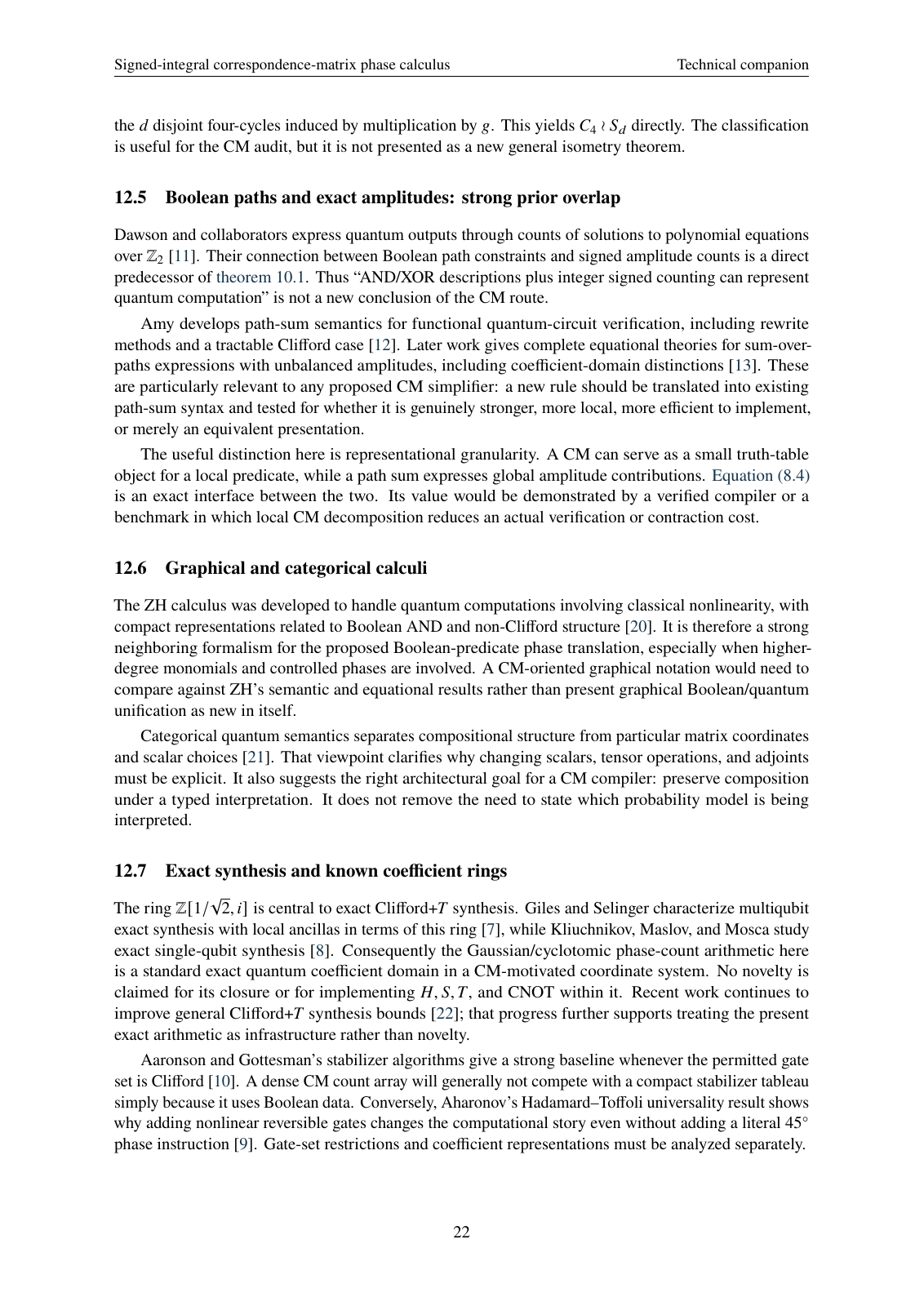 PDF page 24 of 30
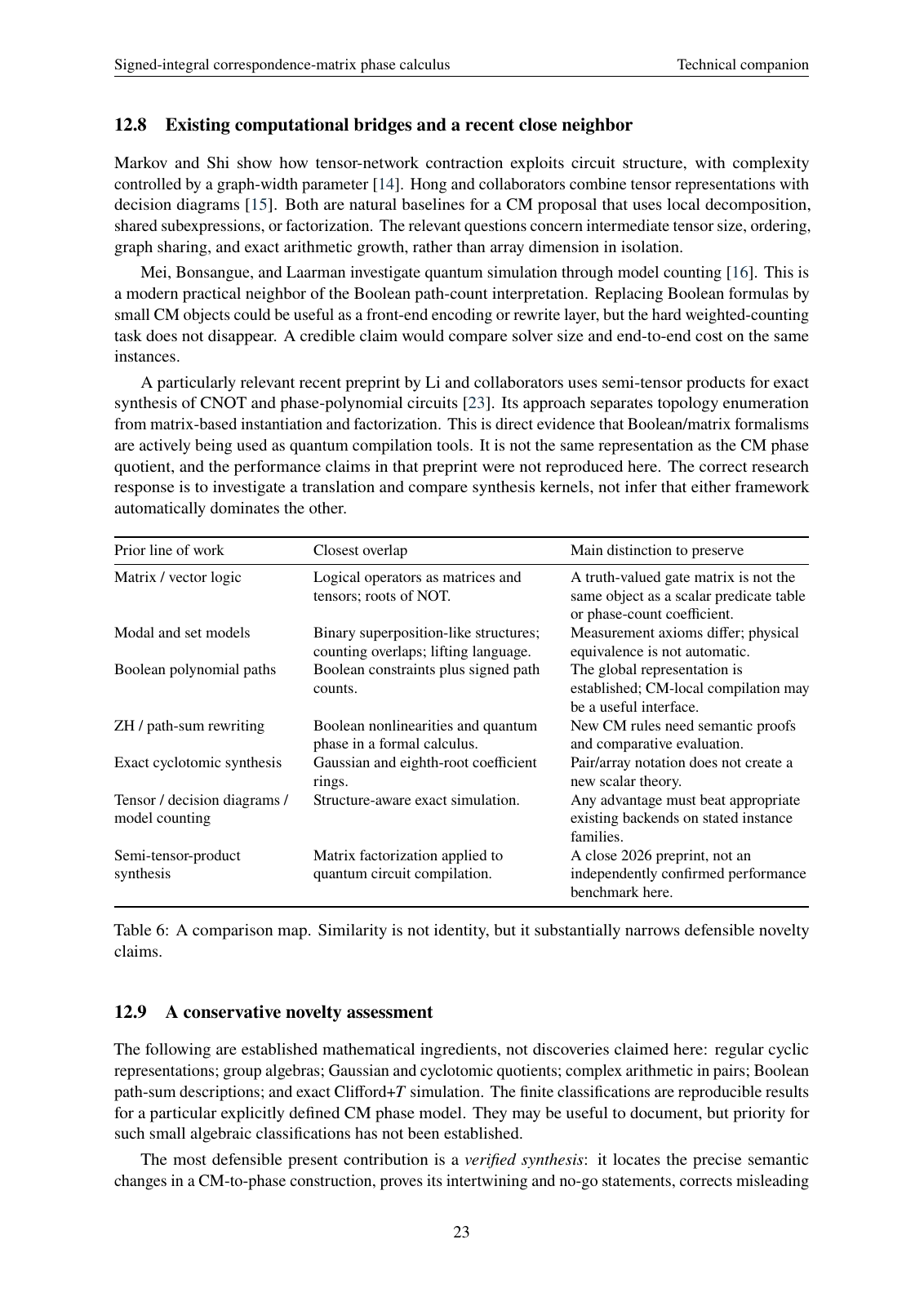 PDF page 25 of 30
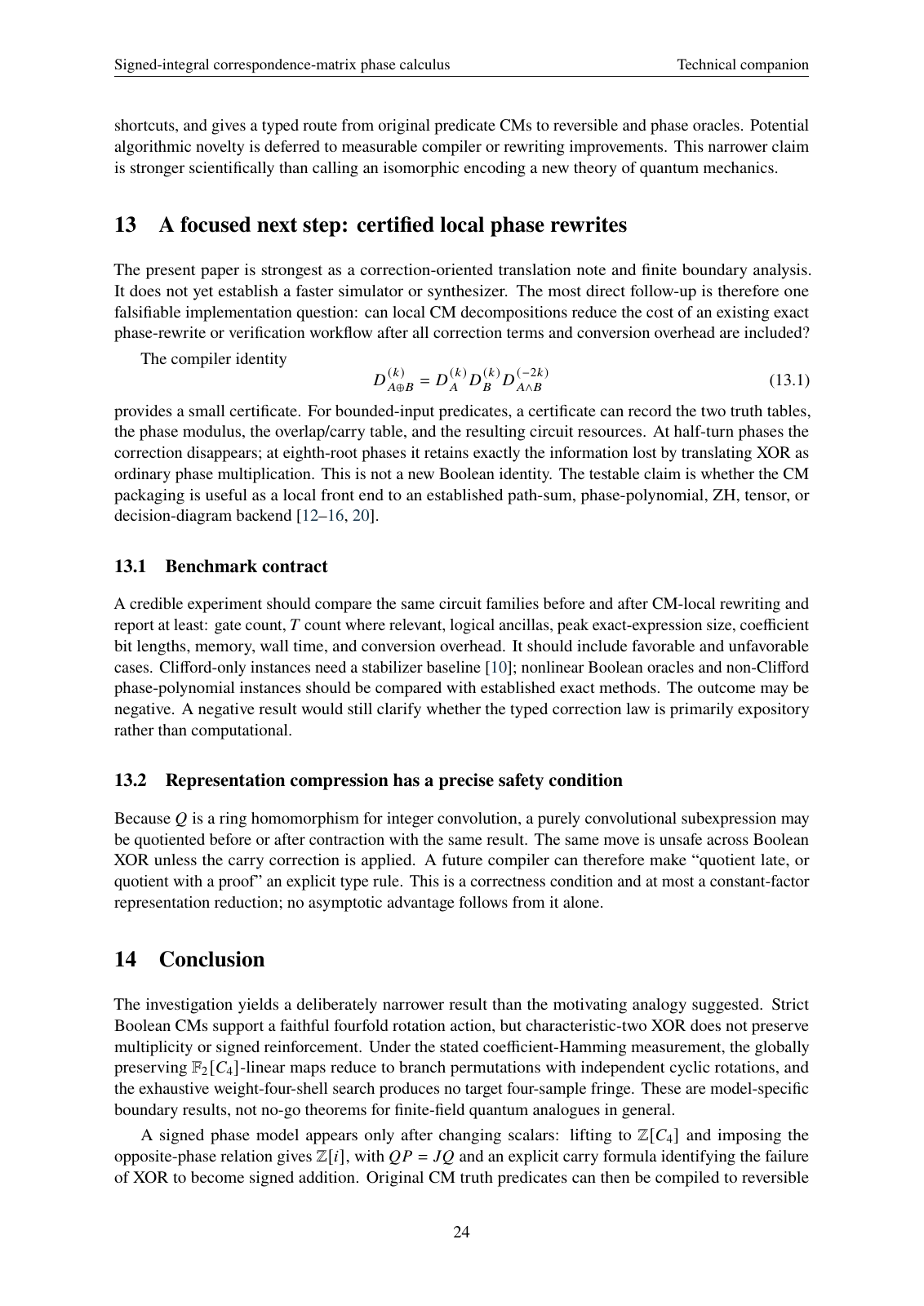 PDF page 26 of 30
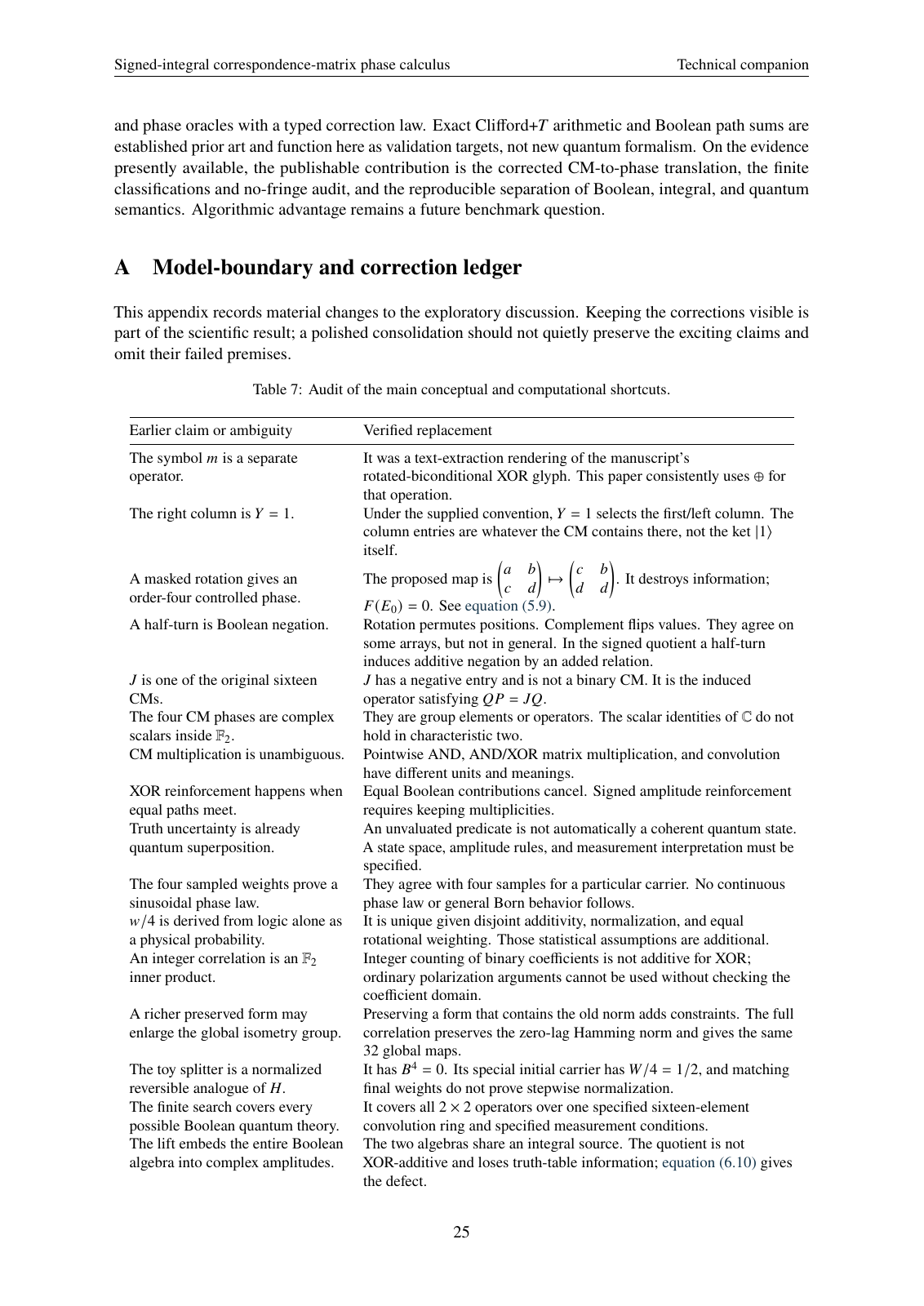 PDF page 27 of 30
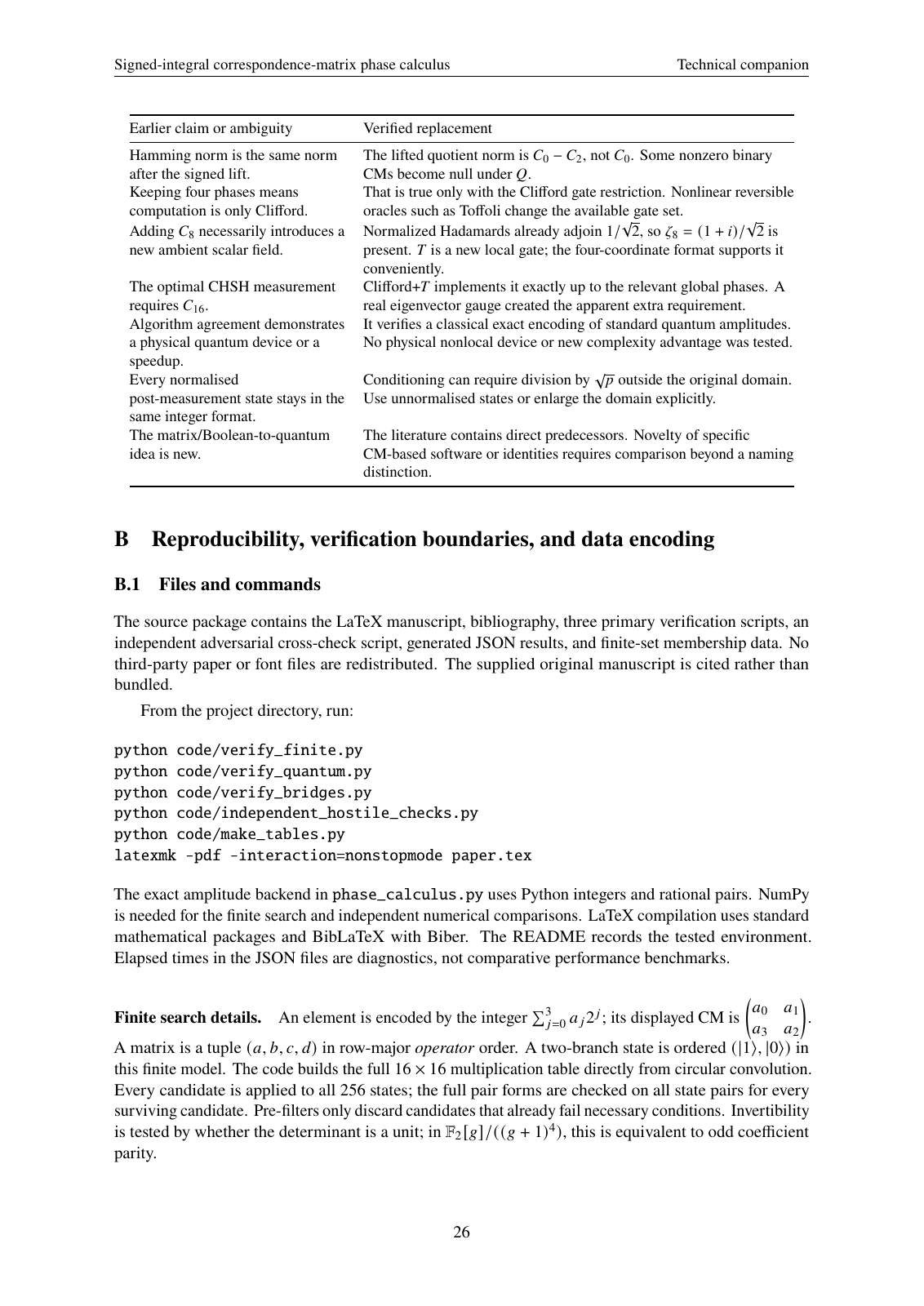 PDF page 28 of 30
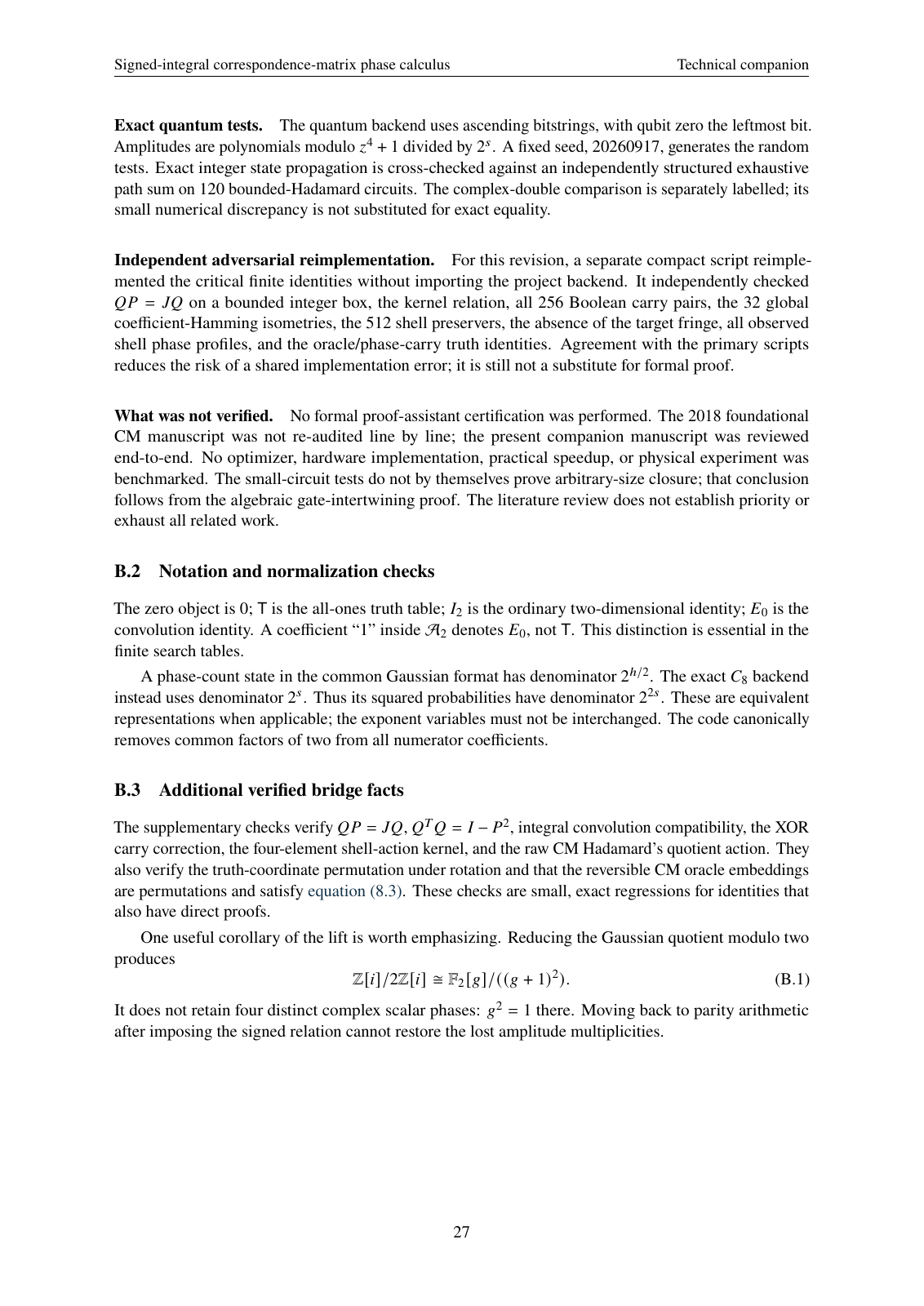 PDF page 29 of 30
 PDF page 30 of 30
Exact source files
paper.tex
1 \documentclass[11pt,a4paper]{article}
2 \usepackage[T1]{fontenc}
3 \usepackage[utf8]{inputenc}
4 \usepackage[a4paper,margin=26mm,headheight=15pt]{geometry}
5 \usepackage{amsmath,amsthm,mathtools}
6 \usepackage{newtxtext,newtxmath}
7 \usepackage{booktabs,longtable,tabularx,array,multirow}
8 \usepackage{graphicx,tikz-cd}
9 \usepackage{microtype}
10 \usepackage{xcolor}
11 \definecolor{ink}{HTML}{15344A}
12 \usepackage{enumitem}
13 \setlist{itemsep=3pt,topsep=5pt,leftmargin=1.6em}
14 \usepackage{fancyhdr}
15 \pagestyle{fancy}\fancyhf{}\fancyhead[L]{\small Signed-integral correspondence-matrix phase calculus}\fancyhead[R]{\small Technical companion}\fancyfoot[C]{\thepage}
16 \renewcommand{\headrulewidth}{0.3pt}
17 \usepackage[colorlinks=true,linkcolor=ink,citecolor=ink,urlcolor=ink,pdftitle={Signed and Integral Lifts of Correspondence Matrices},pdfauthor={Brian Droncheff}]{hyperref}
18 \usepackage[backend=biber,style=numeric-comp,sorting=none,maxbibnames=99,giveninits=true,doi=true,isbn=false,url=true,eprint=true]{biblatex}
19 \addbibresource{references.bib}
20 \usepackage[nameinlink,noabbrev]{cleveref}
21 \newtheorem{theorem}{Theorem}[section]
22 \newtheorem{proposition}[theorem]{Proposition}
23 \newtheorem{lemma}[theorem]{Lemma}
24 \newtheorem{corollary}[theorem]{Corollary}
25 \theoremstyle{definition}\newtheorem{definition}[theorem]{Definition}
26 \theoremstyle{remark}\newtheorem{remark}[theorem]{Remark}
27 \newcommand{\F}{\mathbb F}
28 \newcommand{\Z}{\mathbb Z}
29 \newcommand{\R}{\mathbb R}
30 \newcommand{\C}{\mathbb C}
31 \newcommand{\rot}{\mathcal R}
32 \newcommand{\alg}{\mathcal A}
33 \newcommand{\ones}{\mathsf T}
34 \newcommand{\wt}{\operatorname{wt}}
35 \newcommand{\supp}{\operatorname{supp}}
36 \newcommand{\tr}{\operatorname{tr}}
37 \newcommand{\diag}{\operatorname{diag}}
38 \newcommand{\ket}[1]{\lvert #1\rangle}
39 \newcommand{\bra}[1]{\langle #1\rvert}
40 \newcommand{\ip}[2]{\langle #1,#2\rangle}
41 \newcommand{\cm}[4]{\begin{pmatrix}#1\\#3\end{pmatrix}}
42 \newcommand{\code}[1]{\texttt{\detokenize{#1}}}
43 \newcolumntype{Y}{>{\raggedright\arraybackslash}X}
44 \newcolumntype{L}[1]{>{\raggedright\arraybackslash}p{#1}}
45 \setlength{\emergencystretch}{2em}
46 \setlength{\parskip}{3pt}
47 \setcounter{tocdepth}{2}
48 \numberwithin{equation}{section}
49 \begin{document}
50 \begin{titlepage}
51 \centering
52 \vspace*{11mm}
53 {\small\scshape Correction-oriented technical companion\quad /\quad reproducible computational audit\par}
54 \vspace{12mm}
55 {\LARGE\bfseries Signed and Integral Lifts of\\[5pt] Correspondence Matrices\par}
56 \vspace{6mm}
57 {\large Phase quotients, Hamming-isometry no-go results,\\and exact circuit encodings\par}
58 \vspace{12mm}
59 {\large Brian Droncheff\par}
60 \vspace{3mm}
61 {27 September 2026\quad $\cdot$\quad Submission revision\par}
62 \vspace{12mm}
63 \begin{minipage}{0.91\textwidth}
64 \begin{abstract}
65 This technical companion asks a narrow question: what survives if the four rotational positions of a correspondence matrix (CM) are treated as phase labels, and what must change before those labels can represent signed quantum amplitudes? In the strict Boolean convolution algebra $\F_2[C_4]$, rotation is a faithful $C_4$ action but equal contributions cancel under XOR. An elementary classification, corroborated by exhaustive enumeration of all $65{,}536$ two-branch $\F_2[C_4]$-linear operators, shows that global preservation of the coefficient Hamming weight leaves only the $32$ branch permutations with independent cyclic rotations; the full integer pair-correlation condition gives the same class. A specified weight-four shell has $512$ preservers, but none produces the target four-sample fringe in the tested interferometer.
66
67 The successful phase construction changes scalars. Lifting to $\Z[C_4]$ and quotienting by $1+g^2$ gives $\Z[i]$ and the explicit intertwining relation $QP=JQ$, together with an exact carry/overlap formula measuring the failure of XOR to become signed addition. These identities provide a typed route from predicate CMs to reversible or phase oracles and a CM-visible realization of standard exact Clifford+$T$ arithmetic. The Clifford+$T$ coefficient ring, Boolean path-sum semantics, and general matrix-logic ideas are established prior art; they are used here as comparison targets, not claimed as new. The contribution is therefore a correction-oriented translation and boundary analysis, plus reproducible finite classifications, rather than a new quantum theory, a new exact-synthesis algorithm, or a simulation speedup.
68 \end{abstract}
69 \end{minipage}
70 \vfill
71 \begin{minipage}{0.91\textwidth}\small
72 \textbf{Scope and provenance.} This is a technical companion to the correspondence-matrix program, not a replacement for the foundational CM manuscript. All finite classifications and regression summaries are generated by the accompanying code and were rerun for this revision. The paper separates proved identities, exhaustive finite classifications, regression tests, and proposals. Literature and priority checks were refreshed through 27 September 2026; no claim of exhaustive historical priority is made.
73 \end{minipage}
74 \end{titlepage}
75 \tableofcontents
76 \clearpage
77 \input{sections/01_foundations}
78 \input{sections/02_boolean}
79 \input{sections/03_lift}
80 \input{sections/04_quantum}
81 \input{sections/05_literature}
82 \input{sections/06_applications}
83 \appendix
84 \input{sections/07_audit}
85 % Full interference tables are retained as supplementary source/data, not typeset in the submission manuscript.
86 \clearpage
87 \printbibliography[heading=bibintoc,title={References}]
88 \end{document}
references.bib
   1 @online{droncheff,
   2  author={Droncheff, Brian},
   3  title={Correspondence Matrices; Algorithms for Propositional Logic},
   4  year={2018},
   5  date={2018-05-29},
   6  doi={10.13140/RG.2.2.28036.37764},
   7  url={https://www.researchgate.net/publication/327980262_Correspondence_Matrices_Algorithms_for_Propositional_Logic},
   8  urldate={2026-09-27},
   9  note={Public working-paper version 1.0.1; the archival source package retained for this study is the operative historical reference}
  10 }
  11 @book{stern1988,
  12  author={Stern, August}, title={Matrix Logic}, publisher={North-Holland}, year={1988},
  13  isbn={9780444704320},
  14  note={Historical comparison based on the publisher's preview, not a complete audit of the book},
  15  url={https://api.pageplace.de/preview/DT0400.9781483295497_A23889179/preview-9781483295497_A23889179.pdf}, urldate={2026-09-17}
  16 }
  17 @article{mizraji2008,
  18  author={Mizraji, Eduardo},
  19  title={Vector Logic: A Natural Algebraic Representation of the Fundamental Logical Gates},
  20  journaltitle={Journal of Logic and Computation}, volume={18}, number={1},
  21  year={2008}, doi={10.1093/logcom/exm057},
  22  note={Published online 23 October 2007}
  23 }
  24 @online{mizraji2024,
  25  author={Mizraji, Eduardo},
  26  title={Generalized ``Square roots of Not'' matrices, their application to the unveiling of hidden logical operators and to the definition of fully matrix circular Euler functions},
  27  year={2024}, eprint={2107.06067}, eprinttype={arxiv},
  28  note={Version 5, 10 June 2024; first submitted in 2021},
  29  url={https://arxiv.org/abs/2107.06067v5}, urldate={2026-09-17}
  30 }
  31 @article{mizraji2021,
  32  author={Mizraji, Eduardo}, title={Vector logic allows counterfactual virtualization by the square root of {NOT}},
  33  journaltitle={Logic Journal of the IGPL}, volume={29}, number={5}, pages={859--870}, year={2021},
  34  doi={10.1093/jigpal/jzaa026}, eprint={2003.11519}, eprinttype={arxiv}
  35 }
  36 @article{modal,
  37  author={Schumacher, Benjamin and Westmoreland, Michael D.}, title={Modal Quantum Theory},
  38  journaltitle={Foundations of Physics}, volume={42}, pages={918--925}, year={2012},
  39  doi={10.1007/s10701-012-9650-z}, eprint={1010.2929}, eprinttype={arxiv}
  40 }
  41 @online{ellerman,
  42  author={Ellerman, David}, title={Quantum mechanics over sets},
  43  year={2013}, eprint={1310.8221}, eprinttype={arxiv},
  44  url={https://arxiv.org/abs/1310.8221}, urldate={2026-09-17},
  45  note={The repository metadata records a 2013 submission; the PDF served at review time bears a 22 June 2021 date. The comparison concerns its set/vector lifting and counting constructions}
  46 }
  47 @article{dawson,
  48  author={Dawson, Christopher M. and Haselgrove, Henry L. and Hines, Andrew P. and Mortimer, Duncan and Nielsen, Michael A. and Osborne, Tobias J.},
  49  title={Quantum computing and polynomial equations over the finite field {$Z_2$}},
  50  journaltitle={Quantum Information and Computation}, volume={5}, number={2}, pages={102--112}, year={2005},
  51  eprint={quant-ph/0408129}, eprinttype={arxiv}
  52 }
  53 @article{amy2019,
  54  author={Amy, Matthew}, title={Towards Large-scale Functional Verification of Universal Quantum Circuits},
  55  journaltitle={Electronic Proceedings in Theoretical Computer Science}, volume={287}, pages={1--21}, year={2019},
  56  doi={10.4204/EPTCS.287.1}, eprint={1805.06908}, eprinttype={arxiv}
  57 }
  58 @article{amy2023,
  59  author={Amy, Matthew}, title={Complete Equational Theories for the Sum-Over-Paths with Unbalanced Amplitudes},
  60  journaltitle={Electronic Proceedings in Theoretical Computer Science}, volume={384}, pages={127--141}, year={2023},
  61  doi={10.4204/EPTCS.384.8}, eprint={2306.16369}, eprinttype={arxiv}
  62 }
  63 @article{zh,
  64  author={Backens, Miriam and Kissinger, Aleks},
  65  title={{ZH}: A Complete Graphical Calculus for Quantum Computations Involving Classical Non-linearity},
  66  journaltitle={Electronic Proceedings in Theoretical Computer Science}, volume={287}, pages={23--42}, year={2019},
  67  doi={10.4204/EPTCS.287.2}, eprint={1805.02175}, eprinttype={arxiv}
  68 }
  69 @online{abramsky,
  70  author={Abramsky, Samson and Coecke, Bob}, title={A categorical semantics of quantum protocols},
  71  year={2004}, eprint={quant-ph/0402130}, eprinttype={arxiv},
  72  url={https://arxiv.org/abs/quant-ph/0402130}, urldate={2026-09-17}
  73 }
  74 @article{giles,
  75  author={Giles, Brett and Selinger, Peter}, title={Exact synthesis of multiqubit {Clifford+T} circuits},
  76  journaltitle={Physical Review A}, volume={87}, pages={032332}, year={2013},
  77  doi={10.1103/PhysRevA.87.032332}, eprint={1212.0506}, eprinttype={arxiv}
  78 }
  79 @online{kmm,
  80  author={Kliuchnikov, Vadym and Maslov, Dmitri and Mosca, Michele},
  81  title={Fast and efficient exact synthesis of single qubit unitaries generated by {Clifford} and {T} gates},
  82  year={2012}, eprint={1206.5236}, eprinttype={arxiv},
  83  url={https://arxiv.org/abs/1206.5236}, urldate={2026-09-17}
  84 }
  85 @article{aaronson,
  86  author={Aaronson, Scott and Gottesman, Daniel}, title={Improved Simulation of Stabilizer Circuits},
  87  journaltitle={Physical Review A}, volume={70}, pages={052328}, year={2004},
  88  doi={10.1103/PhysRevA.70.052328}, eprint={quant-ph/0406196}, eprinttype={arxiv}
  89 }
  90 @online{aharonov,
  91  author={Aharonov, Dorit}, title={A Simple Proof that {Toffoli} and {Hadamard} are Quantum Universal},
  92  year={2003}, eprint={quant-ph/0301040}, eprinttype={arxiv},
  93  url={https://arxiv.org/abs/quant-ph/0301040}, urldate={2026-09-17}
  94 }
  95 @article{markov,
  96  author={Markov, Igor L. and Shi, Yaoyun}, title={Simulating quantum computation by contracting tensor networks},
  97  journaltitle={SIAM Journal on Computing}, volume={38}, number={3}, pages={963--981}, year={2008},
  98  doi={10.1137/050644756}, eprint={quant-ph/0511069}, eprinttype={arxiv}
  99 }
 100 @online{mei,
 101  author={Mei, Jingyi and Bonsangue, Marcello and Laarman, Alfons},
 102  title={Simulating Quantum Circuits by Model Counting}, year={2024}, eprint={2403.07197}, eprinttype={arxiv},
 103  url={https://arxiv.org/abs/2403.07197}, urldate={2026-09-17}
 104 }
 105 @online{tdd,
 106  author={Hong, Xin and Zhou, Xiangzhen and Li, Sanjiang and Feng, Yuan and Ying, Mingsheng},
 107  title={A Tensor Network based Decision Diagram for Representation of Quantum Circuits},
 108  year={2020}, eprint={2009.02618}, eprinttype={arxiv},
 109  url={https://arxiv.org/abs/2009.02618}, urldate={2026-09-17}
 110 }
 111 @online{stp2026,
 112  author={Li, Chenjian and Gao, Dingchao and Zhou, Xiangzhen and Guan, Ji and Zhu, Pengcheng and Chu, Zhufei},
 113  title={Parallelizable Exact Synthesis of Quantum Circuits via Semi-Tensor Product},
 114  year={2026}, eprint={2607.24195}, eprinttype={arxiv},
 115  note={Version 2, 16 August 2026. Recent preprint; its performance claims were not independently reproduced in this study},
 116  url={https://arxiv.org/abs/2607.24195v2}, urldate={2026-09-17}
 117 }
 118
 119 @article{wood1999,
 120  author={Wood, Jay A.},
 121  title={Duality for modules over finite rings and applications to coding theory},
 122  journaltitle={American Journal of Mathematics},
 123  volume={121}, number={3}, pages={555--575}, year={1999},
 124  doi={10.1353/ajm.1999.0024}
 125 }
 126 @article{greferath2000,
 127  author={Greferath, Marcus and Schmidt, S. E.},
 128  title={Finite-Ring Combinatorics and MacWilliams' Equivalence Theorem},
 129  journaltitle={Journal of Combinatorial Theory, Series A},
 130  volume={92}, number={1}, pages={17--28}, year={2000},
 131  doi={10.1006/jcta.1999.3033}
 132 }
 133 @article{tan2026,
 134  author={Tan, Xinyu},
 135  title={Unitary Synthesis with Fewer {T} Gates},
 136  journaltitle={PRX Quantum}, volume={7}, pages={033058}, year={2026},
 137  doi={10.1103/pxhd-9s9q},
 138  note={Published 16 September 2026}
 139 }
sections/01_foundations.tex
   1 \section{Scope, claims, and the question being answered}\label{sec:scope}
   2 The motivating question is concrete: can a logical calculus with AND and XOR in the roles of multiplication and addition support something analogous to multiplication by $i$, and can rotations of correspondence matrices provide that operation? An answer must distinguish a four-cycle of pictures from a representation of a group, and a group representation from an amplitude algebra with a positive norm. It must also distinguish a numerical simulation of quantum equations from a physical quantum computer.
   3
   4 The starting manuscript, \emph{Correspondence Matrices; Algorithms for Propositional Logic}, develops CMs, their rotations and complements, XOR composition, logical measurement matrices (LMs), and higher-dimensional constructions \cite{droncheff}. A public 2018 version is available and supplies the historical CM definitions used here. Its measurement discussion explicitly does not incorporate probability densities. Here we retain those definitions when discussing the original calculus and mark every change of coefficients, multiplication, or measurement interpretation. We verify the identities needed below; this is not a line-by-line certification of every statement in the original manuscript.
   5
   6 \paragraph{Four levels of evidence.}
   7 A \emph{proof} establishes an identity for its stated mathematical domain. An \emph{exhaustive check} covers a precisely specified finite universe. A \emph{regression test} checks representative circuits but is not a universal proof. A \emph{research proposal} identifies an untested possibility. The accompanying scripts implement the finite checks and regression tests independently of the prose; informal exploratory assertions are not treated as evidence.
   8
   9 \paragraph{Contribution status.}
  10 The paper deliberately separates CM-specific results from standard algebra and quantum-circuit facts.  The distinction is summarized here so that theorem numbering is not mistaken for a novelty claim.
  11 \begin{table}[htbp]
  12 \centering\small
  13 \begin{tabularx}{\textwidth}{@{}L{0.30\textwidth}Y L{0.25\textwidth}@{}}
  14 \toprule
  15 Item & Status in this paper & Priority position\\
  16 \midrule
  17 Strict $\F_2[C_4]$ Hamming-isometry classification and shell audit & Proved for the stated CM coefficient weight and independently enumerated. & A specialized classification; related Hamming-isometry extension theory is classical.\\
  18 Integral lift, quotient by $1+g^2$, and $QP=JQ$ & Proved explicitly in CM coordinates. & Standard group-ring/quotient algebra used as a CM translation, not claimed as new abstract algebra.\\
  19 XOR carry/overlap correction and typed predicate/phase compiler laws & Proved exactly and exhaustively checked for two-input CMs. & Elementary Boolean/inclusion--exclusion identities; contribution is the typed CM interface.\\
  20 Clifford+$T$ coefficient arithmetic and Boolean path sums & Re-derived and regression tested. & Established prior art; included only to validate the translation.\\
  21 Physical quantum model or asymptotic simulation advantage & Not claimed. & Outside the evidence supplied here.\\
  22 \bottomrule
  23 \end{tabularx}
  24 \caption{Claim discipline for the submission revision.}
  25 \label{tab:claimstatus}
  26 \end{table}
  27
  28 \begin{table}[htbp]
  29 \centering\small
  30 \begin{tabularx}{\textwidth}{@{}L{0.25\textwidth}Y L{0.23\textwidth}@{}}
  31 \toprule
  32 Question & Answer established here & Evidence / limitation\\
  33 \midrule
  34 Does CM rotation realize $C_4$? & Yes, as a faithful linear permutation representation. & Explicit matrix and proof.\\
  35 Does XOR reproduce complex addition? & No: identical terms cancel, and $-1=1$ in characteristic two. & Algebraic obstruction.\\
  36 Can a phase-sensitive quotient be defined? & Yes, after an integral lift and an added opposite-phase relation. & $QP=JQ$ and quotient proof.\\
  37 Do the lifted gates reproduce quantum circuits? & Yes, within the standard exact coefficient domain. & Intertwining proof and recomputed tests.\\
  38 Is the Born rule derived from logic? & No. A support measure is conditionally unique; quantum probabilities use an additional Hilbert-space interpretation. & Assumptions stated explicitly.\\
  39 Is a new algorithmic or physical advantage shown? & No. A concrete compiler/rewrite research program is available. & Benchmarks remain future work.\\
  40 \bottomrule
  41 \end{tabularx}
  42 \caption{A map of the main conclusions. Positive representation results do not erase the negative results or their assumptions.}
  43 \end{table}
  44
  45 \section{Original correspondence matrices and their types}\label{sec:foundations}
  46 \subsection{Boolean semantics and the basis convention}
  47 We use $\oplus$ for XOR. The foundational manuscript uses a rotated-biconditional glyph for XOR; some text renderings display that glyph as $m$. It is not a new operation. Products of Boolean scalar entries mean AND. In the original convention,
  48 \begin{equation}
  49  \ket{1}=\binom10,\qquad \ket{0}=\binom01,\qquad
  50  \ket{x}=\binom{x}{\neg x}.
  51 \end{equation}
  52 Consequently, the \emph{first/left} column of a CM is indexed by $y=1$, and the second/right column by $y=0$. The analogous row order is $x=1,0$. For
  53 \begin{equation}
  54  A=\cm abcd,
  55 \end{equation}
  56 the associated predicate is
  57 \begin{equation}\label{eq:predicate}
  58  f_A(x,y)=a xy\oplus b x\neg y\oplus c\neg x y\oplus d\neg x\neg y
  59           =\bra{x}A\ket{y}.
  60 \end{equation}
  61 For a fixed valuation, exactly one of the four minterms can be true. Thus the contraction reads one entry of $A$. This is the essential content of the truth-table representation in \cite[Sections 2.2--3]{droncheff}.
  62
  63 \begin{proposition}[Pointwise CM composition]\label{prop:pointwise}
  64 Let $A,B$ encode predicates on the same two ordered inputs, and let $\Phi$ be any binary Boolean operation. Applying $\Phi$ entrywise gives
  65 \begin{equation}
  66  f_{A\,\Phi\,B}(x,y)=f_A(x,y)\,\Phi\,f_B(x,y).
  67 \end{equation}
  68 In particular the representation is linear for XOR.
  69 \end{proposition}
  70 \begin{proof}
  71 At each fixed input pair, both sides apply $\Phi$ to the same two selected entries. Since the four input pairs exhaust the truth table, the predicates agree.
  72 \end{proof}
  73 This proof also makes the scope clear: one must align the inputs and their ordering before combining truth tables. A generic pair of quantum state vectors is not a pair of one-hot truth assignments, so the entry-selection argument does not automatically extend to them.
  74
  75 \subsection{The four atomic CMs}
  76 For phase discussions it is useful to order the atomic features clockwise:
  77 \begin{align}
  78  E_0=[\land]&=\cm1000,& E_1=[\Uparrow]&=\cm0100,\\
  79  E_2=[\neg\lor]&=\cm0001,& E_3=[\Downarrow]&=\cm0010.
  80 \end{align}
  81 Then
  82 \begin{equation}
  83  A=a_0E_0\oplus a_1E_1\oplus a_2E_2\oplus a_3E_3,
  84  \qquad A=\cm{a_0}{a_1}{a_3}{a_2}.
  85 \end{equation}
  86 The reordered coordinates are $v(A)=(a_0,a_1,a_2,a_3)^T=(a,b,d,c)^T$. The existence of the four basis features and the XOR expansion are source results \cite[Figure 1 and Section 3.2.1]{droncheff}; the cyclic ordering is a presentational choice.
  87
  88 \subsection{Three different products must not be conflated}
  89 The same array can inhabit different algebras. Its shape alone does not specify its multiplication.
  90 \begin{table}[htbp]
  91 \centering\small
  92 \begin{tabularx}{\textwidth}{@{}L{0.26\textwidth}Y L{0.21\textwidth}@{}}
  93 \toprule
  94 Operation & Definition / role & Multiplicative unit\\
  95 \midrule
  96 Entrywise AND $A\land B$ & Combines truth predicates pointwise. & $\ones=\cm1111$\\
  97 AND/XOR matrix product $AB$ & $(AB)_{ij}=\bigoplus_k A_{ik}B_{kj}$. Acts on two-component Boolean vectors. & $I_2=\cm1001$\\
  98 Cyclic convolution $A\star B$ & $E_j\star E_k=E_{j+k\bmod4}$, extended distributively. Added in this paper's phase interpretation. & $E_0=\cm1000$\\
  99 \bottomrule
 100 \end{tabularx}
 101 \caption{Three distinct algebras on related arrays. Neither the identities nor the products are interchangeable.}
 102 \end{table}
 103 A Boolean truth-table CM is generally neither invertible nor unitary. The all-ones truth table, the ordinary identity matrix, and the convolution identity are three different objects. In particular, an equation such as ``$i$ AND $i$'' cannot be reinterpreted as convolution or gate composition without saying so.
 104
 105 \subsection{Single states, tensor states, and operators}
 106 The tensor product, not XOR, combines two registers:
 107 \begin{equation}
 108  \ket{10}=\ket1\otimes\ket0=(0,1,0,0)^T
 109 \end{equation}
 110 in the source's ordering $(11,10,01,00)$. More generally
 111 \begin{equation}
 112  \ket X\otimes\ket Y=(XY,X\neg Y,\neg XY,\neg X\neg Y)^T.
 113 \end{equation}
 114 The outer product $\ket X\bra Y$ is instead a $2\times2$ operator-shaped array. The two contain related products but have different types. A $2\times2$ CM cannot directly multiply a four-component ket without a specified conversion. Later quantum computations use bitstring labels and the standard ascending storage order $(00,01,10,11)$; this is only a permutation of coordinates, not a change of truth convention.
 115
 116
 117 \subsection{An explicit bridge to logical gate matrices}\label{sec:logicalgate}
 118 The same predicate has a truth-valued linear gate representation
 119 \begin{equation}\label{eq:logicalgate}
 120  M_{f_A}=\begin{pmatrix}a&b&c&d\\\neg a&\neg b&\neg c&\neg d\end{pmatrix},
 121  \qquad M_{f_A}(\ket x\otimes\ket y)=\ket{f_A(x,y)}.
 122 \end{equation}
 123 The tensor input order is $(11,10,01,00)$. Each column is a one-hot truth vector. The identity follows by selecting the column indexed by $(x,y)$, and converting back to the CM simply reshapes the first row. Thus there is a bijection between the sixteen predicate CMs and these sixteen $2\times4$ deterministic logical gate matrices. This is a concrete translation into the dyadic vector-logic viewpoint \cite{mizraji2008}; it is not merely a visual resemblance. The rectangular gate can erase its inputs and is generally not reversible. The oracle construction in \cref{sec:compiler} retains those inputs to obtain a unitary permutation embedding.
 124
 125 \section{What the four rotations actually represent}\label{sec:rotation}
 126 Clockwise rotation is
 127 \begin{equation}
 128  \rot\cm abcd=\cm cadb,\qquad
 129  v(\rot A)=Pv(A),\qquad
 130  P=\begin{pmatrix}0&0&0&1\\1&0&0&0\\0&1&0&0\\0&0&1&0\end{pmatrix}.
 131 \end{equation}
 132 Thus $\rot E_j=E_{j+1\bmod4}$. The matrix has $P^4=I_4$ and $P^2\ne I_4$ over both $\F_2$ and $\Z$.
 133
 134 \begin{proposition}[Faithful rotation representation]
 135 The map $C_4\to GL(4,\F_2)$ sending a generator to $P$ is faithful. With cyclic convolution, the sixteen arrays form
 136 \begin{equation}
 137  \alg_2=\F_2[C_4]\cong\F_2[g]/(g^4-1),\qquad E_j\leftrightarrow g^j,
 138 \end{equation}
 139 and $g\star A=\rot A$.
 140 \end{proposition}
 141 \begin{proof}
 142 The orbit of $E_0$ has length four, so no smaller positive power of $P$ is the identity. The convolution rule is precisely multiplication of the four group elements, extended over $\F_2$.
 143 \end{proof}
 144 The new product is circular convolution: if $A=\sum a_jg^j$ and $B=\sum b_jg^j$, then
 145 \begin{equation}
 146  (A\star B)_k=\bigoplus_{j=0}^3(a_j\land b_{k-j\bmod4}).
 147 \end{equation}
 148 Although multiplication by $g$ is an invertible linear map, it is not a unital algebra automorphism of this convolution algebra. The phrase ``rotation symmetry'' should not obscure that distinction.
 149
 150 Transpose induces the involution $g\mapsto g^{-1}$. It is a natural phase-reversal operation for convolution, not a claim that Boolean complement is complex conjugation. The Boolean ring has
 151 \begin{equation}\label{eq:nilpotent}
 152  g^4-1=(g+1)^4,
 153 \end{equation}
 154 so it contains nilpotents. Its order-four units are not four distinct complex scalar eigenphases; in characteristic two, $-1=1$.
 155
 156 There is also a purely logical reading of the same rotation:
 157 \begin{equation}
 158  f_{\rot A}(x,y)=f_A(\neg y,x).
 159 \end{equation}
 160 Equivalently, a feature indexed by $(x,y)$ moves to $(y,\neg x)$. That motion is a classical basis permutation, expressible as a swap followed by a NOT. It becomes a phase operation only after an additional amplitude interpretation is specified. This provides a useful guard against reasoning from the geometry of the drawing alone.
sections/02_boolean.tex
   1 \section{XOR interference, counting, and the limits of measurement}\label{sec:boolean}
   2 \subsection{A well-defined interference-like experiment}
   3 For two CMs, define
   4 \begin{equation}
   5  I_k(A,B)=A\oplus\rot^kB,\qquad k\in\Z/4\Z.
   6 \end{equation}
   7 This is a useful Boolean cancellation experiment. It is not yet a quantum superposition. Coincident features cancel, since $1\oplus1=0$; two contributions in different positions survive separately. Surviving distinct features should not be described as amplitude doubling.
   8
   9 Let $\wt(A)$ count the ones using ordinary integers. Directly from $a\oplus b=a+b-2ab$ for bits,
  10 \begin{equation}\label{eq:xorweight}
  11  \wt(I_k)=\wt(A)+\wt(B)-2C_{A,B}(k),\qquad
  12  C_{A,B}(k)=\wt(A\land\rot^kB).
  13 \end{equation}
  14 This identity is exact and is also the familiar relationship between Hamming distance and overlap of binary supports. The four complete $16\times16$ interference tables are retained in the supplementary source and in \code{data/interference_tables.json}, rather than typeset in the submission manuscript. The table for $k$ is simply the XOR table with its second argument permuted by $\rot^k$; it does not by itself establish a new additive law.
  15
  16 For $r=[R]=E_0\oplus E_3$, the clockwise orbit is
  17 \begin{equation}
  18  [R]\longrightarrow[L]\longrightarrow[\neg R]\longrightarrow[\neg L]\longrightarrow[R].
  19 \end{equation}
  20 Its self-overlap and XOR-weight profiles are
  21 \begin{equation}
  22  C_{r,r}=(2,1,0,1),\qquad \wt(r\oplus\rot^kr)=(0,2,4,2).
  23 \end{equation}
  24 Thus dividing the latter by four gives the four values of $\sin^2(\phi/2)$ at $\phi=0,\pi/2,\pi,3\pi/2$. This is a four-sample agreement caused by the support geometry, not a derivation of continuous sinusoidal phase dynamics. Other carriers give different profiles: $E_0$ gives $(0,2,2,2)$.
  25
  26 \subsection{What can be derived about Hamming measurement?}
  27 The original LM formalism gives coefficient extraction,
  28 \begin{equation}
  29  \bra{X_i}M_{X\Theta Y}\ket{Y_j}=\Theta_{ij}
  30 \end{equation}
  31 \cite[Section 4.1.4]{droncheff}. Counting the four positive elementary results therefore gives $\wt(\Theta)$. The count is an integer-valued aggregate of Boolean observations, not their XOR.
  32
  33 \begin{theorem}[Conditional uniqueness of normalized support measure]\label{thm:measure}
  34 Suppose $\mu$ is a nonnegative real-valued function on the sixteen CMs with $\mu(0)=0$, $\mu(\ones)=1$, rotation invariance, and finite additivity for disjoint supports:
  35 \begin{equation}
  36  A\land B=0\quad\Longrightarrow\quad
  37  \mu(A\oplus B)=\mu(A)+\mu(B).
  38 \end{equation}
  39 Then $\mu(A)=\wt(A)/4$ for every CM.
  40 \end{theorem}
  41 \begin{proof}
  42 The rotation acts transitively on the four atoms $E_j$, so their measures are equal to some $p$. Their disjoint sum is $\ones$, hence $4p=1$. Each CM is the disjoint union of its occupied atoms.
  43 \end{proof}
  44 The assumption of rotation invariance is an equal-weight assumption about the four elementary positions. Operationally, $\mu(A)$ is the probability that $f_A(X,Y)$ is true if the input pair is sampled uniformly. With a nonuniform input distribution one obtains a weighted count instead. Boolean logic alone does not select a physical sampling distribution.
  45
  46 It is valid, after embedding bit entries in $\R$, that
  47 \begin{equation}
  48  \wt(A)=\|A\|_F^2=\tr(A^TA).
  49 \end{equation}
  50 The products and trace in this equation are ordinary real or integer arithmetic. Under AND/XOR arithmetic, the analogous contraction returns parity and can vanish for a nonzero vector. This distinction prevents an apparent squared-norm formula from being mistaken for a derivation of the physical Born rule. Ellerman's set-based model provides a particularly close prior comparison: it also combines symmetric difference with an external counting interpretation of overlaps \cite{ellerman}.
  51
  52 The count itself is implementable using Boolean gates. For four entries $a,b,c,d$, its three binary digits are
  53 \begin{align}
  54  q_0&=a\oplus b\oplus c\oplus d,\\
  55  q_1&=ab\oplus ac\oplus ad\oplus bc\oplus bd\oplus cd,\\
  56  q_2&=abcd,\qquad \wt(A)=q_0+2q_1+4q_2.
  57 \end{align}
  58 All sixteen cases were checked. The last equality interprets a multi-bit register as an integer; it does not make the scalar addition characteristic two. Likewise $\wt(A\otimes B)=\wt(A)\wt(B)$ for binary support arrays. This tensor-count identity is not a substitute for defining a quantum tensor product of amplitudes.
  59
  60 \subsection{Integer correlation retains orientation but is not XOR-bilinear}
  61 Writing the bit coefficients as ordinary integers, define
  62 \begin{equation}\label{eq:correlation}
  63  C_{A,B}(k)=\sum_{j=0}^3 a_j b_{j-k\bmod4},\qquad
  64  \mathcal C(A,B)=\sum_{k=0}^3 C_{A,B}(k)g^k\in\Z[C_4].
  65 \end{equation}
  66 With $\overline g=g^{-1}$ this is $A\star\overline B$ in the integral group algebra. Thus
  67 \begin{equation}
  68  \mathcal C(B,A)=\overline{\mathcal C(A,B)},\quad
  69  \mathcal C(g^rA,g^sB)=g^{r-s}\mathcal C(A,B).
  70 \end{equation}
  71 The correlation convention is linear in the first argument after integral lifting; conjugating the evaluated form gives the usual Dirac convention. These are genuine conjugation and covariance identities. However, the embedding of Boolean arrays as $0/1$ integer arrays is not additive for XOR: $\mathcal C(A\oplus A,B)=0$, whereas $2\mathcal C(A,B)$ need not vanish. Hence this is not an $\F_2$-sesquilinear inner product. Usual polarization arguments relating norm preservation to inner-product preservation cannot be assumed in that mixed arithmetic.
  72
  73 \section{The finite operator audit and no-go results}\label{sec:finite}
  74 \subsection{The exact search universe}
  75 Let $\alg_2=\F_2[C_4]$ with the convolution product. A two-branch state is $\Psi=(A,B)^T\in\alg_2^2$. We enumerate all $16^4=65{,}536$ matrices
  76 \begin{equation}
  77  U=\cm{u_{11}}{u_{12}}{u_{21}}{u_{22}},\qquad
  78  U\Psi=\binom{u_{11}\star A\oplus u_{12}\star B}{u_{21}\star A\oplus u_{22}\star B}.
  79 \end{equation}
  80 Every operator is tested on all $256$ states. These are all two-by-two \emph{$\alg_2$-linear} operators, not all possible binary circuits, nonlinear maps, measurement models, or operators in arbitrary dimensions. As binary matrices they form a structured subset of the $8\times8$ matrices.
  81
  82 Define $W(A,B)=\wt(A)+\wt(B)$ and the weight-four shell
  83 \begin{equation}
  84  \Sigma=\{(A,B):W(A,B)=4\},\qquad |\Sigma|=\binom84=70.
  85 \end{equation}
  86 Also define the full self-correlation $\mathcal C(A,A)+\mathcal C(B,B)$ and its signed quotient, whose real value is $C_0-C_2$. Full pair-correlation preservation means equality on every pair of states, not merely on self-pairs.
  87
  88 \begin{table}[htbp]
  89 \centering\small
  90 \begin{tabularx}{\textwidth}{@{}Y r@{}}
  91 \toprule
  92 Recomputed property & Count\\
  93 \midrule
  94 All two-by-two $\alg_2$-linear operators & $65{,}536$\\
  95 Invertible operators & $24{,}576$\\
  96 Involutions $U^2=I$ & $640$\\
  97 Involutions sending $(0,r)$ to $(r,r)$ & $4$\\
  98 Preserve $W$ on all $256$ states & $32$\\
  99 Preserve full integer self-correlation on all states & $32$\\
 100 Preserve full integer pair-correlation on all state pairs & $32$\\
 101 Map the weight-four shell into itself & $512$\\
 102 Shell preservers invertible on the full space & $512$\\
 103 Shell-preserving involutions & $96$\\
 104 Distinct actions on the shell / kernel size & $128\,/\,4$\\
 105 Preserve full self-correlation on the shell & $512$\\
 106 Preserve signed self-form globally / on the shell & $2{,}048\,/\,8{,}192$\\
 107 Preserve full signed pair-correlation globally & $32$\\
 108 \bottomrule
 109 \end{tabularx}
 110 \caption{Recomputed classifications. The two shell-preserver sets (weight and full self-correlation) coincide exactly. Data: \code{finite_summary.json}; membership masks: \code{finite_classification.npz}.}
 111 \label{tab:finite}
 112 \end{table}
 113
 114 \subsection{Why the global answer is exactly 32}
 115 \begin{theorem}[Global coefficient-Hamming isometries]\label{thm:hamming}
 116 On $\alg_2^d$, every $\alg_2$-linear transformation preserving the total Hamming weight of the $4d$ binary coefficients on all vectors is a permutation of the $d$ branches followed by an independent cyclic rotation within each branch. The group is $C_4\wr S_d$, of order $4^d d!$. For $d=2$ it consists of the $32$ matrices
 117 \begin{equation}
 118  \diag(g^a,g^b),\qquad \cm0{g^a}{g^b}0,\qquad a,b\in\{0,1,2,3\}.
 119 \end{equation}
 120 \end{theorem}
 121 \begin{proof}
 122 Regard the map as an $\F_2$-linear map on $4d$ binary coordinates. Each unit vector has weight one, so its image must be a unit vector. Images of two different unit vectors cannot coincide, since then their weight-two sum would map to zero. Thus the map is a coordinate permutation. $\alg_2$-linearity means that it commutes with simultaneous multiplication by $g$, which is a permutation with $d$ disjoint cycles of length four. A commuting permutation sends a cycle to a cycle and chooses a cyclic offset within it. There are $d!$ cycle permutations and $4^d$ offsets. Conversely these maps plainly preserve weight.
 123 \end{proof}
 124 The proof is intentionally elementary, but the general phenomenon belongs next to the classical MacWilliams theory of Hamming isometries and its finite-ring extensions.  MacWilliams-type extension theorems state, under their respective hypotheses, that Hamming isometries extend to monomial transformations; Wood established the finite-Frobenius-ring extension property and Greferath--Schmidt gave a combinatorial treatment \cite{wood1999,greferath2000}.  The weight used here is more specific: it counts the four binary coefficients inside each $\F_2[C_4]$ symbol, rather than merely whether a ring symbol is nonzero.  Thus \cref{thm:hamming} should be read as a specialized coefficient-basis classification obtained by combining ordinary binary Hamming isometry with the commuting $C_4$ action, not as a new general MacWilliams theorem.
 125
 126 Full integer-correlation preservation includes the zero-lag self-correlation, which is Hamming weight. Thus it cannot \emph{enlarge} this global group. Every listed phase-permutation does preserve the full correlation, so the classification remains exactly $32$. Earlier motivation suggesting that preservation of a richer form might enlarge the isometry group was incorrect: adding preservation constraints can only retain or remove operators.
 127
 128 The larger signed-self-form class does not contradict this theorem. That form forgets some information, has null directions on raw arrays, and is not a quadratic form over the original XOR addition. Requiring the complete pair form reduces it to the same $32$ maps in this finite test.
 129
 130 \subsection{The shell is richer, but still does not yield the target fringe}
 131 The shell admits the involutory mixer
 132 \begin{equation}
 133  K=\cm1{1\oplus g^2}{1\oplus g^2}1,\qquad K^2=I.
 134 \end{equation}
 135 It is not a global Hamming isometry: $(E_0,0)$ has weight one, whereas its image has weight three. All $512$ shell preservers are invertible, and their restrictions form a group of $128$ permutations of $\Sigma$.
 136
 137 The four-element kernel has a transparent explanation. The binary span of the weight-four vectors in eight coordinates is the even-parity subspace. A linear map equal to the identity on that subspace has the form $I+v\epsilon$, where $\epsilon$ is total parity. Commutation with the two four-cycles requires $v$ to be constant on each cycle, giving four choices. In ring notation they are
 138 \begin{equation}
 139  I+\begin{pmatrix}\alpha\ones&\alpha\ones\\\beta\ones&\beta\ones\end{pmatrix},
 140  \qquad \alpha,\beta\in\F_2.
 141 \end{equation}
 142 Each is invertible because $\epsilon(v)=0$. This explains the observed ratio $512/4=128$ without assigning a new physical meaning to the shell.
 143
 144 For every $U$ in the shell-preserving set, every $\Psi\in\Sigma$, and every $S_k=\diag(g^k,1)$, we computed $W$ branch by branch after $US_k\Psi$. Only seven sequences of first-branch weights occurred:
 145 \begin{equation}
 146  (0,0,0,0),\ (1,1,1,1),\ (2,2,2,2),\ (3,3,3,3),\ (4,4,4,4),
 147 \end{equation}
 148 \begin{equation}
 149  (1,3,1,3),\qquad (3,1,3,1).
 150 \end{equation}
 151 There is no sequence $(0,2,4,2)$ or $(4,2,0,2)$, including cyclic changes of phase origin. The search covers $512\cdot70$ operator/state cases, each at four phases. This is a complete negative result for that experiment, not a prohibition on all finite-field quantum-like theories. Modal quantum theory deliberately uses different measurement assumptions \cite{modal}.
 152
 153 \subsection{Two explicit failures that must not be hidden}
 154 The first attempted conditional rotation used the masks $[R]=\cm1010$ and $[\neg R]=\cm0101$:
 155 \begin{equation}
 156  F(A)=(A\land[\neg R])\oplus(\rot A\land[R]).
 157 \end{equation}
 158 For $A=\cm abcd$ this is
 159 \begin{equation}\label{eq:badmask}
 160  F(A)=\cm cbdd.
 161 \end{equation}
 162 It deletes $a$, sends $E_0$ to zero, and cannot satisfy $F^4=I$. It does not rotate one column as a reversible phase gate. The earlier assertion that its order follows from $\rot^4=I$ was false.
 163
 164 A later toy splitter in the convolution algebra was
 165 \begin{equation}
 166  B=\cm1{g^2}11,\qquad B^2=(1\oplus g^2)I,
 167  \qquad B^4=0.
 168 \end{equation}
 169 It can generate the desired four output weights from a specially chosen carrier, but is nilpotent rather than unitary. Also, $r\ket0$ has $W/4=1/2$ before splitting, not one. Apparent conservation at the final detector does not establish conservation through the circuit. No scalar normalization repairs $B$: if $s^2(1+g^2)=1$, squaring gives $0=1$.
 170
 171 There is an independent obstruction to a familiar Hadamard identity. Over this commutative ring, similarity preserves trace. But $Z_B=\diag(g^2,1)$ has trace $g^2+1\ne0$, while $X=\cm0110$ has trace zero. Hence no invertible $H$ can satisfy $HZ_BH^{-1}=X$. These failures motivate changing the amplitude algebra explicitly, rather than relabeling the failed maps as quantum gates.
sections/03_lift.tex
   1 \section{The integral lift: the precise bridge from CMs to \texorpdfstring{$J$}{J}}\label{sec:lift}
   2 \subsection{A common source, not an embedding of characteristic two}
   3 The successful construction changes the amplitude arithmetic. Retain the four atomic CM positions, but allow an integer number of contributions at each position:
   4 \begin{equation}
   5  \widetilde A=n_0E_0+n_1E_1+n_2E_2+n_3E_3,
   6  \qquad n_j\in\Z.
   7 \end{equation}
   8 Positive counts can describe accumulated paths; negative counts are a useful reduced representation. Addition is now ordinary integer addition. With cyclic convolution these objects form $\Z[C_4]$. Reducing their coefficients modulo two recovers $\alg_2$, but this reduction discards multiplicity information.
   9
  10 Next impose an additional phase relation: opposite positions represent opposite amplitudes. In algebraic terms, quotient by $1+g^2$. The construction is the diagram
  11 \begin{equation}\label{eq:commonlift}
  12  \begin{tikzcd}[column sep=large]
  13  & \Z[C_4] \arrow[dl,"\bmod 2"'] \arrow[dr,"g^2=-1"] & \\
  14  \F_2[C_4] && \Z[g]/(g^2+1)\cong\Z[i].
  15  \end{tikzcd}
  16 \end{equation}
  17 The opposite-phase relation is \emph{a new semantic choice}, not a theorem of Boolean truth tables. There is no unital ring homomorphism from the characteristic-two algebra on the left into the characteristic-zero algebra on the right: the equality $1+1=0$ would have to remain true. Consequently the diagram must not be replaced with a purported inclusion $\F_2[C_4]\subset\Z[i]$.
  18
  19 \subsection{The intertwining equation}
  20 Define
  21 \begin{equation}\label{eq:QJ}
  22  Q=\begin{pmatrix}1&0&-1&0\\0&1&0&-1\end{pmatrix},\qquad
  23  J=\begin{pmatrix}0&-1\\1&0\end{pmatrix}.
  24 \end{equation}
  25 Then $Q\widetilde A=(n_0-n_2,n_1-n_3)^T$. The four elementary images are
  26 \begin{equation}
  27  QE_0=(1,0),\quad QE_1=(0,1),\quad QE_2=(-1,0),\quad QE_3=(0,-1).
  28 \end{equation}
  29 Here $QE_j$ abbreviates $Qv(E_j)$.
  30
  31 \begin{theorem}[CM rotation induces the quarter-turn]\label{thm:intertwiner}
  32 The CM rotation matrix $P$ and the signed quarter-turn matrix $J$ satisfy
  33 \begin{equation}\label{eq:intertwiner}
  34  QP=JQ.
  35 \end{equation}
  36 The kernel of $Q$ is the ideal generated by $1+g^2$, so $J$ is the action induced by rotation on the quotient $\Z[C_4]/(1+g^2)$.
  37 \end{theorem}
  38 \begin{proof}
  39 For $n=(n_0,n_1,n_2,n_3)^T$, $Pn=(n_3,n_0,n_1,n_2)^T$, hence
  40 \begin{equation}
  41  QPn=(n_3-n_1,n_0-n_2)^T=JQn.
  42 \end{equation}
  43 The kernel consists of $(a,b,a,b)$, corresponding to $(a+bg)(1+g^2)$. This is precisely the relation identifying $E_2$ with $-E_0$ and $E_3$ with $-E_1$.
  44 \end{proof}
  45 This is the missing bridge behind the initial analogy. It is stronger than observing that two transformations both have period four. It also makes the limitation unambiguous: $J$ is not one of the sixteen binary CMs. It is a two-dimensional signed representation \emph{induced from} their four-position rotation after lifting and quotienting.  The abstract quotient $\Z[C_4]/(1+g^2)\cong\Z[i]$ is standard algebra; the role of \cref{thm:intertwiner} is to pin that quotient to the CM coordinate convention and to expose exactly where the scalar change occurs.
  46
  47 \subsection{How a general CM amplitude becomes an operator}
  48 For integer coefficients $n_j$, let
  49 \begin{equation}
  50  L_{\widetilde A}=n_0I+n_1P+n_2P^2+n_3P^3
  51 \end{equation}
  52 act by convolution on another lifted CM. Put $u=n_0-n_2$ and $v=n_1-n_3$. Iterating \cref{eq:intertwiner} gives
  53 \begin{equation}\label{eq:operatorbridge}
  54  QL_{\widetilde A}=
  55  \underbrace{\begin{pmatrix}u&-v\\v&u\end{pmatrix}}_{uI+vJ}\,Q.
  56 \end{equation}
  57 Thus multiplication by a CM-valued phase coefficient is not merely a verbal analogy: it is a four-position convolution operator whose quotient is multiplication by the pair $(u,v)$. On pairs, the induced product is
  58 \begin{equation}
  59  (u,v)\cdot(s,t)=(us-vt,ut+vs).
  60 \end{equation}
  61 This is the usual Gaussian-integer product in real coordinates. Writing pairs instead of $i$ removes a symbol from the implementation, not the mathematical complex structure.
  62
  63 \subsection{What is lost, and the exact correction for XOR}
  64 The map $Q$ is not injective. Among the sixteen binary arrays its image contains nine pairs in $\{-1,0,1\}^2$. The zero CM, $I_2$, the XOR truth-table matrix, and the all-ones CM all map to $(0,0)$. These are different predicates. Therefore \emph{one must not use $Q$ as a semantics-preserving compression of arbitrary truth-table CMs}.
  65
  66 Nor does $Q$ preserve the original Boolean operations. For example, $E_0\oplus E_0=0$ while $QE_0+QE_0=(2,0)$. Similarly $E_0\land E_1=0$, whereas $(QE_0)(QE_1)=(0,1)$. The exact additive defect is useful:
  67 \begin{proposition}[Carry/overlap correction]\label{prop:carry}
  68 For binary CMs embedded coefficientwise in the integer lift,
  69 \begin{equation}\label{eq:carry}
  70  Q(A\oplus B)=QA+QB-2Q(A\land B).
  71 \end{equation}
  72 \end{proposition}
  73 \begin{proof}
  74 Apply the integer identity $a\oplus b=a+b-2ab$ at each coordinate, then the integer-linear map $Q$.
  75 \end{proof}
  76 This formula is one practical way to detect an invalid ``Boolean-to-amplitude'' rewrite. Dropping its overlap term changes the semantics.
  77
  78 Transpose satisfies $Q(A^T)=\overline{QA}$, where pair conjugation sends $(u,v)$ to $(u,-v)$. For a binary array, complement happens to satisfy $Q(\neg A)=-QA$ because $Q(\ones)=0$. That last identity is a consequence of the information-losing quotient; it does not identify Boolean NOT with complex conjugation or with a general physical phase operation.
  79
  80 \section{The signed phase norm and visible CM gate operations}\label{sec:normlift}
  81 \subsection{A quotient norm, not a new Boolean Born rule}
  82 The squared length of the quotient coordinates is
  83 \begin{equation}\label{eq:normQ}
  84  N_Q(n)=\|Qn\|^2=(n_0-n_2)^2+(n_1-n_3)^2
  85        =n^T(I-P^2)n.
  86 \end{equation}
  87 The matrix $Q^TQ=I-P^2$ is positive semidefinite with rank two. It is a seminorm on the four raw count coordinates and a positive norm on their quotient. In terms of integer self-correlation,
  88 \begin{equation}
  89  N_Q(n)=C_{n,n}(0)-C_{n,n}(2).
  90 \end{equation}
  91 Unlike Hamming weight, it regards opposite contributions as cancelling. For example, $N_Q(E_0+E_2)=0$ but $N_Q(2E_0)=4$. For $0/1$ entries it equals
  92 \begin{equation}
  93  \wt(A)-2(a_0a_2+a_1a_3),
  94 \end{equation}
  95 not $\wt(A)$ in general.
  96
  97 \begin{proposition}[Conditional uniqueness of the phase quadratic form]
  98 Let a real positive-semidefinite quadratic form on $\R^4$ be invariant under $P$, vanish on $\ker Q$, and assign squared length one to $E_0$. Then it is exactly $N_Q$.
  99 \end{proposition}
 100 \begin{proof}
 101 Positive semidefiniteness implies that null vectors lie in the kernel of the representing symmetric matrix, so the form descends to $\R^4/\ker Q\cong\R^2$. Its symmetric matrix $G$ must satisfy $J^TGJ=G$. Writing out a symmetric two-by-two $G$ forces equal diagonal entries and zero off-diagonal entries: $G=\lambda I$. The value at $QE_0$ fixes $\lambda=1$.
 102 \end{proof}
 103 The theorem has substantive assumptions. In particular, specifying $\ker Q$ as physically null selects the primitive quarter-phase sector. Rotation invariance alone also permits contributions from the trivial and sign sectors of the regular representation. In Fourier language, $Q$ selects evaluation at $g=i$ (with its conjugate); the full coefficient squared length instead averages the energies of all four characters. Changing from one form to the other is not merely remembering more phase data. It is changing which directions carry measurable amplitude.
 104
 105 For a collection of branch amplitudes $z_x=Qn_x$, define
 106 \begin{equation}\label{eq:stateC4}
 107  \Psi=2^{-h/2}\sum_x z_x\ket x,\qquad
 108  \|\Psi\|^2=2^{-h}\sum_x|z_x|^2.
 109 \end{equation}
 110 If we identify this representation with the usual Hilbert-space quantum model, its outcome probabilities are the usual squared moduli. This is a \emph{pullback of the Born rule under an explicit representation}, not a derivation of that empirical probability law from AND, XOR, or rotational symmetry alone.
 111
 112 \subsection{An \texorpdfstring{$S$}{S} gate that really rotates a CM amplitude}
 113 Each logical branch carries an entire lifted CM, rather than one column of a shared CM. In the branch order $(\ket0,\ket1)$, define
 114 \begin{equation}
 115  S_{\rm CM}(A,B)=(A,PB).
 116 \end{equation}
 117 Applying $Q$ separately to both branches gives
 118 \begin{equation}
 119  (QA,QB)\longmapsto(QA,JQB).
 120 \end{equation}
 121 A common rotation of every quotient branch multiplies the whole state by a global phase and does not change its physical predictions. Only relative rotations between branches are observable; four phase labels are not four distinguishable physical states of a lone occupied basis branch.
 122
 123 This is the exact operator meaning of multiplying the $\ket1$ amplitude by a quarter phase. The controlled choice concerns the \emph{branch label}; the rotation acts on all four phase coordinates of its coefficient. This resolves the earlier masked-column confusion.
 124
 125 \subsection{A CM-native splitter and recombiner}
 126 One can keep the geometry visible even for Hadamard. Define on raw counts
 127 \begin{equation}\label{eq:CMH}
 128  H_{\rm CM}:(A,B;h)\longmapsto(A+B,\ A+P^2B;\ h+1).
 129 \end{equation}
 130 The $+$ signs here count paths over $\Z$, not modulo two. By $QP^2=-Q$, its quotient is
 131 \begin{equation}
 132  H:(u,v;h)\longmapsto(u+v,u-v;h+1).
 133 \end{equation}
 134 It preserves the normalized quotient norm because
 135 \begin{equation}
 136  |u+v|^2+|u-v|^2=2(|u|^2+|v|^2).
 137 \end{equation}
 138 The raw four-phase map is not required to be invertible on directions annihilated by $Q$; the induced map on the quotient is unitary. An alternative raw representation uses signed subtraction directly. The two are equivalent after $Q$, not as operations on original Boolean truth tables.
 139
 140 \paragraph{Worked example with every CM visible.}
 141 Start with $E_0\ket0$. Splitting gives $(E_0\ket0+E_0\ket1)/\sqrt2$. A quarter-turn on the second branch gives
 142 \begin{equation}
 143  \frac{E_0\ket0+E_1\ket1}{\sqrt2}.
 144 \end{equation}
 145 Recombination by \cref{eq:CMH} gives raw coefficients $E_0+E_1$ and $E_0+E_3$, with denominator two. Their quotient coordinates are $(1,1)$ and $(1,-1)$, with squared lengths two each. Thus both outcomes have probability $1/2$ in the quantum interpretation.
 146
 147 With no phase shift, the raw outputs are $2E_0$ and $E_0+E_2$. Their quotient lengths are four and zero. With a half-turn the outputs reverse. This is the precise distinction that XOR could not supply: equal directions reinforce by retaining multiplicity, while opposite directions cancel under the quotient.
 148
 149 \subsection{Tensor products and the location of entanglement}
 150 For independent registers, tensor their branch labels and multiply their amplitude coefficients using convolution before quotienting, or Gaussian multiplication afterward. The compatibility follows from $Q(A\star B)=QA\,QB$ in the \emph{integer} convolution algebra. Consequently
 151 \begin{equation}
 152  \|\Psi\otimes\Phi\|^2=\|\Psi\|^2\|\Phi\|^2.
 153 \end{equation}
 154 CNOT sends $\ket{x,y}$ to $\ket{x,x\oplus y}$ and simply permutes the carried coefficients. Applying a splitter and CNOT to $\ket{00}$ yields $(\ket{00}+\ket{11})/\sqrt2$ in the quotient representation. This is an exact encoding of a standard entangled state, not evidence that a classical array implementation has become a nonlocal physical system.
 155
 156 A previous strict-ring state, $[\neg R]\ket{11}+[R]\ket{00}$, was also nonfactorable over $\alg_2$: all $16^4$ possible two-factor assignments failed. Its coefficient matrix has determinant $[\neg R]\star[R]=1+g^2\ne0$, whereas an outer product over a commutative ring has zero determinant. This algebraic nonseparability is correctly distinguished from the Hilbert-space and experimental senses of entanglement.
sections/04_quantum.tex
   1 \section{A direct compiler from original CM predicates to quantum operators}\label{sec:compiler}
   2 The preceding quotient explains a phase coordinate system, but it intentionally loses Boolean truth-table information. There is a second bridge that retains that information and makes direct use of CMs \emph{as specifications of logical operators}. It is particularly important for avoiding the impression that the CMs disappear as soon as Gaussian coordinates are introduced.
   3
   4 \begin{definition}[Reversible CM oracle and CM phase gate]
   5 For the original predicate $f_A$ in \cref{eq:predicate}, define
   6 \begin{align}
   7  O_A\ket{x,y,z}&=\ket{x,y,z\oplus f_A(x,y)},\label{eq:oracle}\\
   8  D_A^{(k)}\ket{x,y}&=\zeta_8^{\,k f_A(x,y)}\ket{x,y},
   9  \qquad\zeta_8=e^{i\pi/4}.\label{eq:phaseoracle}
  10 \end{align}
  11 These act on three and two qubits respectively. They are not the original $2\times2$ truth-table array acting on a ket of the wrong dimension.
  12 \end{definition}
  13
  14 \begin{proposition}[Typed Boolean-oracle embedding and exact phase correction]\label{thm:compiler}
  15 For all two-input CMs $A,B$:
  16 \begin{align}
  17  O_A^2&=I,\qquad O_AO_B=O_{A\oplus B},\label{eq:oraclehom}\\
  18  D_{A\oplus B}^{(k)}
  19  &=D_A^{(k)}D_B^{(k)}D_{A\land B}^{(-2k)}.\label{eq:phasecarry}
  20 \end{align}
  21 The map $A\mapsto O_A$ is injective. For $k=4$, the final factor in \cref{eq:phasecarry} is the identity, so XOR of predicates translates exactly into composition of their sign-phase oracles.
  22 \end{proposition}
  23 \begin{proof}
  24 The oracle preserves $x,y$ and toggles $z$ by its predicate, so two applications cancel and two different oracles toggle by $f_A\oplus f_B$. Distinct predicates differ on some pair and hence produce distinct permutations. For phase gates, apply $f_A\oplus f_B=f_A+f_B-2f_Af_B$ as an integer equality and compare exponents modulo eight. At $k=4$, the overlap correction is a multiple of eight.
  25 \end{proof}
  26 This is an operational use of the original CM composition law, not merely a relation between two four-cycles. It also explains why one cannot transfer an XOR rewrite unchanged to arbitrary $45^\circ$ phase gates. The correction factor may be essential.  The oracle and phase identities are elementary reversible-computation and inclusion--exclusion facts; their role here is to make the CM-to-phase interface type-correct rather than to claim a new oracle theory.
  27
  28 \subsection{All sixteen two-input sign oracles have a simple normal form}
  29 For $A=\cm abcd$, write its algebraic normal form as
  30 \begin{equation}
  31  f_A(x,y)=d\oplus p x\oplus q y\oplus rxy,
  32 \end{equation}
  33 where
  34 \begin{equation}
  35  p=b\oplus d,\qquad q=c\oplus d,\qquad r=a\oplus b\oplus c\oplus d.
  36 \end{equation}
  37 Then
  38 \begin{equation}\label{eq:ANForacle}
  39  D_A^{(4)}=(-1)^d Z_x^p Z_y^q\,CZ_{xy}^{\,r}.
  40 \end{equation}
  41 All sixteen cases were checked independently on all four inputs. As a worked example, OR has $d=0$ and $p=q=r=1$; therefore its sign oracle is $Z_xZ_yCZ$. AND gives $CZ$ as a phase oracle and Toffoli as the reversible oracle $O_A$.
  42
  43 For a general angle the integer expansion is also useful:
  44 \begin{equation}
  45  f_A(x,y)=d+(b-d)x+(c-d)y+(a-b-c+d)xy.
  46 \end{equation}
  47 It factors a diagonal phase predicate into constant, one-variable, and two-variable phases. This is a semantic identity, not an assertion that every controlled phase is a cost-free primitive or admits a particular ancilla-free synthesis. Synthesis constraints must be checked separately \cite{giles,kmm}.
  48
  49 \subsection{Why the typed distinction matters}
  50 The array $E_0$ can mean the predicate $x\land y$, or it can mean one unit of zero-phase amplitude. In the first role it compiles to $O_{E_0}$ or $D_{E_0}^{(k)}$; in the second it maps to $QE_0=(1,0)$. These are different interpretations of the same array. A compiler must distinguish at least \emph{predicate CM}, \emph{phase-count CM}, and \emph{linear operator}. Their allowed rewrites are different. This type discipline is a practical contribution of the audit even if the underlying oracle constructions and Boolean phase identities are established mathematics.
  51
  52 \section{Exact gates, coefficient domains, and the \texorpdfstring{$C_8$}{C8} extension}\label{sec:exact}
  53 \subsection{The common-denominator \texorpdfstring{$C_4$}{C4} format}
  54 For circuits built from $H,S$, CNOT, and Boolean basis permutations, integer Gaussian numerators with a shared denominator $2^{h/2}$ remain a valid representation. Each Hadamard adds or subtracts numerators and increments $h$; $S$ rotates pairs; a permutation reassigns branch labels. This proves closure under those gate rules, and the quotient intertwining proves agreement with the corresponding standard quantum gates.
  55
  56 There are two qualifications. First, the union of the common-denominator formats is not itself closed under arbitrary scalar addition. For example $1+1/\sqrt2$ cannot be written as a single Gaussian integer divided by one power of $\sqrt2$. The format is closed under the specified synchronized circuit updates, not an unrestricted coefficient ring. Second, allowing \emph{arbitrary} reversible Boolean oracles adds gates such as Toffoli, which are not Clifford. Hadamard and Toffoli already support universal quantum computation with the standard real-amplitude encoding \cite{aharonov}. A $C_4$ phase alphabet alone therefore does not characterize the computational power of a gate set.
  57
  58 For precisely $H,S$, and CNOT, the gates generate the Clifford group; efficient stabilizer descriptions are established and generally preferable to dense state vectors in that sector \cite{aaronson}. Our exact group checks generate $24$ one-qubit and $11{,}520$ two-qubit elements modulo global phase. They are checks of the representation, not discoveries of new group orders.
  59
  60 \subsection{Four integer coordinates for exact \texorpdfstring{$45^\circ$}{45-degree} phases}
  61 Let
  62 \begin{equation}
  63  \alg_8=\Z[z]/(z^4+1),\qquad z\mapsto\zeta_8.
  64 \end{equation}
  65 An element is uniquely represented by $(a,b,c,d)$, meaning $a+bz+cz^2+dz^3$. Multiplication by $z$ is the signed cyclic shift
  66 \begin{equation}
  67  (a,b,c,d)\longmapsto(-d,a,b,c).
  68 \end{equation}
  69 Thus $z^2=i$, $z^4=-1$, and $z^8=1$. This $45^\circ$ phase is not an ordinary geometric $45^\circ$ rotation of a four-cell binary CM: the original array does not have eight distinct positions. It is an explicitly enlarged coefficient representation. One can use eight phase bins with opposite-bin reduction, or the four independent signed coordinates above.
  70
  71 Conjugation is
  72 \begin{equation}
  73  \overline{(a,b,c,d)}=(a,-d,-c,-b).
  74 \end{equation}
  75 The squared modulus has the exact form
  76 \begin{align}\label{eq:C8norm}
  77  |a+bz+cz^2+dz^3|^2&=u+v\sqrt2,\\
  78  u&=a^2+b^2+c^2+d^2,\nonumber\\
  79  v&=ab+bc+cd-ad.\nonumber
  80 \end{align}
  81 These identities follow by multiplication with the conjugate and reduction using $z^4=-1$ and $\sqrt2=z-z^3$.
  82
  83 The implementation uses the ring
  84 \begin{equation}\label{eq:ring}
  85  \mathcal D=\Z[z,1/2]=\Z[i,1/\sqrt2].
  86 \end{equation}
  87 An amplitude is a four-integer numerator divided by $2^s$. For Hadamard, multiply each sum or difference by $\delta=z-z^3=\sqrt2$ and increment $s$; this implements division by $\sqrt2$ without floating point. The $T$ gate applies the signed shift on the selected branch, while $S=T^2$ applies two shifts. The exact synthesis literature studies precisely this coefficient domain \cite{giles,kmm}.
  88
  89 \paragraph{An important correction about the hierarchy.}
  90 Once $1/\sqrt2$ has been adjoined for normalized Hadamards, $\zeta_8=(1+i)/\sqrt2$ is already in the ambient scalar ring. Accordingly, adding $T$ is not necessarily a new \emph{number-field} extension beyond the normalized $C_4$ setting. It is an additional local gate and a richer convenient numerator format. It extends Clifford dynamics because $T$ is not a Clifford generator, not because the normalization-free label $C_4$ by itself forbids every eighth-root number.
  91
  92 \subsection{Closure and equivalence theorem}
  93 \begin{proposition}[Exactness of the phase-count representation]\label{thm:exact}
  94 Using bitstring-indexed branch vectors over $\mathcal D$, ordinary tensor products, and the integer update rules above, every finite Clifford+$T$ circuit has an exact phase-count representation. Evaluating $z$ at $e^{i\pi/4}$ intertwines every encoded gate with the standard quantum gate and therefore preserves all circuit amplitudes and their Born probabilities. The same statement holds when additional Boolean permutation oracles are supplied exactly.
  95 \end{proposition}
  96 \begin{proof}
  97 Evaluation is a ring homomorphism because $\zeta_8^4+1=0$. The gate updates agree entrywise with $H$, $S$, $T$, and CNOT; a Boolean permutation agrees by its basis action. Sums, products, and tensor products commute with evaluation. Induction on the gate sequence proves amplitude equality. Standard gate unitarity, or the pairwise Hadamard norm identity and phase/permutation invariance, proves norm preservation. The probability statement uses the usual Hilbert-space measurement rule under this identification.
  98 \end{proof}
  99 This proposition repackages the established exact coefficient domain for Clifford+$T$ circuits \cite{giles,kmm}; it is included to certify the CM translation, not as a new exact-synthesis theorem. It is an exact encoding of known quantum arithmetic, not a distinct physical theory. The primitive character quotient is the reason the encoding has complex structure, even when the code uses no complex-number datatype.
 100
 101 For $H S^k H\ket0$, one obtains
 102 \begin{equation}
 103  P(0)=\left(1,\frac12,0,\frac12\right)_k,\quad
 104  P(1)=\left(0,\frac12,1,\frac12\right)_k.
 105 \end{equation}
 106 For $HTH\ket0$,
 107 \begin{equation}
 108  P(0)=\frac{2+\sqrt2}{4},\qquad P(1)=\frac{2-\sqrt2}{4}.
 109 \end{equation}
 110 Unlike the earlier Hamming-only toy splitter, these circuits preserve the appropriate normalized norm at every step.
 111
 112 \subsection{Measurement and projective caveats}
 113 The representation covers unitary circuits and computes their measurement probabilities exactly. A normalized state obtained by conditioning on an arbitrary outcome may require division by $\sqrt p$, which need not belong to $\mathcal D$. A measurement-capable implementation should therefore keep unnormalized branch vectors and an exact probability record, or explicitly extend its scalar domain. Closure under unitary updates does not silently prove closure under every normalized postselection.
 114
 115 Global phase may also change the apparent required field of a particular matrix representation. For maximal CHSH measurements, real eigenvectors involving $\cos(\pi/8)$ suggest a larger field if that real gauge is insisted upon. However the actual observables are implemented already by Clifford+$T$ circuits:
 116 \begin{align}
 117  U_+&=SHTHS^\dagger,& U_+^\dagger ZU_+&=(Z-X)/\sqrt2,\\
 118  U_-&=SHT^\dagger HS^\dagger,& U_-^\dagger ZU_-&=(Z+X)/\sqrt2.
 119 \end{align}
 120 Thus a $C_{16}$ lift is not necessary for that experiment. The earlier field-degree argument neglected projective equivalence.
 121
 122 \section{A Boolean phase-path theorem and its computational meaning}\label{sec:paths}
 123 The gate rules have a second exact implementation: enumerate Boolean paths and accumulate integer phase counts. This is directly related to established polynomial and sum-over-paths formulations \cite{dawson,amy2019,amy2023}.
 124
 125 \begin{proposition}[CM-specialized phase-path representation]\label{thm:paths}
 126 Consider a circuit built from $H$, diagonal powers of $T$, and reversible Boolean gates, with $h$ Hadamard occurrences. For computational basis input $x$ there are Boolean functions $F_x$ and a phase function $p_x$ with values in $\Z/8\Z$ such that
 127 \begin{equation}\label{eq:pathsum}
 128  \bra yU\ket x=2^{-h/2}
 129  \sum_{\lambda\in\{0,1\}^h:\,F_x(\lambda)=y}
 130  \zeta_8^{\,p_x(\lambda)}.
 131 \end{equation}
 132 \end{proposition}
 133 \begin{proof}
 134 A Hadamard acting on a bit $a$ introduces a new output bit $b$ and contributes the factor $2^{-1/2}\zeta_8^{4ab}$. A $T^k$ gate on bit $a$ contributes $\zeta_8^{ka}$ without changing the bit. A reversible Boolean gate updates bit values deterministically; CNOT uses XOR and Toffoli uses an AND-controlled XOR. Following these rules produces $F_x$ and the sum of all phase contributions modulo eight. Multiplying gate factors along a path and summing paths ending at $y$ gives \cref{eq:pathsum}.
 135 \end{proof}
 136 This proposition is a CM-specialized restatement of established Boolean/sum-over-paths semantics \cite{dawson,amy2019,amy2023}; its purpose is validation of the translation.
 137
 138 The resulting program has Boolean control expressions, but its amplitudes are \emph{integer-weighted sums of phases}. They are not obtained by XORing all paths. With eight counts $n_0,\ldots,n_7$ for each output, opposite-phase cancellation reduces the numerator to
 139 \begin{equation}
 140  (n_0-n_4)+(n_1-n_5)z+(n_2-n_6)z^2+(n_3-n_7)z^3.
 141 \end{equation}
 142 This is the $C_8$ version of the four-position quotient.
 143
 144 Phase kickback is an especially transparent example. Since $\ket-=(\ket0-\ket1)/\sqrt2$ is an eigenvector of the bit flip,
 145 \begin{equation}
 146  U_f\ket x\ket-=(-1)^{f(x)}\ket x\ket-=J^{2f(x)}\ket x\ket-.
 147 \end{equation}
 148 The logical predicate is converted into a half-turn phase. The signed phase sum after final Hadamards is a Walsh-type transform of $(-1)^{f(x)}$, not the original truth-table XOR sum.
 149
 150 \paragraph{Complexity is not removed by notation.}
 151 Direct enumeration may take $2^h$ paths; dense state propagation has $2^n$ amplitudes. Counts need growing integers, so an honest analysis must include both arithmetic-operation count and bit complexity. Polynomial-size Boolean descriptions can encode hard counting tasks \cite{dawson}. Any claim of a faster CM method must exploit a stated structural restriction and compare against existing path-sum, stabilizer, tensor-network, decision-diagram, or model-counting methods \cite{aaronson,markov,tdd,mei}. The present algorithms establish semantics and reproducibility, not a new general simulation bound.
 152
 153 \section{Verification of the lifted calculations}\label{sec:verification}
 154 \subsection{Independent implementations and exactness}
 155 The supplementary code contains an integer-only cyclotomic backend and an independently organized path enumerator. Amplitudes are tuples of integers, denominators are powers of two, and probabilities are rational pairs $r+s\sqrt2$. Equality and normalization tests in this backend are exact. A separate complex-double backend supplies a numerical cross-check; that check is explicitly not used to certify exact identities.
 156
 157 \begin{table}[htbp]
 158 \centering\small
 159 \begin{tabularx}{\textwidth}{@{}Y L{0.38\textwidth}@{}}
 160 \toprule
 161 Check & Newly obtained result\\
 162 \midrule
 163 Parallelogram identity on small integer tuples & $6{,}561$ exact cases, no failures\\
 164 Exact projective Clifford enumeration & $24$ one-qubit; $11{,}520$ two-qubit elements\\
 165 Random exact circuit propagation & $240$ circuits, $1$--$4$ qubits, $24$ gates each\\
 166 Intermediate exact normalization & $5{,}760$ checks, no failures\\
 167 Independent exact paths versus exact state propagation & $120$ circuits, no discrepancies\\
 168 Numerical cross-check against complex doubles & Maximum amplitude difference $1.12\times10^{-15}$\\
 169 Deutsch--Jozsa, all promised functions & $8/8$ at $n=2$; $72/72$ at $n=3$\\
 170 Grover, one iteration, every marked input & $P=1$ at $n=2$; $P=25/32$ at $n=3$\\
 171 Bell correlations & $E(ZZ)=E(XX)=1$; $E(ZX)=E(XZ)=0$\\
 172 Optimal CHSH via exact $C_8$ gates & $2\sqrt2$; both local marginals $1/2$\\
 173 CM phase carry identity & $8{,}192$ input/phase/CM cases\\
 174 Two-input sign-oracle normal forms & All $16$ CMs verified on all inputs\\
 175 \bottomrule
 176 \end{tabularx}
 177 \caption{Recomputed regression results. Randomized tests use a fixed seed. Gate closure and the intertwining identities have separate proofs; finite tests do not replace them.}
 178 \label{tab:quantum}
 179 \end{table}
 180
 181 The Pauli-conjugation group enumeration uses exact signed bit representations rather than floating-point matrix matching. The random circuits include phase powers, CNOT, and where possible Toffoli; this is intentionally broader than the Clifford-only group check. The independent path tests use at most eight Hadamards so that all paths are actually enumerated. Full definitions and commands are given in \cref{app:repro}.
 182
 183 \subsection{What the algorithm examples do and do not demonstrate}
 184 For Deutsch--Jozsa, the all-zero output amplitude is
 185 \begin{equation}
 186  2^{-n}\sum_x(-1)^{f(x)}.
 187 \end{equation}
 188 It has magnitude one for constant functions and vanishes for balanced ones. Exhausting the promise sets for two and three inputs verifies the implementation against this identity. The oracle is supplied explicitly in the test; constructing it efficiently from an arbitrary external problem remains a separate task.
 189
 190 For Grover with one marked item among $N$, one iteration gives marked amplitude $\sin(3\theta)$ with $\sin\theta=1/\sqrt N$. Direct gate propagation gives success probabilities one for $N=4$ and $25/32$ for $N=8$, matching this elementary amplitude calculation. The three-qubit marked-state phase uses a nonlinear oracle outside the Clifford-only subgroup.
 191
 192 For CHSH, the Bell state and the observables $A_0=Z,A_1=X$, $B_0=(Z+X)/\sqrt2,B_1=(Z-X)/\sqrt2$ give correlations $(1,1,1,-1)/\sqrt2$. The exact circuit calculation also checks that changing the remote setting leaves each local marginal equal to $1/2$. This is a centralized calculation of quantum probabilities. It is not an experimental Bell test, a local-hidden-variable explanation, or evidence that Boolean hardware can evade Bell's assumptions. The conclusion is representational agreement, as guaranteed by \cref{thm:exact}.
sections/05_literature.tex
   1 \section{Literature review: what is already known, and what is distinctive?}\label{sec:literature}
   2 \subsection{Search scope and evidence standard}
   3 The review was conducted through 27 September 2026. Searches covered the paper title and author; correspondence matrices and matrix logic; vector logic and square roots of NOT; finite-field and set-based quantum models; Boolean polynomial path sums; exact cyclotomic synthesis; ZH and categorical calculi; and tensor, decision-diagram, model-counting, and semi-tensor-product methods. Primary author papers, repository versions, and publisher records were preferred. The bibliography identifies the inspected version when version changes matter.
   4
   5 This is a targeted deep review, not a systematic review with a provably complete citation corpus or a patent/priority search. No absence-of-results claim is used as proof of novelty. The search did not establish that the precise package of CM notation, audits, and translations here has appeared before; equally, it did not establish that it is new. Several of the central mathematical ideas have close, explicit predecessors. The recent semi-tensor-product preprint is reported as an adjacent proposal, not as independently verified performance evidence.  A final September 2026 search also found continuing progress in Clifford+$T$ unitary synthesis, reinforcing that exact-circuit representation and synthesis are active, well-developed areas rather than open novelty territory for the present encoding.
   6
   7 \subsection{Matrix logic and vector logic: direct predecessors}
   8 \paragraph{Stern's matrix logic.}
   9 August Stern's 1988 book \emph{Matrix Logic} already develops a matrix/operator formulation of logical transformations \cite{stern1988}. The publisher preview establishes historical overlap with the broad idea of representing logic in vector spaces. A full technical comparison with that book has not been completed here, and its broader physical interpretations are not adopted. It is enough to rule out treating ``logic represented by matrices'' as a novel general principle.
  10
  11 \paragraph{Mizraji's vector logic.}
  12 Mizraji's vector logic maps truth values to orthonormal vectors, monadic operations to square matrices, and dyadic operations to rectangular matrices acting on Kronecker products \cite{mizraji2008}. In a two-dimensional truth space, a dyadic truth-valued gate is naturally a $2\times4$ map. Droncheff's two-input CM is instead a $2\times2$ table whose contraction with two one-hot vectors returns a scalar truth value. The dimensions and operational semantics differ, but \cref{eq:logicalgate} explicitly translates every predicate CM into such a deterministic dyadic gate. This strengthens the prior-art connection: the name ``correspondence matrix'' does not by itself establish mathematical separation.
  13
  14 Mizraji also studies counterfactual vector logic using square roots of NOT \cite{mizraji2021}. This is a close conceptual predecessor to extending a logical operator calculus beyond its original Boolean values. It is not the same as the integral phase quotient here, and its logical interpretation need not be the interpretation used in a physical quantum circuit.
  15
  16 \paragraph{A particularly close imaginary-unit analogue.}
  17 The revised manuscript on generalized square roots of NOT explicitly discusses matrix extensions of the imaginary unit, Deutsch-type reasoning, and matrix circular functions \cite{mizraji2024}. On a two-valued truth space, with NOT represented by $X$, one familiar root is
  18 \begin{equation}
  19  V=\frac{1+i}{2}I+\frac{1-i}{2}X,\qquad V^2=X,\quad V^4=I.
  20 \end{equation}
  21 This is close to the motivating question, but differs from $J^2=-I$ and from the strictly Boolean convolution model. It uses complex coefficients; it does not make $i$ a new Boolean truth value. The distinction is instructive: both $V$ and $J$ have period four, but their squares and representations differ. The present contribution must therefore be judged by the explicit quotient and compiler identities, not by fourfold periodicity or the generic use of matrices for phase.
  22
  23 \subsection{Finite-field and set-based models: close to the Boolean stage}
  24 \paragraph{Modal quantum theory.}
  25 Schumacher and Westmoreland formulate quantum-like structures over finite fields with a modal distinction between possible and impossible outcomes \cite{modal}. This line of work demonstrates that superposition-like algebra, tensor structure, and nonclassical-looking logical properties can be investigated without the usual complex Hilbert-space probability model. It is an important counterweight to an overbroad conclusion that characteristic two forbids every useful quantum analogue. Our no-go theorem concerns Hamming-preserving $\F_2[C_4]$-linear maps under a specified measurement functional. It does not invalidate modal models with different measurement axioms.
  26
  27 \paragraph{Quantum mechanics over sets.}
  28 Ellerman's set-based program uses the correspondence between subsets and binary vectors, symmetric difference, and an integer-valued overlap count such as $|S\cap T|$ \cite{ellerman}. It also explicitly discusses a sets-to-vector-spaces lifting principle. This is especially close to the Hamming/counting portion of the present investigation. The lesson is twofold: an external non-modular count on binary data is an established construction, and its status depends on the model's probability assumptions. Our integral $C_4$ lift and opposite-phase quotient specify a particular character representation; the cited set program has a different organization and interpretation. Neither adjacency justifies deriving empirical quantum probabilities from truth values without additional premises.
  29
  30
  31 \subsection{Hamming isometries and the finite-ring context}
  32 The global coefficient-weight theorem in \cref{thm:hamming} sits close to classical Hamming-isometry theory.  Over a finite field, the MacWilliams extension theorem identifies linear Hamming isometries with monomial equivalences; over finite Frobenius rings, Wood proved the corresponding extension property, and Greferath--Schmidt supplied a combinatorial treatment \cite{wood1999,greferath2000}.  The present weight is not the standard ring-symbol Hamming weight: each element of $\F_2[C_4]$ contributes the Hamming weight of its four binary coefficients.  Consequently, the short proof of \cref{thm:hamming} is best understood as the ordinary binary coordinate-permutation theorem together with the requirement that the permutation commute with the $d$ disjoint four-cycles induced by multiplication by $g$.  This yields $C_4\wr S_d$ directly.  The classification is useful for the CM audit, but it is not presented as a new general isometry theorem.
  33
  34 \subsection{Boolean paths and exact amplitudes: strong prior overlap}
  35 Dawson and collaborators express quantum outputs through counts of solutions to polynomial equations over $\Z_2$ \cite{dawson}. Their connection between Boolean path constraints and signed amplitude counts is a direct predecessor of \cref{thm:paths}. Thus ``AND/XOR descriptions plus integer signed counting can represent quantum computation'' is not a new conclusion of the CM route.
  36
  37 Amy develops path-sum semantics for functional quantum-circuit verification, including rewrite methods and a tractable Clifford case \cite{amy2019}. Later work gives complete equational theories for sum-over-paths expressions with unbalanced amplitudes, including coefficient-domain distinctions \cite{amy2023}. These are particularly relevant to any proposed CM simplifier: a new rule should be translated into existing path-sum syntax and tested for whether it is genuinely stronger, more local, more efficient to implement, or merely an equivalent presentation.
  38
  39 The useful distinction here is representational granularity. A CM can serve as a small truth-table object for a local predicate, while a path sum expresses global amplitude contributions. \Cref{eq:phasecarry} is an exact interface between the two. Its value would be demonstrated by a verified compiler or a benchmark in which local CM decomposition reduces an actual verification or contraction cost.
  40
  41 \subsection{Graphical and categorical calculi}
  42 The ZH calculus was developed to handle quantum computations involving classical nonlinearity, with compact representations related to Boolean AND and non-Clifford structure \cite{zh}. It is therefore a strong neighboring formalism for the proposed Boolean-predicate phase translation, especially when higher-degree monomials and controlled phases are involved. A CM-oriented graphical notation would need to compare against ZH's semantic and equational results rather than present graphical Boolean/quantum unification as new in itself.
  43
  44 Categorical quantum semantics separates compositional structure from particular matrix coordinates and scalar choices \cite{abramsky}. That viewpoint clarifies why changing scalars, tensor operations, and adjoints must be explicit. It also suggests the right architectural goal for a CM compiler: preserve composition under a typed interpretation. It does not remove the need to state which probability model is being interpreted.
  45
  46 \subsection{Exact synthesis and known coefficient rings}
  47 The ring $\Z[1/\sqrt2,i]$ is central to exact Clifford+$T$ synthesis. Giles and Selinger characterize multiqubit exact synthesis with local ancillas in terms of this ring \cite{giles}, while Kliuchnikov, Maslov, and Mosca study exact single-qubit synthesis \cite{kmm}. Consequently the Gaussian/cyclotomic phase-count arithmetic here is a standard exact quantum coefficient domain in a CM-motivated coordinate system. No novelty is claimed for its closure or for implementing $H,S,T$, and CNOT within it.  Recent work continues to improve general Clifford+$T$ synthesis bounds \cite{tan2026}; that progress further supports treating the present exact arithmetic as infrastructure rather than novelty.
  48
  49 Aaronson and Gottesman's stabilizer algorithms give a strong baseline whenever the permitted gate set is Clifford \cite{aaronson}. A dense CM count array will generally not compete with a compact stabilizer tableau simply because it uses Boolean data. Conversely, Aharonov's Hadamard--Toffoli universality result shows why adding nonlinear reversible gates changes the computational story even without adding a literal $45^\circ$ phase instruction \cite{aharonov}. Gate-set restrictions and coefficient representations must be analyzed separately.
  50
  51 \subsection{Existing computational bridges and a recent close neighbor}
  52 Markov and Shi show how tensor-network contraction exploits circuit structure, with complexity controlled by a graph-width parameter \cite{markov}. Hong and collaborators combine tensor representations with decision diagrams \cite{tdd}. Both are natural baselines for a CM proposal that uses local decomposition, shared subexpressions, or factorization. The relevant questions concern intermediate tensor size, ordering, graph sharing, and exact arithmetic growth, rather than array dimension in isolation.
  53
  54 Mei, Bonsangue, and Laarman investigate quantum simulation through model counting \cite{mei}. This is a modern practical neighbor of the Boolean path-count interpretation. Replacing Boolean formulas by small CM objects could be useful as a front-end encoding or rewrite layer, but the hard weighted-counting task does not disappear. A credible claim would compare solver size and end-to-end cost on the same instances.
  55
  56 A particularly relevant recent preprint by Li and collaborators uses semi-tensor products for exact synthesis of CNOT and phase-polynomial circuits \cite{stp2026}. Its approach separates topology enumeration from matrix-based instantiation and factorization. This is direct evidence that Boolean/matrix formalisms are actively being used as quantum compilation tools. It is not the same representation as the CM phase quotient, and the performance claims in that preprint were not reproduced here. The correct research response is to investigate a translation and compare synthesis kernels, not infer that either framework automatically dominates the other.
  57
  58 \begin{table}[htbp]
  59 \centering\small
  60 \begin{tabularx}{\textwidth}{@{}L{0.26\textwidth}Y Y@{}}
  61 \toprule
  62 Prior line of work & Closest overlap & Main distinction to preserve\\
  63 \midrule
  64 Matrix / vector logic & Logical operators as matrices and tensors; roots of NOT. & A truth-valued gate matrix is not the same object as a scalar predicate table or phase-count coefficient.\\
  65 Modal and set models & Binary superposition-like structures; counting overlaps; lifting language. & Measurement axioms differ; physical equivalence is not automatic.\\
  66 Boolean polynomial paths & Boolean constraints plus signed path counts. & The global representation is established; CM-local compilation may be a useful interface.\\
  67 ZH / path-sum rewriting & Boolean nonlinearities and quantum phase in a formal calculus. & New CM rules need semantic proofs and comparative evaluation.\\
  68 Exact cyclotomic synthesis & Gaussian and eighth-root coefficient rings. & Pair/array notation does not create a new scalar theory.\\
  69 Tensor / decision diagrams / model counting & Structure-aware exact simulation. & Any advantage must beat appropriate existing backends on stated instance families.\\
  70 Semi-tensor-product synthesis & Matrix factorization applied to quantum circuit compilation. & A close 2026 preprint, not an independently confirmed performance benchmark here.\\
  71 \bottomrule
  72 \end{tabularx}
  73 \caption{A comparison map. Similarity is not identity, but it substantially narrows defensible novelty claims.}
  74 \end{table}
  75
  76 \subsection{A conservative novelty assessment}
  77 The following are established mathematical ingredients, not discoveries claimed here: regular cyclic representations; group algebras; Gaussian and cyclotomic quotients; complex arithmetic in pairs; Boolean path-sum descriptions; and exact Clifford+$T$ simulation. The finite classifications are reproducible results for a particular explicitly defined CM phase model. They may be useful to document, but priority for such small algebraic classifications has not been established.
  78
  79 The most defensible present contribution is a \emph{verified synthesis}: it locates the precise semantic changes in a CM-to-phase construction, proves its intertwining and no-go statements, corrects misleading shortcuts, and gives a typed route from original predicate CMs to reversible and phase oracles. Potential algorithmic novelty is deferred to measurable compiler or rewriting improvements. This narrower claim is stronger scientifically than calling an isomorphic encoding a new theory of quantum mechanics.
sections/06_applications.tex
   1 \section{A focused next step: certified local phase rewrites}\label{sec:applications}
   2 The present paper is strongest as a correction-oriented translation note and finite boundary analysis.  It does not yet establish a faster simulator or synthesizer.  The most direct follow-up is therefore one falsifiable implementation question: can local CM decompositions reduce the cost of an existing exact phase-rewrite or verification workflow after all correction terms and conversion overhead are included?
   3
   4 The compiler identity
   5 \begin{equation}
   6  D_{A\oplus B}^{(k)}=D_A^{(k)}D_B^{(k)}D_{A\land B}^{(-2k)}
   7 \end{equation}
   8 provides a small certificate.  For bounded-input predicates, a certificate can record the two truth tables, the phase modulus, the overlap/carry table, and the resulting circuit resources.  At half-turn phases the correction disappears; at eighth-root phases it retains exactly the information lost by translating XOR as ordinary phase multiplication.  This is not a new Boolean identity.  The testable claim is whether the CM packaging is useful as a local front end to an established path-sum, phase-polynomial, ZH, tensor, or decision-diagram backend \cite{amy2019,amy2023,zh,markov,tdd,mei}.
   9
  10 \subsection{Benchmark contract}
  11 A credible experiment should compare the same circuit families before and after CM-local rewriting and report at least: gate count, $T$ count where relevant, logical ancillas, peak exact-expression size, coefficient bit lengths, memory, wall time, and conversion overhead.  It should include favorable and unfavorable cases.  Clifford-only instances need a stabilizer baseline \cite{aaronson}; nonlinear Boolean oracles and non-Clifford phase-polynomial instances should be compared with established exact methods.  The outcome may be negative.  A negative result would still clarify whether the typed correction law is primarily expository rather than computational.
  12
  13 \subsection{Representation compression has a precise safety condition}
  14 Because $Q$ is a ring homomorphism for integer convolution, a purely convolutional subexpression may be quotiented before or after contraction with the same result.  The same move is unsafe across Boolean XOR unless the carry correction is applied.  A future compiler can therefore make ``quotient late, or quotient with a proof'' an explicit type rule.  This is a correctness condition and at most a constant-factor representation reduction; no asymptotic advantage follows from it alone.
  15
  16 \section{Conclusion}
  17 The investigation yields a deliberately narrower result than the motivating analogy suggested.  Strict Boolean CMs support a faithful fourfold rotation action, but characteristic-two XOR does not preserve multiplicity or signed reinforcement.  Under the stated coefficient-Hamming measurement, the globally preserving $\F_2[C_4]$-linear maps reduce to branch permutations with independent cyclic rotations, and the exhaustive weight-four-shell search produces no target four-sample fringe.  These are model-specific boundary results, not no-go theorems for finite-field quantum analogues in general.
  18
  19 A signed phase model appears only after changing scalars: lifting to $\Z[C_4]$ and imposing the opposite-phase relation gives $\Z[i]$, with $QP=JQ$ and an explicit carry formula identifying the failure of XOR to become signed addition.  Original CM truth predicates can then be compiled to reversible and phase oracles with a typed correction law.  Exact Clifford+$T$ arithmetic and Boolean path sums are established prior art and function here as validation targets, not new quantum formalism.  On the evidence presently available, the publishable contribution is the corrected CM-to-phase translation, the finite classifications and no-fringe audit, and the reproducible separation of Boolean, integral, and quantum semantics.  Algorithmic advantage remains a future benchmark question.
sections/07_audit.tex
   1 \section{Model-boundary and correction ledger}\label{app:audit}
   2 This appendix records material changes to the exploratory discussion. Keeping the corrections visible is part of the scientific result; a polished consolidation should not quietly preserve the exciting claims and omit their failed premises.
   3
   4 \begingroup\small
   5 \begin{longtable}{@{}L{0.31\textwidth}L{0.62\textwidth}@{}}
   6 \caption{Audit of the main conceptual and computational shortcuts.}\\
   7 \toprule
   8 Earlier claim or ambiguity & Verified replacement\\
   9 \midrule\endfirsthead
  10 \toprule Earlier claim or ambiguity & Verified replacement\\\midrule\endhead
  11 The symbol $m$ is a separate operator. & It was a text-extraction rendering of the manuscript's rotated-biconditional XOR glyph. This paper consistently uses $\oplus$ for that operation.\\
  12 The right column is $Y=1$. & Under the supplied convention, $Y=1$ selects the first/left column. The column entries are whatever the CM contains there, not the ket $\ket1$ itself.\\
  13 A masked rotation gives an order-four controlled phase. & The proposed map is $\cm abcd\mapsto\cm cbdd$. It destroys information; $F(E_0)=0$. See \cref{eq:badmask}.\\
  14 A half-turn is Boolean negation. & Rotation permutes positions. Complement flips values. They agree on some arrays, but not in general. In the signed quotient a half-turn induces additive negation by an added relation.\\
  15 $J$ is one of the original sixteen CMs. & $J$ has a negative entry and is not a binary CM. It is the induced operator satisfying $QP=JQ$.\\
  16 The four CM phases are complex scalars inside $\F_2$. & They are group elements or operators. The scalar identities of $\C$ do not hold in characteristic two.\\
  17 CM multiplication is unambiguous. & Pointwise AND, AND/XOR matrix multiplication, and convolution have different units and meanings.\\
  18 XOR reinforcement happens when equal paths meet. & Equal Boolean contributions cancel. Signed amplitude reinforcement requires keeping multiplicities.\\
  19 Truth uncertainty is already quantum superposition. & An unvaluated predicate is not automatically a coherent quantum state. A state space, amplitude rules, and measurement interpretation must be specified.\\
  20 The four sampled weights prove a sinusoidal phase law. & They agree with four samples for a particular carrier. No continuous phase law or general Born behavior follows.\\
  21 $w/4$ is derived from logic alone as a physical probability. & It is unique given disjoint additivity, normalization, and equal rotational weighting. Those statistical assumptions are additional.\\
  22 An integer correlation is an $\F_2$ inner product. & Integer counting of binary coefficients is not additive for XOR; ordinary polarization arguments cannot be used without checking the coefficient domain.\\
  23 A richer preserved form may enlarge the global isometry group. & Preserving a form that contains the old norm adds constraints. The full correlation preserves the zero-lag Hamming norm and gives the same $32$ global maps.\\
  24 The toy splitter is a normalized reversible analogue of $H$. & It has $B^4=0$. Its special initial carrier has $W/4=1/2$, and matching final weights do not prove stepwise normalization.\\
  25 The finite search covers every possible Boolean quantum theory. & It covers all $2\times2$ operators over one specified sixteen-element convolution ring and specified measurement conditions.\\
  26 The lift embeds the entire Boolean algebra into complex amplitudes. & The two algebras share an integral source. The quotient is not XOR-additive and loses truth-table information; \cref{eq:carry} gives the defect.\\
  27 Hamming norm is the same norm after the signed lift. & The lifted quotient norm is $C_0-C_2$, not $C_0$. Some nonzero binary CMs become null under $Q$.\\
  28 Keeping four phases means computation is only Clifford. & That is true only with the Clifford gate restriction. Nonlinear reversible oracles such as Toffoli change the available gate set.\\
  29 Adding $C_8$ necessarily introduces a new ambient scalar field. & Normalized Hadamards already adjoin $1/\sqrt2$, so $\zeta_8=(1+i)/\sqrt2$ is present. $T$ is a new local gate; the four-coordinate format supports it conveniently.\\
  30 The optimal CHSH measurement requires $C_{16}$. & Clifford+$T$ implements it exactly up to the relevant global phases. A real eigenvector gauge created the apparent extra requirement.\\
  31 Algorithm agreement demonstrates a physical quantum device or a speedup. & It verifies a classical exact encoding of standard quantum amplitudes. No physical nonlocal device or new complexity advantage was tested.\\
  32 Every normalised post-measurement state stays in the same integer format. & Conditioning can require division by $\sqrt p$ outside the original domain. Use unnormalised states or enlarge the domain explicitly.\\
  33 The matrix/Boolean-to-quantum idea is new. & The literature contains direct predecessors. Novelty of specific CM-based software or identities requires comparison beyond a naming distinction.\\
  34 \bottomrule
  35 \end{longtable}
  36 \endgroup
  37
  38 \section{Reproducibility, verification boundaries, and data encoding}\label{app:repro}
  39 \subsection{Files and commands}
  40 The source package contains the LaTeX manuscript, bibliography, three primary verification scripts, an independent adversarial cross-check script, generated JSON results, and finite-set membership data. No third-party paper or font files are redistributed. The supplied original manuscript is cited rather than bundled.
  41
  42 From the project directory, run:
  43 \begin{verbatim}
  44 python code/verify_finite.py
  45 python code/verify_quantum.py
  46 python code/verify_bridges.py
  47 python code/independent_hostile_checks.py
  48 python code/make_tables.py
  49 latexmk -pdf -interaction=nonstopmode paper.tex
  50 \end{verbatim}
  51 The exact amplitude backend in \code{phase_calculus.py} uses Python integers and rational pairs. NumPy is needed for the finite search and independent numerical comparisons. LaTeX compilation uses standard mathematical packages and BibLaTeX with Biber. The README records the tested environment. Elapsed times in the JSON files are diagnostics, not comparative performance benchmarks.
  52
  53 \paragraph{Finite search details.}
  54 An element is encoded by the integer $\sum_{j=0}^3a_j2^j$; its displayed CM is $\cm{a_0}{a_1}{a_3}{a_2}$. A matrix is a tuple $(a,b,c,d)$ in row-major \emph{operator} order. A two-branch state is ordered $(\ket1,\ket0)$ in this finite model. The code builds the full $16\times16$ multiplication table directly from circular convolution. Every candidate is applied to all $256$ states; the full pair forms are checked on all state pairs for every surviving candidate. Pre-filters only discard candidates that already fail necessary conditions. Invertibility is tested by whether the determinant is a unit; in $\F_2[g]/((g+1)^4)$, this is equivalent to odd coefficient parity.
  55
  56 \paragraph{Exact quantum tests.}
  57 The quantum backend uses ascending bitstrings, with qubit zero the leftmost bit. Amplitudes are polynomials modulo $z^4+1$ divided by $2^s$. A fixed seed, $20260917$, generates the random tests. Exact integer state propagation is cross-checked against an independently structured exhaustive path sum on $120$ bounded-Hadamard circuits. The complex-double comparison is separately labelled; its small numerical discrepancy is not substituted for exact equality.
  58
  59 \paragraph{Independent adversarial reimplementation.}
  60 For this revision, a separate compact script reimplemented the critical finite identities without importing the project backend.  It independently checked $QP=JQ$ on a bounded integer box, the kernel relation, all $256$ Boolean carry pairs, the $32$ global coefficient-Hamming isometries, the $512$ shell preservers, the absence of the target fringe, all observed shell phase profiles, and the oracle/phase-carry truth identities.  Agreement with the primary scripts reduces the risk of a shared implementation error; it is still not a substitute for formal proof.
  61
  62 \paragraph{What was not verified.}
  63 No formal proof-assistant certification was performed. The 2018 foundational CM manuscript was not re-audited line by line; the present companion manuscript was reviewed end-to-end. No optimizer, hardware implementation, practical speedup, or physical experiment was benchmarked. The small-circuit tests do not by themselves prove arbitrary-size closure; that conclusion follows from the algebraic gate-intertwining proof. The literature review does not establish priority or exhaust all related work.
  64
  65 \subsection{Notation and normalization checks}
  66 The zero object is $0$; $\ones$ is the all-ones truth table; $I_2$ is the ordinary two-dimensional identity; $E_0$ is the convolution identity. A coefficient ``$1$'' inside $\alg_2$ denotes $E_0$, not $\ones$. This distinction is essential in the finite search tables.
  67
  68 A phase-count state in the common Gaussian format has denominator $2^{h/2}$. The exact $C_8$ backend instead uses denominator $2^s$. Thus its squared probabilities have denominator $2^{2s}$. These are equivalent representations when applicable; the exponent variables must not be interchanged. The code canonically removes common factors of two from all numerator coefficients.
  69
  70 \subsection{Additional verified bridge facts}
  71 The supplementary checks verify $QP=JQ$, $Q^TQ=I-P^2$, integral convolution compatibility, the XOR carry correction, the four-element shell-action kernel, and the raw CM Hadamard's quotient action. They also verify the truth-coordinate permutation under rotation and that the reversible CM oracle embeddings are permutations and satisfy \cref{eq:oraclehom}. These checks are small, exact regressions for identities that also have direct proofs.
  72
  73 One useful corollary of the lift is worth emphasizing. Reducing the Gaussian quotient modulo two produces
  74 \begin{equation}
  75  \Z[i]/2\Z[i]\cong\F_2[g]/((g+1)^2).
  76 \end{equation}
  77 It does not retain four distinct complex scalar phases: $g^2=1$ there. Moving back to parity arithmetic after imposing the signed relation cannot restore the lost amplitude multiplicities.
Related boundaries: CM model correctness audit. No simulation, timing or full computational campaign was rerun for this reading-copy release. No physical or cognitive advantage follows from making these documents accessible.