Research collection and working note · Website reading copy · 12 November 2026
Structured Boolean Factorization
Edition and limits. The original Phase 5 note is historical within this collection. Read the later corrected proofs and negative-result gate first; no integrated final manuscript or algorithmic speedup is asserted. Original bylines and dates remain as printed. This is not external peer review, priority clearance or a claim that unfinished work has become a final research paper.
Structural factorization mathematics with corrected Phase 5B proofs and retained negative computational evidence.
Download unchanged PDF · Exact source ZIP · Main TeX · Version/provenance
Scope, corrections and later evidence
Read these records before treating the preserved draft as current. They are not silently merged into it. Local-only links in the original notes are presented as references, not working website links.
Complete page-faithful online reading copy
All 3 pages are shown below, including equations, tables, figures and references. Images preserve the supplied PDF rather than attempting a mathematical transcription. They are not reflowing MathML or screen-reader-certified; the PDF, exact TeX and limited extracted text provide alternatives.
PDF page 1 of 3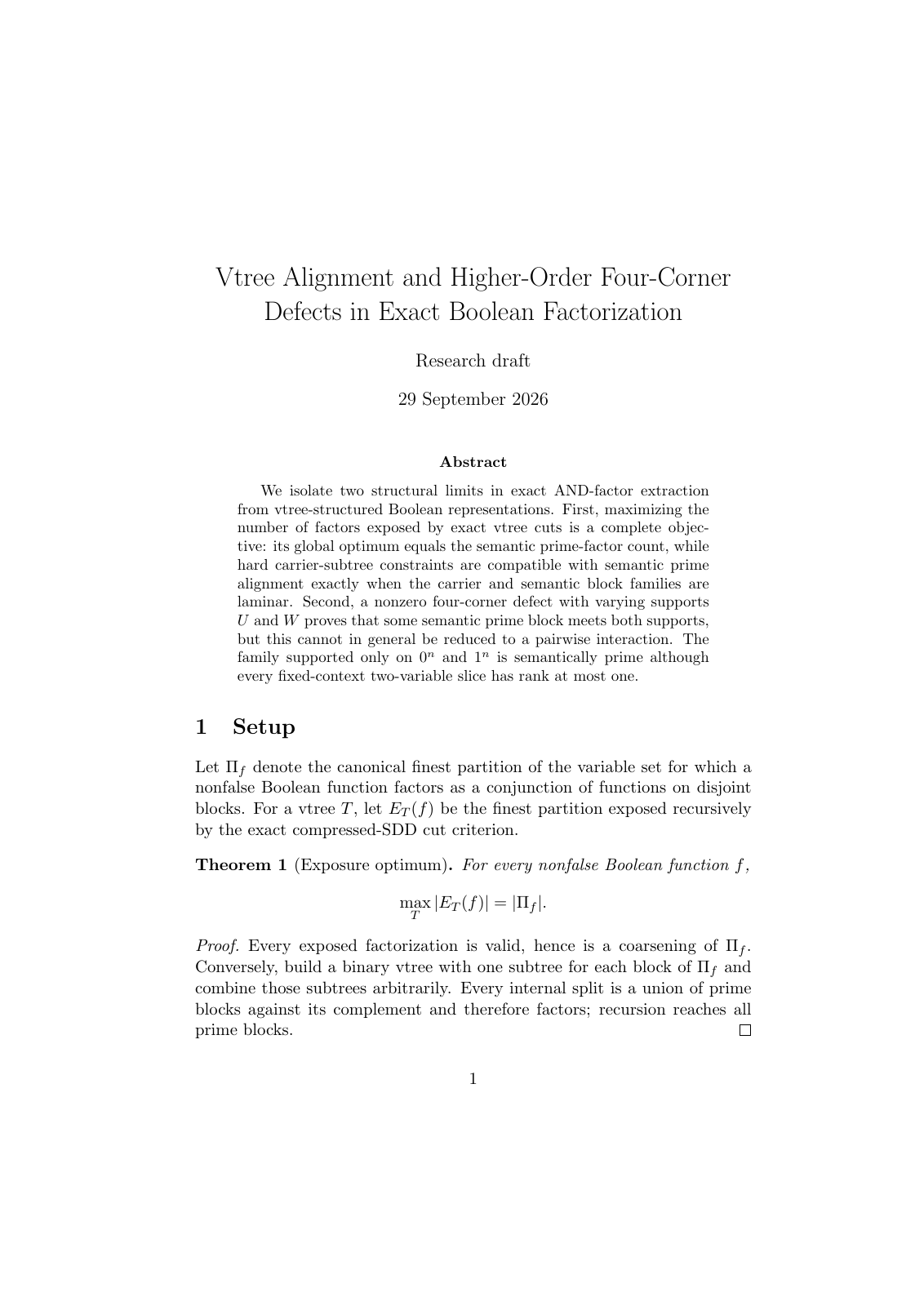 PDF page 2 of 3
 PDF page 3 of 3

Exact source files
THEOREM_NOTE_DRAFT.tex
   1 \documentclass[11pt]{article}
   2 \usepackage{amsmath,amssymb,amsthm,booktabs}
   3 \newtheorem{theorem}{Theorem}
   4 \newtheorem{lemma}{Lemma}
   5 \newtheorem{corollary}{Corollary}
   6 \title{Vtree Alignment and Higher-Order Four-Corner Defects in Exact Boolean Factorization}
   7 \author{Research draft}
   8 \date{29 September 2026}
   9 \begin{document}\maketitle
  10 \begin{abstract}
  11 We isolate two structural limits in exact AND-factor extraction from vtree-structured Boolean representations. First, maximizing the number of factors exposed by exact vtree cuts is a complete objective: its global optimum equals the semantic prime-factor count, while hard carrier-subtree constraints are compatible with semantic prime alignment exactly when the carrier and semantic block families are laminar. Second, a nonzero four-corner defect with varying supports $U$ and $W$ proves that some semantic prime block meets both supports, but this cannot in general be reduced to a pairwise interaction. The family supported only on $0^n$ and $1^n$ is semantically prime although every fixed-context two-variable slice has rank at most one.
  12 \end{abstract}
  13
  14 \section{Setup}
  15 Let $\Pi_f$ denote the canonical finest partition of the variable set for which a nonfalse Boolean function factors as a conjunction of functions on disjoint blocks. For a vtree $T$, let $E_T(f)$ be the finest partition exposed recursively by the exact compressed-SDD cut criterion.
  16
  17 \begin{theorem}[Exposure optimum]
  18 For every nonfalse Boolean function $f$,
  19 \[
  20 \max_T |E_T(f)|=|\Pi_f|.
  21 \]
  22 \end{theorem}
  23 \begin{proof}
  24 Every exposed factorization is valid, hence is a coarsening of $\Pi_f$. Conversely, build a binary vtree with one subtree for each block of $\Pi_f$ and combine those subtrees arbitrarily. Every internal split is a union of prime blocks against its complement and therefore factors; recursion reaches all prime blocks.
  25 \end{proof}
  26
  27 \begin{theorem}[Carrier/semantic compatibility]
  28 Let $\Pi$ and $\Sigma$ be partitions of the same ground set. A binary rooted leaf-labelled tree can contain every block of both partitions as a subtree leaf set if and only if the combined block family $\Pi\cup\Sigma$ is laminar.
  29 \end{theorem}
  30 \begin{proof}
  31 Subtree leaf sets form a laminar family, giving necessity. Conversely, represent the inclusion poset of a finite laminar family as a rooted tree and refine nodes of degree greater than two by inserting binary nodes.
  32 \end{proof}
  33
  34 \section{Defect support}
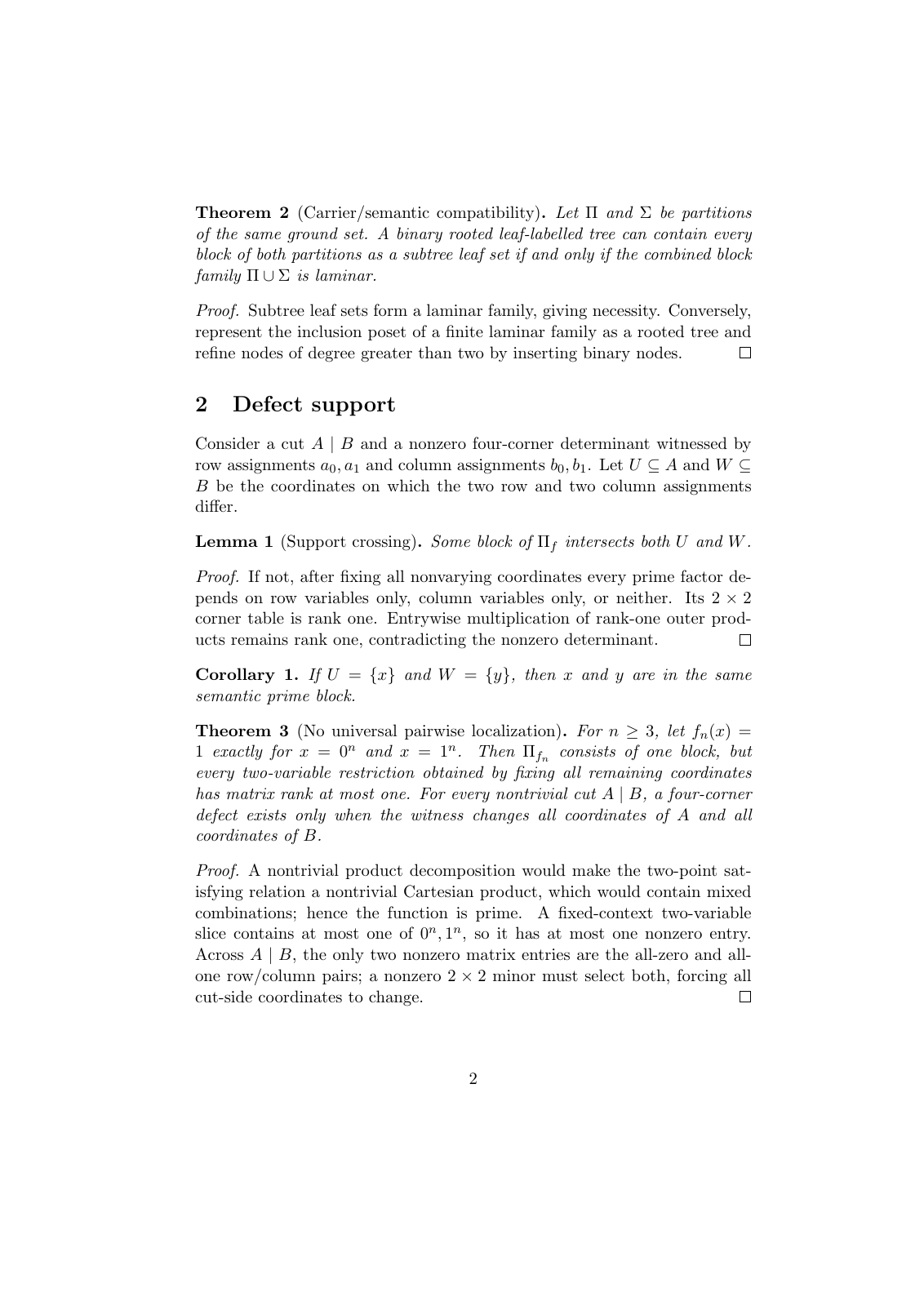
  35 Consider a cut $A\mid B$ and a nonzero four-corner determinant witnessed by row assignments $a_0,a_1$ and column assignments $b_0,b_1$. Let $U\subseteq A$ and $W\subseteq B$ be the coordinates on which the two row and two column assignments differ.
  36
  37 \begin{lemma}[Support crossing]
  38 Some block of $\Pi_f$ intersects both $U$ and $W$.
  39 \end{lemma}
  40 \begin{proof}
  41 If not, after fixing all nonvarying coordinates every prime factor depends on row variables only, column variables only, or neither. Its $2\times2$ corner table is rank one. Entrywise multiplication of rank-one outer products remains rank one, contradicting the nonzero determinant.
  42 \end{proof}
  43
  44 \begin{corollary}
  45 If $U=\{x\}$ and $W=\{y\}$, then $x$ and $y$ are in the same semantic prime block.
  46 \end{corollary}
  47
  48 \begin{theorem}[No universal pairwise localization]
  49 For $n\ge 3$, let $f_n(x)=1$ exactly for $x=0^n$ and $x=1^n$. Then $\Pi_{f_n}$ consists of one block, but every two-variable restriction obtained by fixing all remaining coordinates has matrix rank at most one. For every nontrivial cut $A\mid B$, a four-corner defect exists only when the witness changes all coordinates of $A$ and all coordinates of $B$.
  50 \end{theorem}
  51 \begin{proof}
  52 A nontrivial product decomposition would make the two-point satisfying relation a nontrivial Cartesian product, which would contain mixed combinations; hence the function is prime. A fixed-context two-variable slice contains at most one of $0^n,1^n$, so it has at most one nonzero entry. Across $A\mid B$, the only two nonzero matrix entries are the all-zero and all-one row/column pairs; a nonzero $2\times2$ minor must select both, forcing all cut-side coordinates to change.
  53 \end{proof}
  54
  55 \section{Interpretation}
  56 The results support hyperedge-valued defect evidence rather than automatic pairwise must-link edges. They also show that carrier blocks should not be hard-wired into vtrees when they cross emerging semantic factors.
  57 \end{document}
Related boundaries: CM model correctness audit. No simulation, timing or full computational campaign was rerun for this reading-copy release. No physical or cognitive advantage follows from making these documents accessible.