
ProLT · Lecture 01 · 1 of 37
Why give logic a topology?
In this lecture
- 0:00 · L01.S01 — A difference we cannot yet tell apart
- 0:24 · L01.S02 — Four possible states
- 1:14 · L01.S03 — What one certificate can distinguish
- 2:17 · L01.S04 — Where topology enters
- 2:58 · L01.S05 — Two ways to acquire information
- 3:45 · L01.S06 — Pause and predict
- 4:36 · L01.S07 — A direct distinguishability check
- 5:25 · L01.S08 — What we will build
Complete transcript
Show transcript
Could two situations be different, yet look exactly the same through the observations we are allowed to make?
Imagine a card hidden inside an envelope. It might have a dot, a stripe, both, or neither.
We want to work out which card it is. But what we can discover will depend on what evidence we are allowed to use.
Let’s give two statements short names. X means “the card has a dot.” Y means “the card has a stripe.”
There are four possibilities.
Card A has a dot only. Card B has both features. Card C has a stripe only. Card D has neither.
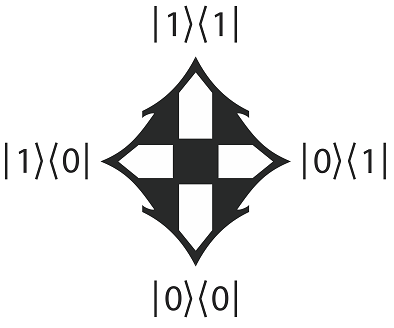
Each possibility is a state: a complete answer to both questions about the card. On our diagram, the first bit answers X, the dot question, and the second answers Y, the stripe question. One means true and zero means false.
This diagram is our map of the possibilities. It does not tell the observer which card is actually inside the envelope.
Now suppose the only available certificate says, “The card has a dot.” A certificate is evidence establishing the statement written on it.
That statement is true for A and B. It is false for C and D.
A and B really are different: B has a stripe. But the dot certificate cannot tell them apart. Both satisfy exactly the same available test.
It can distinguish A from D in one direction: certifying a dot excludes D. It also excludes C, because C has no dot. The positive dot certificate leaves A and B possible.
The reverse needs care. We have not supplied a certificate saying “the card has no dot.” Without a dot certificate, we cannot simply conclude “no dot.”
A statement can be false without its negation being available as a certificate.
We can draw a region around the states that a certificate would confirm. For “has a dot,” that region contains A and B.
Topology gives precise rules for organizing regions called open sets. In this paper, those regions are generated from the observations we choose to make available.
They record which distinctions those observations can express.
We will learn the rules later. For now, the key idea is that topology can describe the structure of observation, even when our points are logical states rather than locations on a map.
There are two ways we might improve our information: add an observation, or learn a fact.
First, we could make another certificate available: “The card has a stripe.” We would then have a way to distinguish B from A. All four cards would still be possible; we have improved our observation tools.
Second, we could learn as a fact that the hidden card has a stripe. Then only B and C remain possible. We have narrowed the candidates.
Adding an observation changes what we can distinguish. Learning a fact changes which states remain possible. The paper carefully separates these two operations.
Let’s check the distinction.
Return to our original setup, with only the dot certificate available.
If you obtain that certificate, can you conclude that the card is A?
And if you have no such certificate, can you conclude that the card has no dot?
Both answers are no.
The dot certificate leaves A and B possible. And having no dot certificate does not establish that the card lacks a dot. A certificate for “no dot” would be a separate observation.
With only the dot test available, does it distinguish A from D? Does it distinguish A from B? State which positive certificate could establish the distinction, rather than guessing the hidden card.
The dot test distinguishes A from D in one direction: a positive dot certificate excludes D. It does not distinguish A from B, because both satisfy the same available test. The presence of a distinction is different from identifying the actual valuation.
This is the starting point of propositional logical topology: connect the states of a logical system with the distinctions its observations support.
The paper brings established ideas from logic and topology together around that connection.
We will build the background step by step, including sets, logic, distance, and topology.
Next, we start with sets: a simple language for describing which states belong to which regions.