Diagnosing While Repairing:
Information Loss, Adaptive Order,
and Noisy Readouts
Abstract
Can a system be repaired without losing the distinction needed to identify its original fault? We study binary components, silent coordinate resets, and specified nondestructive diagnostic ports. A two-component normal form characterizes exactly reportable origin labels. For three components, overlapping series-health ports give no exact-feasibility advantage to adaptive repair order. Replacing one series port by parallel health gives a separation, minimal in supported origins and binary components within this reset class. Its fixed-order comparator permits adaptive diagnostics, but at exact deterministic feasibility these normalize to a saturated preset schedule. The witness is therefore a restricted adaptive-testing realization.
Under common fresh binary-symmetric readout noise, adaptive order attains arbitrarily small origin-label error with certain restoration, whereas every fixed order retains a positive Bayes-error floor. Positive full-support noise also forces every component repair, changing the cost contract. An exact Bellman recursion gives finite-read optima through seven readings. A charged extension certifies the Bayes-error/expected-read convex frontier through cap six; ordinary curtailed majority attains its minimum-error cap-six endpoint at expected total unit action cost . For the same four-origin model at noise , a separate statewise-minimax calculation certifies cap-four error with adaptive repair order and for private mixtures of precommitted orders. Recalibrating only the terminal report on one fixed acquisition experiment attains , strictly above the full adaptive optimum. These comparisons change the error objective; they do not establish an optimized minimax cost frontier. An exact optimal-action cell audit excludes attaining the cap-four optimum with deterministic acquisition even when terminal reporting may randomize. For the separate objective of uniform expected reads with every origin’s error at most , the exact cap-four minimum is reads. The specialized characterizations, witness, and quantitative benchmarks are the focus; data processing, adaptive testing, and noise amplification are established methods. Supporting examples and prospective validation are separated from the main argument. External priority and physical applicability remain unresolved.
Status and lineage. This is a companion working manuscript to the completed Causal Self-Diagnosis with Noisy Tests, v0.3 [3]. The v0.3 sources and PDF are unchanged. This document consolidates three separate deterministic repair reports and the subsequent noisy-repair addendum [2, 1]. It is not a submitted paper. Submission attribution remains undecided. Simulated reviews are internal AI assessments, not reports from human specialists or external endorsement. This edition retains the mathematical results of v0.2.4 and integrates the subsequent source audit and theorem-by-theorem model comparison. Appendix G records the updated access scopes, applicability qualifications and unresolved priority questions. Reviews apply only to their recorded inputs and source snapshots.
1 Question, antecedents, and model boundaries
Restored performance, present-state knowledge, and knowledge of an original fault are different outcomes. A repair can improve the first while destroying the last. The question here is operational: which origin distinctions can a controller report through its declared ports while leaving the system healthy, and how do order, noise, and cost change that answer?
The intended reader works with finite-state diagnosis, adaptive experiments, or control and is familiar with elementary probability and decision trees. The running witness has three binary fault components, two health ports, and an immutable label . Its first port reading selects which component should be repaired first to preserve that label. Restored state is the same on every successful path; it does not identify the original label. A fixed order models a precommitted maintenance sequence while still allowing diagnostics and their timing to react to evidence. This is a mathematical restriction, not a claim that a particular device uses it.
| Question | Result and status |
| What survives a repair? | The two-bit axis normal form (Theorem 2.1) and exact cost/error benchmark (Proposition 2.4); the oracle bound supplies established Bayesian machinery, not the main novelty claim. |
| When does order help? | Series/series feasibility equivalence, then a series/parallel separation and class-specific minima (Theorems 3.1–3.3). These are specialized structural results; the origin-count spine bound is an elementary general observation, not a reset-specific novelty claim. |
| What changes with noise? | Common-channel floor and amplification, no-skip restoration costs, and exact cap- benchmarks (Theorems 4.1–4.2, Proposition 4.3, Section 4.3). No new general amplification or scalable planning method is claimed. |
| Which error guarantee? | Exact cap-four statewise-minimax certificates and a fixed-acquisition randomized-report optimum (Sections 6–7). These use standard finite-game/Bayes-support methods and do not optimize minimax costs. |
| Where must coins enter, and what do guarantees cost? | The complete cap-four optimal-action audit requires acquisition randomization for exact optimality (Section 8). A separate uniform-mean-read optimum under four statewise error constraints is certified at one point (Section 9); no full frontier is claimed. |
The main path is contract local reportability repair-order separation common-noise transfer. Separate counterfactual, compound-action, and prospective validation examples are in the appendices.
Repair as experiment and decision-theoretic troubleshooting are established ideas [5]. Adaptive state identification, the distinction between initial-state testing and homing, and the significance of reliable resets have substantial finite-machine antecedents [24, 11, 21]. Initial-state estimation with sensor failures is also established [26]. Our fixed-order baseline permits adaptive diagnostics and stopping. At exact deterministic feasibility it normalizes to a saturated preset word (Proposition 1.3); this is not a cost or noisy finite-budget equivalence. A coordinate repair to health is also different from a reset that recreates the unknown original specimen.
The preceding acquisition manuscript [18] and companion baseline [3] distinguish static acquisition from state-changing interventions. Their known static-channel oracle does not automatically identify a pre-repair port with the same physical port after repair. The stage and physical state matter. Controlled information and state-independent strategy emulation have direct decision-theory ancestry [6, 17]; the finite examples and stated reductions here do not establish external originality. Appendix F records what was actually read and what remains unavailable.
1.1 Relation to state-changing testing
The deterministic local-reset model has a direct Mealy representation. Use physical bit vectors as states. Diagnostic input leaves state unchanged and emits ; reset input changes state to and emits a common dummy symbol. Reporting is initial-label identification on the supported start set , and is full initial-state distinguishing on when is injective there. The physical state space and need not coincide: the running witness has four supported starts in an eight-state physical cube. All resets are legal, so remaining resets can be appended after retaining the report; restoration changes costs but adds no exact adaptive feasibility obstruction in this perfect-reset class.
State-changing initial-state experiments, merging obstructions and adaptive versus preset tests have established antecedents [24, 23, 12]. Known start subsets and experiments without reset-to-start are also established [12]. Repair/configuration experiments and cost-sensitive observation–repair planning are established in troubleshooting [5, 9]. We claim no new general formalism or general advantage of adaptive distinguishing experiments.
At exact deterministic feasibility, our fixed-order diagnostic syntax normalizes to a saturated preset schedule (Proposition 1.3). This does not preserve cost, finite-read budgets or noisy risk.
Thus the four-origin example is a restricted adaptive-versus-preset realization, even against our adaptive-diagnostic fixed-order syntax. Its distinctive objects are the coordinate-reset/port characterizations, specified monotone-port realization, component bound and exact finite-model cost/risk expressions. Their external priority remains unresolved. The four-origin lower bound is an elementary unresolved-spine observation that already applies to deterministic total-input experiments; it is not specifically a reset-model novelty claim. Neither saturation nor appended completion is a cost, finite-read-budget or noisy-risk equivalence.
Generic identification theorems require matching their hypotheses. The published injectivity/completeness criterion in [23] has a no-compatible-distinct-state-pair assumption. We do not transfer it automatically to an arbitrary origin label or a restricted start set. An elementary encoding, a generic solver, and a different objective each leave result-level historical comparison to be done; none establishes novelty or non-subsumption.
1.2 Shared notation and information contract
The origin is , with finite and each . The complete physical state after actions is and the controller’s entire retained information is : its action/answer record and any retained private random information. A finite-valued origin label is fixed throughout the experiment. A current-state target, such as health of , is a different variable.
Actions are chosen from the available history and private randomness independent of . Fresh private draws are independent of the origin and physical innovations; previously drawn variables still retained by the controller are included in . Every causally persistent response type must be part of when a current-state sufficiency claim is made. An origin/current belief is bookkeeping, not an additional sensor exposing . The record is retained perfectly: a repair does not delete the controller’s notes or silently remove private information it still uses.
| Symbol | Meaning |
|
| Immutable origin, supported origin set, positive origin prior. |
|
| Changing complete physical state and entire retained information. |
|
| Origin labels: two-bit actuator fault, two-bit original success of , and three-bit joint fault , respectively. |
|
| Current three-bit port values. is not an origin target. |
|
| Projection deleting coordinate . |
|
| Executed-reset set, posterior on origins, and minimum immediate Bayes label error. |
In the local-reset models, , with meaning faulty. silently sets coordinate to zero and leaves all others unchanged. All such resets are legal, commute, and are idempotent. Diagnostics read specified functions of current state without changing it. No repair returns a free success bit, no full-state assay is implicit, and no rerun from the unknown origin is available. Restoring means ending at .
Definition 1.1 (Policy classes and success). An order-adaptive policy may choose its next reset after diagnostics. A fixed-order policy selects a permutation of the reset coordinates before observations, but may adapt diagnostic times, ports, and stopping. It may pass a coordinate only if omitting its reset preserves the required restoration guarantee; a passed coordinate cannot be repaired later. A randomly selected fixed permutation is independent of .
Exact origin reporting and certain restoration means statewise almost sure finite termination with correct report and at every supported origin. In a noisy experiment we instead specify statewise or prior-averaged report error, retaining the separately stated restoration requirement.
Finite deterministic protocols suffice for the positive exact results. For exclusions, almost surely finite randomized policies are included. In a finite-origin deterministic model, intersect the probability-one sets of successful random tapes over all origins. Fixing a tape in that intersection gives one terminating deterministic policy for all origins, so randomization does not supply missing exact information.
1.3 Assumption map
The following contracts are kept separate throughout.
|
Table 3: Assumption contracts used in the results. A changed contract is not silently transferred to another model.
|
|
|---|---|
|
Model |
Assumptions and objective |
|
|
|
|
Erasure certificate |
Finite origin, countable retained records (or the standard Borel expectation form), finite complete current state, future kernels factoring through state and retained record. Oracle information, not an actual-port sufficiency claim. |
|
Two-bit local repair |
One deterministic port; initial answer known and its cost sunk; silent perfect local resets; exact reporting/restoration and explicit positive action prices. |
|
Three-bit order |
Deterministic two-port readout; no free initial reading; silent perfect resets; fixed order chosen before evidence. Feasibility minimality and exact costs are class-specific. |
|
Noisy bridge |
Fresh independent common binary-symmetric channels (BSCs), known polarity, rates below ; perfect resets. Small original-label error and certain restoration; all actual reads and repairs charged. |
|
Finite-cap minimax |
Same four physical origins, common fresh BSC , hard individual-read cap, forced report and certain restoration. Private mixtures and terminal-report coins are origin-independent; memory, private coins and computation are unpriced. Maximum-origin error is optimized; expected read counts are reported separately. |
|
Perturbed repair |
Complete reset-kernel total variation (TV) bounds; matching diagnostic laws; each reset once; matched finite policy class. Joint failure is probabilistic, rather than certain restoration. |
|
One-use coupling |
Separate model with immutable response types and a shared one-use resource. Unknown same-unit coupling, not physical erasure. |
|
|
|
|
|
|
|
|
|
1.4 A current-state oracle and irreversible loss
A diagnostic prefix, possibly randomized, yields the entire retained record and complete state . Assume the conditional law of every future controlled trajectory, given and future chosen actions, has no further dependence on . For countable records put
Proposition 1.2 (Oracle erasure certificate). For countable records every allowed continuation has Bayes origin-label error at least
An oracle revealing in addition to retained attains this error. exactly when every positive-mass fiber has one origin label.
Proof. With supplied, future controlled observations can be simulated using only those variables and state-independent private randomness. A terminal report is therefore a garbling of . At its correct mass is at most . Sum over fibers. A maximizing oracle report attains the bound. All nonmaximal label masses vanish in a fiber exactly when the fiber has one label, proving the zero-error statement. □
Appendix E gives the conditional-expectation form for general retained records, including continuous private seeds.
The proof is a finite Bayes/data-processing argument, not a new general information principle. A positive certifies irreversible loss under the complete-state contract. A zero does not show actual-port recovery: two current states can carry opposite labels while all available ports are constant. Omitting a persistent response type can create a false merge; Appendix A exhibits this danger explicitly.
For deterministic prefixes, opposite-label origins mapping to the same current state and retained record cannot subsequently be separated. Noninjectivity of the physical state map alone is insufficient if the record already identifies the origin. The expected oracle error cannot decrease under further physical processing with its generated record: the later state/record is a garbling of the earlier complete state/record. The actual observer can nevertheless improve by measuring previously hidden surviving information.
1.5 Exact-feasibility normalization
The following reduction makes the relation to preset experiments explicit. It is an elementary comparison argument, not a claim of historical priority.
Proposition 1.3 (Fixed-order normalization). Suppose the origin support is finite, all coordinate resets are silent, perfect and always legal, and there are finitely many deterministic nondestructive ports with finite outputs. Retain the full record and any private information used by the controller; private randomness is independent of the origin. Let be a finite-valued origin label. There is no cost or read-budget constraint. Let invoke every port in a fixed order. For a repair permutation , write for the retained port-output record of the preset word
An exact, certainly restoring fixed- policy exists for if and only if is constant on every fiber of . Moreover, existence of some such fixed-order policy is equivalent to existence of a finite preset label-distinguishing word in this reset/port alphabet. Exact reporting includes almost surely finite termination.
Proof. For sufficiency execute and report its common fiber label; all coordinates have been reset. For necessity first consider a deterministic exact fixed- controller. Between distinct resets every port answer is constant at the current state, and repeated resets are identities. If a coordinate is passed without its reset, restoration requires it to be zero at every supported origin on that history: no later coordinate action can change it. Inserting that reset acts identically on that branch. Reading all ports at each stage therefore supplies every answer that the controller could obtain there. Simulate its reads and next-reset or safe-pass choices from successive vectors in ; the resulting report is a function of that record. Equal records require equal labels. Complete unused resets after retaining the report.
For an exact randomized controller, intersect its probability-one sets of successful private tapes over finite and fix a tape in the intersection. The deterministic argument applies. If the permutation was itself randomly selected before observing, this tape fixes one successful permutation, which suffices for the existence statement. Finally, any finite preset word is refined by some : delete repeated resets, list first reset occurrences, append never-used resets, and insert all ports at each stage. Original read outputs remain recoverable. Conversely is itself preset. □
The inserted readings and completion repairs may raise cost or length. This is not an equality of optimal costs, a finite-budget risk result, or a positive-noise policy normalization. State-dependent permissions, consuming ports and hidden persistent types are outside its contract.
Bayes-report consequence. The deterministic record factorization in Proposition 1.3 also permits the saturated record to reproduce any terminal report of the restoring controller, even when that report is erroneous. Safe passes still act as identities on their compatible origins. Thus, for a fixed deterministic order and any prior, the canonical record has no larger minimum Bayes report risk. It need not have the same action cost; this does not normalize a noisy channel or preserve a read cap.
The explicit comparison in Appendix G shows that observational equivalence need not preserve the terminal health predicate. A diagnostic quotient alone is therefore not a restoration-cost-preserving reduction.
2 Two local repairs: reportability, access, and cost
Let current fault bits be , with perfect silent resets and . The sole diagnostic returns a known Boolean . Work on a known initial-answer support ; that initial reading is already obtained and its cost is sunk. If several initial-answer blocks are observed, the following analysis is applied separately on each block. Define the alternative first-repair signatures
The interface does not grant both signatures on the same original specimen: after both repairs the answer is .
Theorem 2.1 (Repair-axis characterization). A finite-valued origin label is exactly reportable with certain restoration if and only if it is constant on the fibers of at least one of .
Proof. Before the first repair all diagnostics repeat known . A deterministic policy has a common first useful repair on . Until the other repair, every diagnostic is and repeated is an identity. Once both repairs occur, current state is for all origins and future answers are constant. Thus the complete informative record factors through . An exact report requires constant label on its fibers. A randomized exact policy gives a deterministic successful tape by the finite-origin argument in Section 1, so the same necessity holds. Conversely, execute a qualifying repair, read the port once, retain the answer, perform the other repair, and report its common fiber label. A constant label is included automatically. □
For a fixed first repair , let . The complete-current-state oracle error and the optimal actual-port error after that repair are
The second value is attained by reading the intermediate port and completing restoration. No later action exposes a further origin distinction.
Proposition 2.2 (When the port attains the oracle bound). , with equality precisely when every port fiber containing positive mass has a label that maximizes simultaneously at all its positive-mass current states.
Proof. For each , the maximum of the sum of nonnegative label masses is at most the sum of their maxima. Equality holds exactly when a maximizing label has zero deficit at every summand. Sum over . This retains ties; pairwise intersections of sets of maximizers need not have a common element in general. □
For example, take , origins equally likely, and target . Initial system failure is known from ; is a world-only port, not a system-health port. After , current states retain , so the genie error is zero. The actual port reads zero at both; then erases the distinction. The attainable error is even with unlimited diagnostics. This is inaccessible surviving information, rather than loss already certified by the initial current-state oracle.
2.1 Two answerable targets that cannot be paired
Use series health and known failed origins , with positive masses . Let and , the success of actuator repair at the original time. The deterministic model supplies this counterfactual response table:
First preserves enough for exact ; first preserves enough for exact . Their pair identifies all three origins and is not attainable. Its minimum Bayes error, with eventual restoration, is
This follows directly from the two intermediate partitions, and is attained by choosing the less costly error in the better partition, ignoring action prices for this error calculation.
Corollary 2.3 (No single finest reportable origin partition). In this model the set of exactly reportable origin labels need not consist of the coarsenings of one attainable partition.
Proof. Such a partition would refine both individually reportable and , hence their discrete joint partition. It would make their pair reportable, contradicting Theorem 2.1. □
This changes the hypotheses of the static finest-acquisition result [18]; it does not refute that result. Removing the simultaneous fault removes this particular obstruction.
2.2 A solved deterministic cost/error benchmark
Charge per invoked repair and per diagnostic, including repairs of already healthy components. With initial failure known, useful policies reduce to three forms: repairs both without further testing; repairs , tests, and repairs on failure; is the symmetric policy.
| Policy | Expected cost | error | error |
To see completeness, delete pre-repair repeated constants, identity repairs, and post-restoration tests. Before the second distinct repair, at most one port answer can matter. On a successful test the other coordinate is known healthy, so paying to reset it is dominated. Without that test, restoration requires both repairs. This covers all horizons; randomization supplies convex mixtures of these forms.
Consequently restoration minimizes the three displayed costs; exact requires and exact requires . Testing improves restoration cost over precisely when . For uniform prior and :
These are prior-averaged errors, not maximum statewise errors.
Proposition 2.4 (Exact constrained frontier for the stated prices). For , a certainly restoring policy with , exists exactly when . Its minimum expected cost is
For nonnegative soft penalties the scalarized optimum is
Proof. Let mixture probabilities be . Bayes-optimal terminal reports have and ; worse reporting improves neither constraint. Hence , , which are compatible precisely under the stated sum condition. Cost is . Setting each positive-cost coefficient at its lower bound gives the formula and a feasible mixture, with . For soft penalties minimize the three affine costs over the mixture simplex. □
The bounded error ranges, sunk initial reading, deterministic port, and perfect resets are part of this benchmark. They will change in the noisy three-bit model.
3 When adapting repair order adds exact diagnostic power
Current state is ; repairs reset their own coordinates. Unlike Section 2, no initial diagnostic is free. Every port invocation costs its stated price. For feasibility one may consider both ports saturated between useful repairs, but this is only an information upper bound, not a cost convention.
A fixed policy that safely passes an unrepaired coordinate knows that coordinate is zero throughout its current support; otherwise restoration would fail at an origin where it is one. Inserting its reset is therefore an identity on that support. Thus for feasibility fixed policies are dominated by a full permutation with both ports read at every stage. This is the exact-feasibility normalization of Proposition 1.3; it neither charges inserted identity actions in cost comparisons nor preserves a noisy risk budget. Repeated resets are also silent identities.
3.1 Overlapping series ports give feasibility equivalence
Let and , and let . Its initial full-cube fibers are
For support write and let delete coordinate of an origin. The projection notation is distinct from the prior .
Theorem 3.1 (Series/series order equivalence). For every and finite label , the following are equivalent:
-
An order-adaptive policy exactly reports and certainly restores.
-
A fixed-order policy does so, with adaptive diagnostics allowed.
-
For some , is constant on the fibers within .
A label-constant or empty satisfies the third condition.
Proof. On every diagnostic before a first useful repair is the same. A deterministic winning policy therefore chooses one common first repair there. Equal origins then have identical complete current state and retained record. Proposition 1.2 requires equal labels, proving necessity; the finite-origin random-tape argument covers randomized exact policies.
For sufficiency, buy both initial diagnostics. The other three fibers are singleton and identify the origin immediately. On , choose a qualifying and one of the following fixed schedules:
| First repair | Paid observations and continuation |
| , read ; , read ; . | |
| , read and ; , . | |
| , read ; , read ; . | |
Each schedule exposes its surviving projection and restores. The same permutation is harmless on the initial singleton fibers because the origin label is already retained. This proves a common fixed-order implementation. The reverse implication is immediate. □
The result concerns exact feasibility, not equality of optimal costs. There is only one initially ambiguous output group, so incompatible ordering requirements cannot arise across different ambiguous groups.
3.2 One series-to-parallel change
Keep but replace by parallel health . Both ports still depend essentially on two overlapping components and are monotone in health. Among monotone two-input Boolean functions that essentially depend on both inputs, AND and OR are the two gates. This is one specified relaxation, not a universal weakest relaxation.
Use origins and immutable target :
| Origin | Initial | Initial | |
Figure 1. Exact adaptive protocol for Table 8. Each read is paid. The report concerns the immutable origin; completion concerns the current state.
| Read initial
| |
|
|
|
| : retain ; reset | : retain ; stop |
| : retain ; reset | : retain ; reset |
| Final state in every case. | |
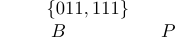
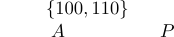
By contrast, before loses the pair ; before loses . A single fixed permutation cannot protect both pairs. Under noisy decoding, this selective completion is replaced by executing all three resets; see Table 9.
Theorem 3.2 (Exact adaptive separation). An adaptive-order policy exactly reports and restores . No fixed-order policy does so. The optimal Bayes error over fixed orders, ignoring action prices, is
Proof. Buy initial . If , reset and buy ; identifies , while identifies . Reset in either case and only in the latter. If , reset and buy ; identifies , while identifies . Reset only in the latter. Retain . This restores every origin and uses exactly the originally faulty repairs.
For any order with before , origins have identical port records until either or , even if has occurred. The position cannot safely be passed while remains possible. Executing merges this opposite-label pair. For before , the same argument applies to . These cases exhaust all permutations, and random pre-observation order selection only mixes their risks. They yield the two lower bounds in the displayed formula. Reading both ports before and after every reset distinguishes all other origin classes in each order, so each pair bound is sharp. □
In particular all six fixed orders have error under a uniform prior. The comparator permits adaptive diagnostic times. Nevertheless, Proposition 1.3 makes this an adaptive-versus-preset separation inside the specified reset model. The displayed adaptive policy identifies all four supported origins, so it also solves full initial-state identification on . This does not claim identification of every state in the physical cube.
3.3 Class-specific minimality
Theorem 3.3 (Origin and binary-component minima). In the class of silent perfect always-legal coordinate resets and arbitrary finite deterministic nondestructive port bundles, an exact adaptive-order versus all-fixed-order label/restoration separation requires at least four possible origins and at least three binary components. The preceding witness attains both bounds.
The origin-count spine argument is a general deterministic decision-tree observation; the binary-component argument uses the local-reset square geometry. These are scoped minima, not claims of historical firstness or a minimum whole-machine state count.
Proof. With at most three origins, any informative diagnostic split has at most one label-mixed child: two mixed children would each require two origins. In a winning tree follow the unique unresolved child at each split. Its unresolved spine supplies one sequence of repairs. Delete repeated resets and extend the sequence to a permutation of all coordinates. A fixed-order controller follows its diagnostics and repairs until the label is learned, then completes that permutation. Branches leaving the spine already know their label, and all resets remain legal. Thus a winning adaptive tree supplies a winning fixed order.
For one binary component there is no ordering choice. For two, let be the vector of all port outputs and saturate the initial observation for feasibility. The -first surviving axis is observable exactly when ; the -first axis exactly when . A blind axis cannot resolve a label-mixed initial fiber. If one axis is blind, every solvable mixed fiber uses the other first repair, giving a global order.
If both axes are observable, a first repair reveals its surviving bit. A fiber that needs before contains an opposite-label pair with the same ; a fiber that needs before contains an opposite-label pair with the same . A single fiber requiring both orders cannot be won adaptively, since no pre-repair diagnostic splits it. Conflicting requirements must therefore come from disjoint initial fibers. But a horizontal and a vertical edge of the two-bit square always intersect: an edge fixing and one fixing share . Thus such disjoint fibers cannot impose them. One common order works. These arguments apply to a deterministic successful tape of any exact randomized policy. □
No minimum port count, truth-table edit distance, nonbinary result, or noisy minimality theorem is asserted. Hidden response types, consuming tests, partial resets, noncommuting repairs and changing admissibility lie outside this theorem.
3.4 Exact deterministic costs under the same obligations
Proposition 3.4 (Adaptive exact cost in the four-origin witness). For all positive priors and action costs, the minimum adaptive expected cost for exact and certain restoration is
Proof. Every originally faulty coordinate needs its own reset, giving the three weighted terms. Every exact path also needs and . Initial is constant. Before , a first or irreversibly merges one opposite-label pair. A first leaves current candidates with label zero, with label zero, and with label one; the two latter-origin label-one possibilities have harmlessly merged. Both ports are then constant, . A subsequent loses versus , while loses versus . Thus an exact policy cannot begin a reset before . After , both branches still have both labels; gives equal outputs on both candidates after every common later reset history, so is necessary. The constructive policy of Theorem 3.2 buys each once and resets exactly the faulty components, attaining every lower bound. Randomization cannot improve per-path obligations. □
At uniform prior and unit prices the mean necessary repair count is two, so the exact diagnostic/restoration value is four. Restoration alone has value three for both classes: reset all three without observing. Any deterministic policy that first diagnoses charges every origin at least one reading plus mean necessary repair count two, hence costs at least three. A no-reading policy must reset all three. Mixtures do not lower the scalar optimum.
The difference four versus three is the cost of a different reporting obligation. The equal-task order comparison is feasibility versus infeasibility; it is not a finite speed-up ratio.
4 A noisy-readout bridge with certain restoration
Keep the four origins, perfect repairs and ports , of Theorem 3.2. Port returns its current bit XOR a fresh independent flip, . Conditioned on the origin, full available past and selected port, this is the same common binary-symmetric channel (BSC); innovations and private policy coins are independent. Readings do not change state, consume a shared resource, or alter later permission. Channel polarity is known.
The common-channel qualification is substantive. A state-dependent noise rate can carry information absent from the nominal bit (Section 4.5). The following fixed-order bound does not follow from a generic bound on error probability alone.
| Obligation | Deterministic ports | Common fresh positive-noise BSCs |
| Origin reporting | Exact report feasible adaptively | Finite error specified; adaptive error tends to zero as read budgets increase. |
| Final physical state | Always | Always with perfect repairs, including wrong decoded routes. |
| Repair completion | Known healthy coordinates may be skipped | All three repairs required almost surely on termination. |
| Fixed-order comparison | Exact reporting infeasible; Bayes floor | Unlimited-read infimum still ; a finite-cap optimum is a separate quantity. |
| Risk criterion | Exactness or the stated Bayes loss | Finite-cap table optimizes Bayes error; maximum statewise error is reported separately, and Appendix C.2 targets each origin. |
4.1 A total block protocol
Choose positive odd integers :
-
Read initial times and take majority .
-
If , execute ; if , execute .
-
Read current times and take majority . Retain report .
-
Execute each of the other two coordinate repairs once, then report.
Every coordinate is reset exactly once on every readout record. Restoration is certain even on a wrong first-branch decision. This protocol deliberately does not use the deterministic policy’s certainty-based skips.
Write
| Origin | after correct route | after wrong route | ||
Theorem 4.1 (Exact block risks). For the stated protocol,
With , its Bayes error is
Uniform-prior error is and maximum statewise error is . Its exact action cost is .
Proof. For either label-zero origin, the correct route leaves and the wrong route . Its report error is . At either label-one origin, on both routes and error is . Fresh conditional readout noise gives the same second-block error after every first-block record. Sum with prior weights; makes label-zero origins the worst ones. Count actual port and repair invocations for cost. The repair completion proves restoration independently of decoding. □
Both error criteria tend to zero as both block lengths tend to infinity. For and , and
These are achievable risks and a protocol cost, not global expected-cost optima. One read per stage instead gives Bayes error . With equal block error , exactly when .
Theorem 4.2 (Noisy fixed-order infimum). Under the same common fresh channels, the infimum Bayes error over fixed-order policies with arbitrary finite read budgets and certain restoration is from Theorem 3.2. In particular it is for the uniform prior.
Proof. An exact-port controller simulates a noisy policy using independent private flips with the true rates. It preserves actual chosen actions, order and restoration. It cannot have smaller error than the exact-port floor already proved. This is an information comparison even when the noisy controller itself does not know the rates.
For the reverse inequality, take a finite saturated exact-port schedule of the better fixed order. Replace each requested port by an odd majority block and complete all repairs on every answer record. The true port bit stays constant within a block. There are finitely many oracle stages and , so a union bound on majority errors makes its report risk converge to the exact schedule’s risk. All wrongly decoded branches remain executable because every reset is legal. A pre-observation mixture of orders cannot beat their minimum. □
The all-history lower bound also covers statewise almost surely finite stopping. The infimum statement does not claim a zero-error finite policy or a general finite-attainment result.
4.2 Positive full support removes safe skips
Proposition 4.3 (Restoration cost changes at positive noise). If and all four origins have positive prior, every statewise almost surely finite, certainly restoring policy resets each coordinate at least once, almost surely at each origin. Hence expected repair cost is at least . Exact finite origin-label reporting is impossible.
Proof. The laws of every finite action/readout record under a common policy are mutually absolutely continuous across origins: each response symbol has positive likelihood, policy action probabilities are the same at a common history, and silent repairs supply no observed exclusion. Private policy coins are included as state-independent information. If a positive-probability terminal event omitted reset , its finite terminal-time components have positive probability under an origin with . Other resets never change , so restoration would fail. Every coordinate is faulty at some supported origin. Countable terminal times extend the argument to almost surely finite stopping.
Similarly, disjoint exact report events for two origin labels cannot have their required positive finite-time probabilities under mutually absolutely continuous finite-prefix laws. □
At zero noise, some exact diagnostics justify skipping healthy coordinates; the cost-four policy in Proposition 3.4 uses that fact. Positive full-support noise plus certain restoration prevents these skips. A small permitted restoration-failure probability or trusted repair feedback changes the task and can change the cost.
4.3 Exact finite-read dynamic programming
For uniform origins, common , and a hard cap on individual readings, let be the executed-reset set, the posterior on origins, and the remaining read count. Current state at origin is , obtained by zeroing coordinates in . Let . The terminal report can be retained while all remaining repairs are performed. Therefore the exact finite recursion is
omitting the final minimum at . For a fixed order only its next unused reset is allowed. This recursion minimizes report error under a read cap; it includes no diagnostic-price penalty. An empty reset minimum is . More explicitly, if is the stipulated BSC probability for port at , then
Zero-probability answer branches are omitted.
Completeness follows by induction on : the next useful operation is a report/completion, an unused reset, or a port invocation. Repeated silent resets can be removed. A private randomized mixture cannot improve scalar Bayes risk below its best deterministic member. All future distributions and origin loss depend on history through , so no additional policy memory improves this value. A diagnostic constant on current support is a common-channel random coin and can be omitted. If reporting already attains the complete-current-state genie bound, future controlled garbling cannot improve it and the state can be pruned.
| Maximum reads | Adaptive Bayes optimum | Best fixed-order optimum |
All six fixed orders agree in this particular symmetric instance, but were evaluated separately. A second implementation with normalized rational posteriors, no genie pruning and no constant-test pruning reproduced all eight adaptive and 48 fixed-order values. The recurrence justifies finite-cap optimality; the table does not extrapolate an optimum beyond .
An adaptive advantage over fixed orders at the same cap appears already at . The adaptive value first falls below the unrestricted fixed-order floor at among these caps. That certificate has state risks : its average is below but its worst-state error is not. It uses readings in expectation and thus unit expected cost with all three repairs. These are properties of a particular risk-optimal certificate, not a proof of minimum expected cost. The cap-three certificate uses only two reads. The cap-seven certificate has Bayes error , worst-state error and expected reads .
Complete exported graphs at caps three, four and seven were independently forward-evaluated through physical reset/readout laws. The checks cover all 11, 21 and 55 graph nodes respectively, posterior consistency, node values, budgets and all healthy terminal states. No statewise-minimax optimum is inferred from a Bayes calculation.
4.4 Unknown common rates and calibrated bounds
Suppose fixed fresh common rates are unknown but , with known polarity. The majority decoder needs only the polarity, not exact rates. Couple flips using common uniform variables to see is increasing. The risk formulas in Theorem 4.1 are increasing in both on , so replacing them by gives a uniform upper bound. For , the usual exponential estimate gives a sufficient block size; the exact binomial sum is preferable at small budgets.
If rates are merely below with no positive known margin, convergence is pointwise in the actual rates and there is no uniform finite budget for achieving a Bayes target strictly below the prior-only Bayes error (here under the uniform label prior) over all such rates. For maximum statewise error the corresponding nontrivial target is below , the error of a fair private guess without evidence. If a separate calibration procedure produces simultaneous bounds with failure probability at most , and the declared episode law holds conditional on that calibration information, unconditional report error is at most plus the worst covered-model bound. Calibration samples and its conditioning and independence obligations are separate costs. A finite table cannot certify indefinite fresh repeatability or common garbling against arbitrary alternatives.
4.5 An arbitrarily small informative-noise violation
Keep the initial nominal at all four origins, but stipulate and for conditionally independent and identically distributed initial reads, with these two rates known to the decoder. Then a fixed-order controller can learn before repairs and restore afterwards. For every positive rate separation, the distinct Bernoulli laws yield error tending to zero. This is a change to the complete observation contract, not a counterexample to Theorem 4.2.
For reads, exact uniform-label Bayes risk is
Selected values are approximately
These integer probability sums quantify a large finite-budget cost of a small leak. The qualitative infinite-budget floor is not robust to arbitrary hidden-state-dependent noise. If a persistent sensor type carries that dependence, it belongs in complete state; silently dropping it invalidates an erasure argument.
4.6 A restricted imperfect-reset corollary
Compare ideal and actual finite-state models on a common complete state space with the same immutable origin and action interface. At every matching origin, history and current state, suppose the complete transition/readout law of reset is within in total variation (TV) of the ideal silent point reset. In the simple silent model this says the ideal next state occurs with probability at least . Diagnostic laws agree with the common fresh BSC while coupled states agree. Compare the same syntactic finite policies, each invoking every reset exactly once. Both models have the identical initial joint law of origin and complete physical state, locally , and the same terminal health predicate. All discrepancy bounds and the additional below are in .
Proposition 4.4 (Joint-success stability in the matched class). Let . For the block adaptive protocol, actual probability of wrong origin label or not restored is at most ; restoration failure alone is at most . For every fixed-order policy in the matched class, actual joint failure is at least .
Proof. Couple origin and private randomness identically. While histories and states agree, chosen actions agree; couple diagnostics identically and maximally couple each reset. Conditional survival of agreement at that reset is at least . For precision, induct on the set of resets still unused while states and histories match. The empty set has survival bound one. If the history-dependent next reset is , its conditional match probability is at least , and the induction bound for the remaining set is on every matching successor history. Their product is , independent of the adaptive choice of . Matching diagnostics do not reduce survival. This proves the asserted product bound. The entire terminal origin/report/physical-state law differs by at most . The ideal adaptive joint bad event equals label error because ideal restoration is certain. Apply the coupling bound to that event. For a fixed order, actual joint failure dominates actual label error, which differs from the ideal label error by at most ; invoke Theorem 4.2. □
At uniform prior, common , and three reads per block, strict separation follows if . If each ,
The comparator may use any finite read cap but must satisfy the same each-reset-once and complete-kernel contract. The corollary does not cover arbitrary repeated imperfect repairs, hidden unmodeled damage, unmatched stopping rules or repair feedback. It certifies probabilistic joint success, not certain restoration. Nor is proved to be an unavoidable error floor.
With additional per-read complete-kernel discrepancies , the corresponding mismatch bound becomes
For a matched fixed cap , analogous per-read factors must cover its own sequence. Observation-marginal fit alone does not bound hidden damage or changed executability. This is a specialization of the baseline’s finite-horizon coupling principle [3], not a new general robustness theorem.
5 Charging the finite-cap experiment
Keep precisely the four-origin common-channel model of Section 4, now with uniform prior, , unit read and repair prices, and a hard cap on individual readings. The output is always a label; there is no abstention. Restoration is certain. We minimize expected read count , where is the random total number of reads, subject to a Bayes error bound, allowing private origin-independent randomization. This is neither a statewise-minimax criterion nor a promise that each run uses the mean number of readings.
5.1 A familiar attainable endpoint
For each of the two three-read majority blocks, stop after two agreeing answers; otherwise obtain the third. This is ordinary curtailed sampling [7], not a new sequential-testing mechanism. For every potential three-answer sequence the decision is unchanged: two equal answers already determine its majority. With a constant current bit and fresh BSC error , the probability of a third read is , so
Use this rule first on , then route by its decoded majority exactly as in the total block protocol, then use it on current . Retain and complete the other two repairs. A coupling with three potential independent flips at each stage gives the same two decoded majorities, route and terminal label as the uncurtailed policy. Omitting an unused reading changes neither state nor permission.
Conditioned on any origin and the entire first-block record, the current bit is fixed and fresh second-block innovations still have their stipulated law. Thus both its error for that current bit and its expected length are unchanged even after a wrong route. For a label-zero origin, a wrong route nevertheless makes origin-label error , not . Applying Theorem 4.1 gives
Each origin has , while the hard cap remains six. Consequently
The comparator is the same two-stage, certainly restoring, forced-label experiment with two full blocks: its cost is nine and its entire origin-risk vector agrees. Both policies adapt repair order. This comparison is distinct from a fixed-repair-order comparison and from the different restoration-only task. It is an exact model saving, not measured hardware performance.
5.2 The support oracle and its scope
The following establishes the optimization problem computed in the accompanying exact certificates. Remove repeated resets, which are silent identities. Positive full support and certain restoration force all three different resets (Proposition 4.3); completion therefore costs exactly three in an undominated policy. Its charge is removed only as a constant, not as a terminal obligation.
Let be the set of coordinates already reset, the remaining read cap, and unnormalized posterior weights on the four origins. Current state is obtained from by zeroing . For port , let be its true current bit and set
Weights may be divided by a common factor. The optimal remaining scalar loss at price is
Omit the last line at and empty reset minima. For adaptive order, contains all unused resets; for a declared fixed permutation it contains only its next unused coordinate. The stop alternative retains the Bayes report, then executes all unused resets (in the selected order if fixed). Constant ports remain in the action set.
Proposition 5.1 (Finite-cap charged completeness). At the stated contract, this recursion gives . Among equal scalar losses one may minimize expected reads. For each fixed cap, the Pareto-undominated decreasing convex boundary of attainable pairs is certified by exact supporting lines. The corresponding error-constrained expected cost is three plus its boundary abscissa. For the fixed-order comparator, solve each of the six pre-observation permutations before taking their minimum support value.
Proof. Given and the complete retained history, supplies the conditional origin law. The common fresh channel and reset maps make the future conditional experiment depend only on . A reset changes only ; a read has exactly the displayed predictive probabilities and posterior update. Stop plus completion is executable and restores every origin. Induct on to obtain the scalar recursion and its lexicographic tie break. Removing redundant resets leaves at most nonterminal actions, with finite menus and binary answers. Thus only finitely many deterministic policies need be considered. A private randomized policy is a mixture of these trees. Its risk and expected reads are linear in mixture weights; conversely an origin-independent root mixture is feasible. The attainable efficient lower boundary is therefore polygonal. A fixed permutation is chosen before any data; mixing such policies cannot lower any scalar support minimum.
The price selects : any deterministic policy that reads at all buys at least one reading, whereas the greatest possible risk improvement is . The price , with the stated tie break, selects the minimum-risk, minimum-read endpoint. Exclude dominated horizontal extensions beyond this endpoint from the efficient boundary. For two candidate supported boundary points with , , query the exact oracle at . If its value equals , the achievable chord is a supporting boundary segment. If smaller, the returned point lies strictly between their abscissae and splits the interval. To see this, each endpoint was obtained from a supporting price, bracketing the chord price; a point outside the interval that strictly improves the chord would contradict the appropriate endpoint’s supporting inequality. These supporting prices are retained under subdivision. Finitely many policy pairs ensure termination; all accepted chords are achievable by root mixtures and exclude any point below them. No finite grid of prices substitutes for this test. □
| Adaptive repair order | Fixed repair order, chosen before observations |
| — | |
Exact rational computation gives Table 12; accompanying policy DAGs, all supporting-line calls and physical forward checks make the numerical claims inspectable. In particular, no policy in the declared cap-six class has risk below , and the least expected reads at that error is . The ordinary curtailed policy above attains this pair; it is not asserted identical to the tie-broken exported DAG. At allowed error , adaptive minimum expected reads is , realized by mixing the vertices at reads and with respective weights and . The fixed-order cap-six class cannot attain that threshold (its minimum is ), although its unlimited-read infimum is .
The numerical frontier is a finite-model computational result supported by a proved recurrence, exact arithmetic and independent checks. Neither those checks nor the endpoint’s elementary curtailment establish external novelty, unrestricted-horizon expected-cost optimality, minimax optimality, uncertain-sensor validity, or physical savings. Broader priors, unequal prices and different noise/reset laws require their own computation and contract; this section has not solved them.
6 Statewise minimax with a hard read cap
The Bayes objective above averages origin errors under a stated prior. We now minimize their maximum. These are different guarantees: a Bayes-optimal policy need not be statewise-minimax, and improving maximum error can worsen average error. This section uses the same physical witness, with origins and labels ordered as
Each read returns its current true port bit XOR a fresh independent Bernoulli flip, conditional on the entire past, chosen port and origin. The known common channel is nondestructive and has no permission, clock or resource effect. Each silent perfect reset sets its own bit to zero and is always legal. Retain all records and private information. Require a forced binary report, certain restoration at all four origins, and at most individual port invocations. Private coins, computation and memory are unpriced; every actual port call counts toward the cap and unit read charge. No unknown sensor mode, repair failure or retry is introduced.
6.1 Three comparator classes and a root certificate
Write for adaptive repair order. For a permutation , fixes that order globally before observations while allowing adaptive diagnostics and stopping. Write for a private root lottery over such fixed-order policies, selected independently of the origin and sensor innovations before any observation and retained by the controller. Selecting the permutation after observing is outside . Randomized terminal reports are allowed in every class. The distinction between a single and a mixture matters for minimax. Mixing cannot lower linear Bayes support below the best preselected permutation: ; individual permutation values may differ. Define, for the selected class ,
Auxiliary statistical priors below never change the physical support.
Proposition 6.1 (Finite-tree reduction and exact weak-duality certificate). At finite , each class’s risk vectors form the convex hull of finitely many feasible deterministic trees. For any simplex vector , put
A feasible root mixture with risk vector gives
|
| (5) |
Exact equality of the displayed bounds certifies the global finite-cap value without enumerating the full risk hull.
Proof. Positive full-support noise makes every finite answer word possible at every origin for a common action history and fixed private tape. Each coordinate is initially faulty somewhere. A terminating branch omitting its reset would therefore fail restoration at a compatible origin. All three distinct resets are compulsory, including at zero auxiliary prior mass. Repeated resets are identities; simulate their memory effects and delete them. Useful trees then have depth at most and finite action/output menus. A report can be retained before unconditional completion; fixed-order completion follows the unused suffix.
Presample private choices at the finitely many possible useful histories. Intersect the probability-one successful tape sets over the finite physical support and discard null tapes. Every remaining tape yields a feasible deterministic tree. This includes terminal-report coins, and proves the finite convex-hull statement. Every weighted average of four risks is at most their maximum, so each policy’s maximum risk is at least the stated minimum weighted risk. A feasible mixture supplies the upper bound. □
The lower bound is computed by a scalar linear-support oracle, not by maximizing over origins after each answer. Let be the executed-reset set, the remaining read cap and normalized origin weights. Write for the true current bit of port when bits in are zeroed, and let on agreement and otherwise. For a read,
Both are positive even on a boundary prior. The support recursion is
Omit the last term at , and the reset term when none remains. contains all unused coordinates for , or only the next unused coordinate for . Stopping still completes all unused physical resets in the permitted order. Induction on proves completeness of this recursion; constant-port reads are included. Start at . For take . Taking instead would exclude mixtures. A local maximum inside the posterior recursion would change the game by letting the adversarial origin vary across histories.
6.2 Exact small-cap values and an explicit cap-four policy
Proposition 6.2 (Certified small-cap minimax values). For the contract above, the following values are attained and have exact matching full-policy linear-support lower bounds:
For each single globally fixed permutation, at every cap.
Certificate and comparator argument. For the ten displayed games the delivered exact certificates specify nonnegative unit-sum root weights, complete policy DAGs, four physical risks and a simplex prior. Rational recursion above matches each feasible maximum risk exactly. Appendix D records the independent reconstructions and physical readback; the cap-four certificates are made explicit below. Thus optimality uses (5), rather than floating-point convergence or a prior grid. For a single , the opposite-label lost pair in Theorem 4.2 has identical record laws under every allowed continuation. Its two errors sum to one, so maximum error is at least ; an origin-independent fair report with full restoration attains it. □
Define two adaptive acquisition/report policies; both complete all unused resets after retaining the report.
-
: buy one initial reading ; reset if and if . Read current until two agreeing answers or a third answer settles majority. Report one minus that majority.
-
: decode initial by the same curtailed majority-of-three procedure, then take the same route. If used three reads, buy one and report . If used two reads, buy one ; report zero immediately when , and otherwise buy a second and report one exactly when that answer is zero.
Here policy names are distinguished from the reset-coordinate names by context. Both use at most four reads. Direct physical enumeration gives
Select policy with probability and with at the root. Every origin’s risk then equals . At the least-favourable prior
the complete rational oracle gives the same value. Averaging two policies alone would prove only feasibility, not optimality.
Mean reads of are at every origin; those of are . Their attaining mixture has means
and uniform mean . Unit total action cost adds three resets. These are properties of this certificate, not optimized costs or an equal-expected-cost comparison.
For completeness, the fixed-order-mixture cap-four certificate uses
and the following four exported deterministic trees (column identifiers in the supplied package):
The mixture equalizes all four risks at ; the minimum of all six fixed-order support oracles matches it at the displayed prior. Full DAGs, including unused reset suffixes, accompany these risk summaries.
Corollary 6.3 (Private randomness and the unrestricted comparator). Some private randomization is necessary for the exact cap-four adaptive optimum. Every deterministic capped policy has maximum error at least , but attainment of that deterministic bound is not shown. The unrestricted-read minimax infimum is ; no finite-cap attainment is asserted.
Proof. A deterministic policy uses at most four independent rational-channel reads. Extend each shorter noise word to four potential flips and sum: every origin’s error is an integer multiple of . This includes using observed sensor noise as a random source. The certified optimum lies strictly between and , proving a gap of at least for deterministic policies.
The uniform-prior Bayes floor in Theorem 4.2 is for every fixed-order policy, hence for every private mixture and for its maximum risk. In the exact-port experiment equally mix the canonical -before- and -before- schedules. Their lost opposite-label pairs are disjoint and exhaust the four origins; report resolved origins correctly and fairly guess the lost pair. Each origin then has risk . Replace the finitely many exact queries by growing odd-majority blocks under common fresh noise and complete every reset. A finite union bound makes each origin’s excess error tend to zero, proving the infimum. □
The adaptive cap-four value is below even that unrestricted fixed-mixture infimum. No all-horizon adaptive cost optimum, charged-minimax frontier, unknown-noise result or general prior/port/reset classification follows. Finite games, convexification, Bayes support optimization and this arithmetic grid argument are established methods; no historical firstness is claimed. In particular, this corollary alone does not locate the necessary private randomness in acquisition rather than terminal reporting. Section 8 supplies the additional optimal-action cell argument for that stronger cap-four-specific conclusion.
7 What changing only the terminal report can achieve
Freeze the physical acquisition and stopping rule of policy in Section 6; only its final report may change. This separates reallocating reads from recalibrating the answer on an existing experiment. The hard cap remains four; all origins, noise/reset assumptions, complete retained record, unpriced private coins and certain restoration remain. There is no abstention, extra assay, free origin information or early acquisition change conditioned on a terminal coin.
The full diagnostic record is , where is the first answer and
is the ordered stopped word. Actions and completion are deterministic functions of this record. In particular, the first-reset identity retains even if its written field is deleted. Every allowed randomized reporter is represented by , the conditional probability of reporting one at each of the twelve full records.
Proposition 7.1 (Full-record terminal-report minimax). On this fixed acquisition experiment the exact minimax maximum-origin error is . An attaining reporter outputs one on , zero on , and one with probability on , for either . Its four origin risks all equal . The full adaptive cap-four value is strictly smaller, by .
Proof. Let be the stopped-word law at a constant true bit :
Multiplying the initial law and the true post-reset law gives, for the proposed reporter,
Equating them yields the stated and .
For a lower bound against all twelve-record reporters, choose . At either observed , the joint masses of that record and each origin label are
These retain and its route. Each record contributes at least to weighted error, for any randomized reporter. The Bayes action is strictly one on , strictly zero on , and tied on since there. For each , the six minimum-mass contributions are respectively
Their sum over both values is . Weighted error is bounded by maximum-origin error, so the feasible equalizer matches the full-record lower bound. Finally, . □
Thus some acquisition change beyond frozen experiment is needed to attain the full adaptive optimum. The supplied root mixture of and does so. This comparison alone establishes neither uniqueness nor necessity of randomized acquisition across all other acquisition trees. Section 8 addresses that latter question with a separate complete optimal-action audit; it does not prove uniqueness.
Cost and error tradeoff. The frozen experiment takes three reads with probability and four with at every origin. Its mean stays ; unit read-plus-reset cost stays . Those are fixed-experiment costs, not a global optimum. The old majority reporter has risks , maximum and uniform-average . The recalibrated reporter lowers the maximum to about while raising uniform-average error to that value and raising label-one-origin errors. It is neither an error-vector Pareto improvement nor preservation of the same majority decisions. The full minimax policy changes acquisition and expected reads; the common constraint is the hard cap, not equal expected cost.
Two finite checks and an information qualification. Exact enumeration of all deterministic full-record reporters gives best maximum error . Private terminal-report randomization therefore improves this restricted optimum by . This is a result for the specified finite experiment, not a general theorem about all reporters.
The canonical optimal kernel above happens to ignore . This is justified by its full-record lower bound and is not universal sufficiency of the word. At positive prior , full Bayes loss is , whereas deliberately coarsening to alone gives . This coarsening suppresses both and the recoverable route/action information. Deleting only the written field while keeping the route loses none of it. No physical erasure or actual forgetting is asserted. Other optimal tied-word kernels also exist; uniqueness of the displayed -blind reporter is not claimed.
The proof and accompanying physical transcript checks establish only this fixed-experiment result. They do not close literature gaps, external priority, hardware validity, human review or publication readiness.
8 Terminal coins cannot replace acquisition randomness
Section 7 freezes only one acquisition experiment. We now allow every deterministic acquisition strategy, including arbitrary sensor-answer-dependent ports, resets and stopping, while allowing any privately randomized full-record terminal report. “Deterministic acquisition” means that the next acquisition action is a deterministic function of the complete observed history. Sensor noise may drive it; independent private coins may not. Presampling a terminal seed is allowed only when it has no effect on acquisition. A root lottery over trees would change this restricted class. All physical assumptions, unpriced private terminal coins and certain-restoration obligations of Section 6 remain, with hard read cap four.
Proposition 8.1 (Acquisition randomization is necessary for exact optimality). Let be the minimum maximum-origin error in this restricted class. Then
Thus some private randomness affecting acquisition is necessary to attain the full adaptive cap-four optimum. The exact value , uniqueness of an optimal full-class policy, and a required time or location of its private draws are not determined here.
Positive-prior restriction and exact cell certificate. Use the strictly positive least-favourable prior and write . Every policy satisfies . Equality of maximum risk with forces every origin risk to equal , and weighted error to equal the complete Bayes-support minimum. At every reached history such a policy must choose a Bayes-optimal acquisition action and a Bayes-optimal terminal report: a strictly worse choice has positive weighted regret. Fresh full-support noise and positive prior make every permitted finite answer history positive. A randomized terminal report can vary only at a posterior label tie.
Here is the complete finite computation used to audit all minimizing actions, rather than one tie-broken optimal DAG. Let be the reset set, the remaining cap, and . Start with . Multiply by four when a read answer agrees with its current true bit at , and by one otherwise; let denote that update. The likelihood of this history at is . The integer-scaled support recurrence is
Omit unavailable terms at zero cap or full reset set. Stopping completes all unused resets. Induction on proves completeness; no constant read, reset/read/stop tie or alternative repair order is pruned. The exact root value is , giving .
The recurrence evaluates 1240 raw states. Traversing every minimizing action and both outcomes of every minimizing read gives 177 raw root-optimal states and 138 optimal stop states. Dividing weights by their common factor gives 156 and 117 distinct normalized states, respectively; the independent reconstruction agrees on all action menus after this projection. Four optimal stop states are tied. Each has , reset set containing the first component, and raw weights . Thus each such full terminal record has physical likelihood vector . Increasing its probability of reporting one changes the risk vector in direction
The special direction is asserted only for these root-optimal tied stops; other, nonoptimal histories can have different posterior ties.
For each fixed optimal deterministic acquisition tree, set all its tied reports initially to zero, with risk numerator vector . If it has tied terminal histories, arbitrary reporting kernels give exactly , , since their independent report probabilities may sum to any number in . Compute the set of such cells recursively: stops give a point or tie segment; resets copy the child set; a read adds one chosen child cell from each observed-answer branch. Take a set union over acquisition alternatives, never their convex hull. Distinct full histories may select different continuation cells even when their sufficient-state tuples coincide; caching the full set imposes no common choice at merged histories. Induction gives both coverage of every permitted tree and a physical tree witness for every produced cell.
The exact root union has eight cells. Removing point cells that are segment endpoints leaves the following complete set, in numerator units with denominator 625:
This is the attainable Bayes-optimal face in the restricted class, not its entire risk set. On , equality of the first two coordinates forces , when the last two differ. On it forces , giving , whose two pairs differ. Neither singleton is diagonal. Hence the union contains no equalizer , excluding attainment of with deterministic acquisition and arbitrary terminal coins.
After deleting repeated identity resets there are finitely many capped acquisition trees. For each, terminal reporting kernels form a compact finite product of intervals with affine risk image. Their finite union is compact, so maximum risk attains its minimum there. Nonattainment of therefore gives , without a claimed numerical gap. The closed terminal-only policy of Section 7 gives the upper bound . □
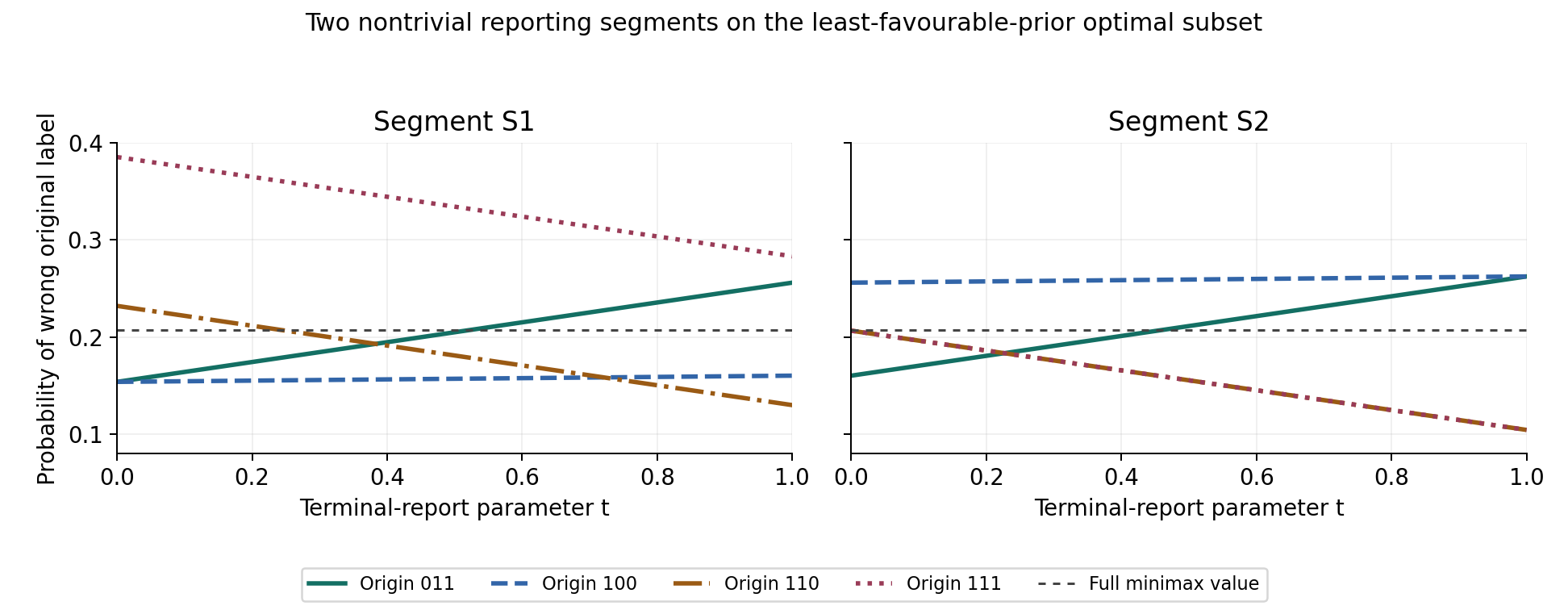
Figure 2. The two nontrivial reporting segments in the exact restricted Bayes-optimal subset. Each curve is an origin’s error; coincident curves overlap. The two singleton vectors are listed in the proof. No segment has all four curves at the full minimax value. This is not the entire restricted-class risk set and does not compute .
The no-private-coins grid alone cannot prove this proposition: terminal coins break that grid, and optimal tied stops really occur. The supplied exact set audit and two independent physical reconstructions are essential. Neither this strict separation nor its finite certificate asserts that near-optimal or other useful policies must randomize acquisition, that the A/B root mixture is unique, or that the result holds for other channel/reset/port contracts. No general new randomization principle, historical novelty or hardware benefit is claimed.
9 One statewise-error-constrained expected-read optimum
We change the objective once more, keeping hard cap four and the same physical contract. Allow arbitrary origin-independent root mixtures and terminal-report coins. Minimize uniform-prior expected reads , subject to at every origin, where . The objective is neither worst-origin expected reads nor a per-origin expected-read budget. The error constraint is not prior-averaged error. At each fixed origin, risk averages over sensor innovations and private coins; it need not satisfy the bound separately for every root component or individual realized run. All three resets remain compulsory; unit total expected action cost is . “Statewise” qualifies report error, not a physically validated safety guarantee.
Proposition 9.1 (Exact cap-four constrained cost point). For this specified problem,
This is one constrained cost point, not a complete frontier or an unrestricted-horizon optimum.
Feasible mixture and complete two-measure lower bound. Define three deterministic policies, each completing all unused resets. Policy buys one initial , routes zero to reset the second component and one to reset the first, then buys one current and reports . Policy buys no readings and reports zero. Policy takes the same one- route, then reads as follows: first answer one gives report zero immediately; first answer zero buys a second ; a second zero gives report one, whereas a second one buys the third and reports one exactly when that third answer is zero. Their risks and read means are
Choose at the root with weights . All four mixed risks equal ; mixed read means are
Every branch respects cap four and ends at . Thus the mixture is feasible. Its unequal per-origin means also show why the resource objective must be named.
For a lower bound set
For every policy satisfying the four risk constraints,
Compute over the complete same physical class, not just the three exhibited policies. Error penalties and read cost use different weights. With normalized posterior under the uniform origin law, put . The terminal loss is . The complete recursion is the minimum of that terminal loss, every legal next-reset continuation, and, for each port,
where use the ordinary channel posterior update of Section 6, now started at . Read cost is one under this measure; reset cost is omitted only because exactly three resets are compulsory and added afterward. Completion still satisfies all physical origins. Induction on proves completeness. Normalizing as a prior while retaining unit read cost would compute a different objective.
Exact rational evaluation gives . Independent unnormalized likelihood implementations agree; complete exported policy readback checks the primal at every origin. Consequently
matching the exhibited feasible mixture exactly. □
The inherited cap-four Bayes frontier in Section 5 has minimum expected reads for the different, weaker constraint . Under the present contract, requiring every origin to satisfy the bound costs an additional
uniform expected reads, with the same three-reset additive charge. This compares two guarantees; it is not a same-task improvement or a new derivation of the inherited frontier. The new policy need not preserve the old decisions or error vector.
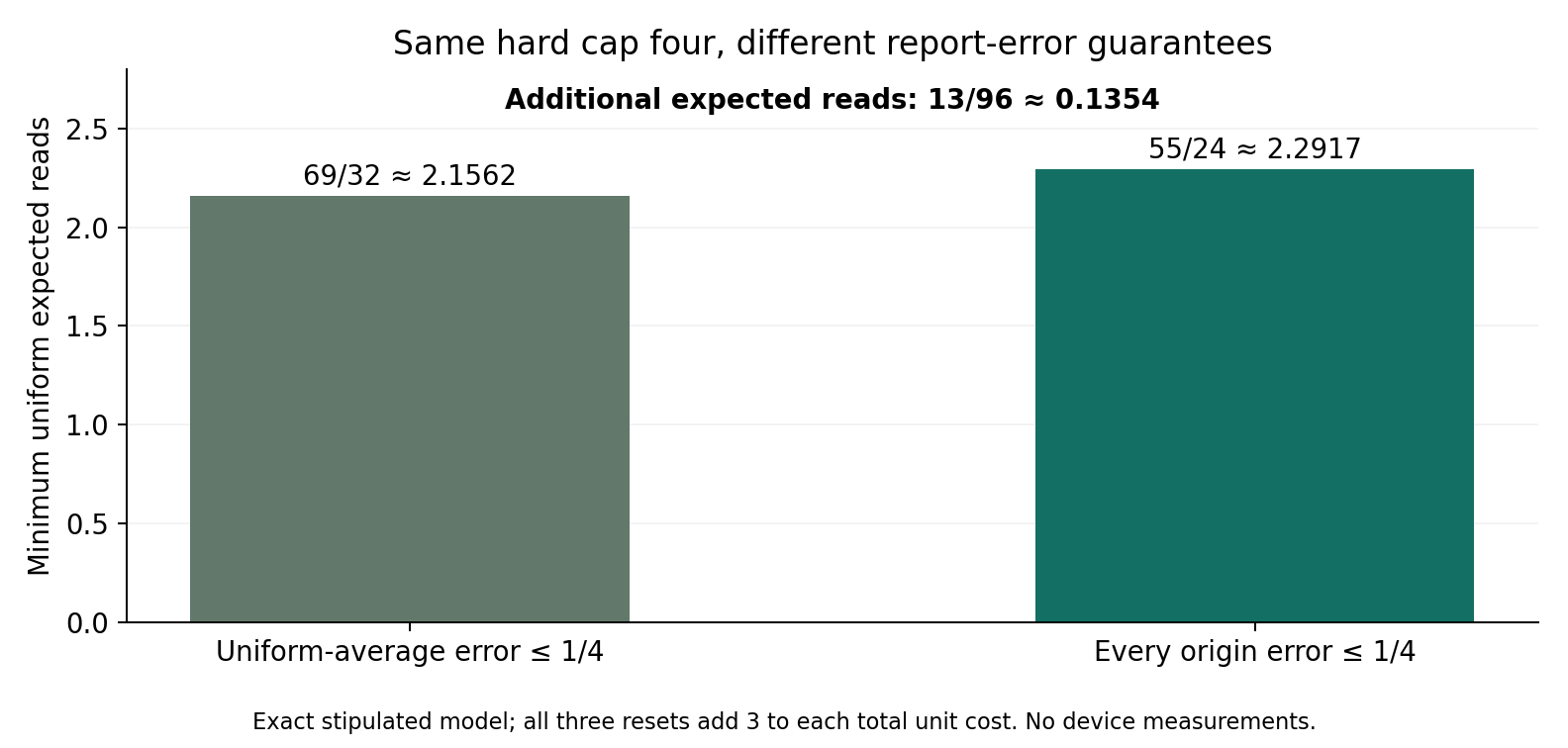
Figure 3. Exact uniform expected reads under two different error guarantees at the same hard read cap four. Both require certain restoration and add three unit reset charges. The difference prices the stronger statewise report-error constraint in this stipulated model; it is not measured hardware saving or a same-task improvement.
An initial feasible candidate used reads, with a proposed dual support value seven. The complete oracle refuted that support claim, returning for those candidate penalties. The corrected point above improves the feasible candidate by reads. Failed-candidate code and its explicit counterevaluation remain audit history, distinct from the passing final certificate. No full constrained frontier, worst-origin resource optimum, unknown-channel or imperfect-reset result, measured savings, human review or external novelty follows.
10 Discussion and remaining questions
The finite models separate several mechanisms that a single diagnostic score can hide. Physical erasure is a loss even for a complete-current-state oracle. Limited ports can make surviving information inaccessible. Distinct interventions can each expose a target while no common protocol exposes their pair. An early observation can select which distinction a repair must preserve. A different one-use model leaves response types present but their same-unit coupling unidentified.
The deterministic series/series equivalence is an important negative result: adding one component and overlapping sensing does not by itself create an adaptive-order advantage. The series/parallel witness gives a specified class-specific adaptive-versus-preset realization with explicit scoped minimality and costs. The origin-count lower bound is a general decision-tree observation; the component bound uses the coordinate-reset geometry. Fixed-order diagnostic adaptivity normalizes at exact deterministic feasibility (Proposition 1.3), so a stronger policy syntax alone is not a novelty distinction. The noisy bridge preserves the information advantage under common fresh channels, while simultaneously changing which repairs certain restoration requires. This is why deterministic action prices and noisy risk guarantees cannot be blended silently.
The charged frontier closes one specified cap-six expected-cost benchmark, not unrestricted-horizon optimization. Open mathematical tasks include all-horizon expected-cost optimal noisy policies, statewise-minimax optima beyond the checked caps and a charged-minimax frontier, a specified retry/partial-repair model, and broader port-family classification. The noisy four-origin example has not been proved minimal in a noisy class. The series/series feasibility theorem does not establish cost equality. Calibration uncertainty and model discrepancy need a charged, complete statistical contract; a nominal low error rate is not enough.
Sections 6–7 close only the declared small-cap minimax and frozen-acquisition reporting questions. They distinguish a single precommitted order from a private root mixture of such orders, and a changed error objective from an improvement of every origin’s risk. The complete optimal-action audit of Section 8 additionally requires some private acquisition randomness for exact cap-four optimality, even allowing arbitrary terminal coins. It does not prove uniqueness or locate the draws in time. The exact deterministic-acquisition value remains open. Section 9 closes one uniform-expected-read point under four statewise error constraints; a full constrained frontier and other resource objectives remain open. These exact finite-game calculations do not establish a new general minimax method.
The manuscript’s specific examples and reductions are derived and internally checked relative to the inspected antecedents. We do not establish external novelty, an exhaustive literature search, or subsumption by no prior theorem. Four unavailable originals and additional preview-only finite-machine work limit positioning (Appendix F). Human external review and proof-assistant certification have not occurred. The supplied arguments and exact checks also do not validate a physical apparatus.
The candidate contribution is the declared local-reset specialization and its structural and quantitative results, rather than a new general state-identification formalism. A submission decision still needs a target-specific assessment of priority and significance. The focused comparison narrows the candidate claims; it does not establish firstness of the axis/series characterizations, component bound or exact formulas. Responsible human submission authorship remains unconfirmed, and target-specific AI-use disclosure requirements have not been selected. This revised working manuscript preserves the unchanged v0.3 baseline. A concrete software or hardware application can motivate further research once its actual ports and repair transitions are specified. There is no conclusion about subjective awareness or general architectural superiority.
The updated source comparison distinguishes a framework encoding from a theorem supplying a particular local characterization or constant. The accessible pure-policy asymptotic and scalar Bayesian results do not automatically transfer to finite-cap minimax equalization. Likewise, prior-weighted wrong-declaration risks differ from the per-origin label-error constraints used here. Appendix G records the precise remaining reduction obligations.
A One-use response coupling is not physical erasure
This appendix retains a separate result from the second repair iteration. The earlier deterministic models supply complete response tables. Here the same-unit response coupling is unknown. Interventional marginals need not identify counterfactual coupling, a well-established causal-identification issue [20]; the following construction makes the intervention-access restriction explicit.
Complete actuator state is , with a fixture coordinate . Immutable remain in physical state forever. Initially and . Local one-use method sets and if ready; if spent it is a no-op. Trusted local replacement sets while retaining both response types. A world repair sets and is a no-op here. The sole diagnostic returns system health ; neither type is directly sensed. Repairs do not emit extra feedback.
Let
The origin-time counterfactual asks whether method would have succeeded if used while the original specimen was ready.
Proposition A.1 (Transcript-equivalent couplings). Every permitted adaptive policy has the same transcript law in and , including stopping and restoration observations. Under the specified prefix that invokes while the original specimen is ready, before either another method or replacement, and then observes failure,
Over all fair-marginal couplings, the sharp identification interval is .
Proof. Before a first ready-state method, probes reveal known failure. Whichever method is chosen first can expose only one fair response bit. Both methods are no-ops thereafter, and replacement makes subsequent health observations constant. All permitted trajectories are generated by one common fair response coin under either model; induction over chosen actions includes adaptive stopping and state-independent private randomness.
Failure under that first-ready prefix means . The two couplings then impose and respectively. More generally let
Both marginals stay fair and every permitted transcript law stays the same, while the conditional counterfactual is . Every value in is attained. The two-model class alone has identified set , with the same sharp lower and upper bounds. □
The specified prefix matters: applying first and then a spent-state does not condition on failure of the original response. A current-state oracle still sees . Projecting complete state onto current fault would hide a persistent response type and falsely suggest physical erasure. After spent-state failure, executing now is a no-op and its prospective current success is zero in both models. That is a different time-indexed question.
A port exposing the untried type or a resource-restoring operation that permits both original responses would change the access contract. Independent reruns on newly drawn specimens can recover marginals without revealing the same-unit coupling. None of those additions is implicitly granted here.
B An auxiliary destructive-intervention model
This auxiliary model separates physical erasure from restoration value using compound interventions, rather than coordinate resets. Consider states , origin support , healthy and failed . Operation sends to /pass and to /fail; sends to /pass and to /fail. At both operations leave state unchanged and report its health. Trusted replacement sends all states to /pass. An optional paid assay reports the complete current state without changing it.
Let original actuator label be on and original -success label be . Every origin pair has some separating experiment, yet no policy using only learns exactly: a first merges , a first merges , and first merges all origins. Each merge includes opposite labels. First does learn . After /fail, the present-time success of is zero at known state ; the origin-time alternative remains uncertain.
With positive priors and costs , assay cost , define . The exact certainly restoring values are
Indeed a failed first or reaches , where only restores and further assays reveal no origin. A first assay identifies the origin and selects its cheapest restoring action. Positive-cost repetitions add nothing; these first-action cases exhaust useful protocols. Exact forces first , while exact also permits first . At uniform prior and the three values are , , and , respectively. This synthetic compound-intervention model is distinct from the local-reset models in the main text and is not a physical device.
C Prospective validation and what it would establish
No physical experiment or device calibration was performed for this manuscript. The motor simulation in v0.3 and the coordinate-reset model here implement different contracts. Existing simulated motion or thermal results do not validate the repair ports, transition law, or the exact repeated-read interface assumed above.
C.1 A credible first implementation
A software fault-injection benchmark can expose three process-local fault bits, the specified series/parallel diagnostic endpoints, and silent local reset endpoints. A separate scorer retains the immutable origin and checks terminal health; the controller receives only its allowed action/read transcript. Fresh readout flips can be produced by an explicitly independent generator. This is an engineered benchmark, not evidence of a naturally occurring topological safety constraint or of hardware matching the model.
Before outcome trials, test transition locality and silence, transcript retention, polarity and freshness, restoration scoring, and absence of timing or metadata side channels. The benchmark must not grant a policy access to the scorer’s truth or the ability to recreate its unknown origin midway through an episode. Independent commissioned episodes may start from known origins for blinded evaluation; that experimental ability is not an extra action available within a policy.
Freeze the observation interface and policies before confirmation. Score original-label error, final health, their joint failure, actual read counts and actual repair counts separately. A pure performance score would conceal whether original-cause knowledge survived. Empirical trials of a few fixed policies do not establish an all-policy lower bound; that conclusion comes from the structural theorem. Likewise a programmed Bernoulli generator tests a declared interface, not whether uncontrolled sensor noise satisfies common garbling.
A hardware study additionally needs a concrete device, independent calibration, complete response-state variables, settling and thermal envelopes, fault setup, reset and restoration verification, resource accounting, engineering limits, and an explicit mismatch model. No numerical operating limits for such a device are supplied here.
C.2 A distinct four-origin confirmation design
For illustration, freeze the six-read block protocol of Theorem 4.1 at and perfect repairs. Its two label-zero origins have error and its two label-one origins . The proposed claim is each origin’s error is below , with simultaneous one-sided confidence at least .
Take independent Bernoulli episodes in each origin cell. Use Bonferroni level per cell and accept a cell only when its error count satisfies
The binomial lower tail decreases as the null error rate increases, so the test controls each null . Bonferroni supplies familywise level . In these displayed exact rational cases the accepted tail is strictly below .
| Episodes per origin | Accept errors at most | Four-cell pass power | Episodes total |
Cutoffs and powers were evaluated by exact rational binomial sums. For the displayed power, the two rates above are stipulated and the four cells are independent, giving
Cross-cell independence is needed for this power product, not for Bonferroni coverage. Each cell still requires its own binomial sampling model; repeated errors within a device or session may change the independent sampling unit. Optional stopping needs a different confidence contract.
At per origin the planned six-read/three-reset policy uses actions, excluding setup, calibration and controls. No minimum-sample claim, budget authorization or actual observations are implied. This is not the earlier motor study’s twelve-rate criterion or its cutoff of 24 errors at 400 per cell. Readout-model calibration and restoration validation remain separate from report-error confirmation.
C.3 Useful failures of the model
A measured reset that changes other coordinates, emits a success hint, or leaves a persistent mode changes the information problem. A port’s stable rate difference between nominally identical states can destroy the fixed-order floor. Shared offsets or preparation errors can prevent repetition from amplifying information. Such outcomes would be useful model findings, not failed attempts to confirm the same theorem. Any revised result should state its complete kernel, target, policy class and task loss before rerunning an optimization.
D Computational evidence and AI-assisted review
Analytical proofs establish the declared all-history statements. Finite enumeration corroborates them; it does not extrapolate an untested horizon. The complete Bellman recurrence establishes optimality only at its specified cap. All reported computations are finite-model calculations, not apparatus data or proof-assistant certificates.
| Result | Exact corroboration |
| Local repair and minimality | v0.2 simulated-referee checker: 270 two-bit axis cases and 765 square observation/support/label cases; corresponding normal-form and minimality arguments are proved in the text. |
| Series equivalence and fixed floor | v0.2 simulated-referee checker: 21,146 cube support/finite-label cases and 486 fixed-order/prior comparisons. No arbitrary port-family classification is inferred. |
| Finite-read optimum | Separately written rational recursions agree on all eight adaptive values and 48 fixed-order values through cap seven. Full policy graphs at caps three, four and seven were forward-checked. |
| Auxiliary models and design | Earlier exact checks cover the compound example, paired response models and four binomial confirmation rows. The prospective rows remain plans rather than observations. |
| Exact-feasibility normalization | v0.2.1 isolated rerun: 765 two-bit support/observation/label cases and 1,530 fixed-order/canonical equalities; all 15 witness label partitions, finite-quotient search over arbitrary finite preset words, and six uniform fixed-order floors. |
| Charged finite-cap frontier | Inherited v0.2.2 exact rational supporting-chord calculations for caps zero through six, adaptive and fixed order; 55 selected policy DAGs physically forward-checked. An independent recursion checks 93 cap-six scalar/order cases; 36 adversarial all-order exports verify corrected completion suffixes. |
The exact certificate-verification scripts use Python’s standard library. Optional parent LP discovery uses SciPy/NumPy, and figure generation uses Matplotlib/NumPy; those are separate from the supplied exact verifiers. PDF building and layout QA have their own documented tools. The main reproduction command and the fresh referee checker write only into isolated copied directories; full commands and manifests are in the package README. The original article v0.3, earlier companions v0.1 and v0.2 and their source records and v0.2.1/v0.2.2 are frozen. Some historical third-party evidence is not redistributed; its authoritative paths and hashes are separately inventoried. Unavailable original literature is not needed to execute the supplied finite-model computations.
AI tools assisted drafting, exact calculations and simulated referee roles. Three simulated roles assessed rigor, exposition and publication positioning for v0.2. Their reports, input snapshots, proposed corrections and read-back dispositions accompany the manuscript. For v0.2.1 the authoring agent performed a bounded readback of the new normalization, supported-start distinction and affected claims, together with the isolated targeted rerun and PDF checks. This is not a new independent simulated-referee assessment or external peer review. The implementations were separately written and the checked values are explicit, but they can share assumptions and derivational errors. Agreement does not establish novelty, human peer review, institutional endorsement, or physical validity. Responsible submission authorship and venue-specific disclosure remain to be confirmed.
The subsequent programme additionally conducted a hostile full-source AI read of frozen v0.2.1 and independently rechecked its 56 cap-zero-through-seven adaptive/fixed values, square and normalization cases. For v0.2.2, separate AI roles assessed the charged recurrence/frontier and physically evaluated exported policies without importing the optimizer. They found and corrected a fixed-order completion-export defect: the first candidate listed unused resets in natural order rather than the selected permutation. Its saved tie-selected policies and numerical frontier were unaffected; adversarial nonselected orders exposed the defect and passed after repair. The supplied review records identify source hashes, exact scopes, precision edits and readback dispositions. These are simulated internal assessments, not independent human peer review or a new endorsement of external priority. The new checks do not broadly rerun all inherited auxiliary computations or validate a physical device.
For v0.2.3, separately written exact minimax solvers agree on the cap-four adaptive and precommitted-order-mixture games. The primary certificates cover ten games at caps zero through four. A parent reader that imports neither solver checks 27 selected physical DAGs, four-origin risks, caps, restoration and fixed-order suffixes, and recomputes the complete rational support lower bounds. A hostile actual-artifact reader checks those 27 DAGs, ten records and 512 explicit cases for the displayed adaptive policies. Separate boundary-prior attacks retain all four physical restoration obligations. This is bounded computational corroboration of Proposition 6.1, not proof-assistant certification.
For the fixed acquisition experiment, independently written physical enumerations reconstruct all twelve records from 64 origin/potential-noise cases; exact primal/dual equality includes arbitrary randomized reports. All 4096 deterministic reporters and the deliberately coarsened -word experiment are checked. The full-class comparison value is inherited from the closed minimax certificate, rather than newly solved by each terminal-rule checker. Hostile review distinguishes the report-risk tradeoff, recoverable route information and the unproved necessity of acquisition randomization. The edition-specific bounded readback binds the actual revised source, records findings and their dispositions, and separately records PDF QA. These internal AI reviews are neither human expert reports nor endorsement of external priority or readiness to submit.
Detailed research chronology, earlier review reports, correction histories and new v0.2.4 records are supplied with distinct scopes. For the acquisition-randomness result, two separately written complete recursions agree on the optimal-action state sets after raw/normalized weight projection, all minimizing action menus and eight reporting cells. Exported deterministic acquisition trees are evaluated at both terminal parameter endpoints across 512 physical origin/potential-noise cases. The nonconvex union proof, rather than witness feasibility alone, excludes the full equalizer. An attempted no-tied-stop shortcut was rejected because four optimal tied stops actually exist. A draft check that imposed their special direction at nonoptimal states was also corrected and disclosed.
For the constrained-cost point, a normalized-posterior parent oracle and independently written absolute-likelihood recursions agree on the complete support value . The parent additionally checks seven selected policy DAGs from two different attaining mixtures across 448 potential-noise cases; an independent direct three-rule evaluation checks 192 cases. The first parent solver uses floating-point LPs only for finite master discovery; exact Fraction-valued weights, physical risks/means and complete support equality certify the final value. The independent master is rational. The hostile readback checks actual sources and exports, both resource/error measures, the rejected candidate dual and the corrected lower/upper match. The assertion-failing initial-candidate script remains explicitly failed audit history, not a passing reproduction command. These checks certify the stated finite-model point, not a full frontier or empirical advantage.
The actual new-edition source readbacks, finding dispositions, PDF checks and preservation hashes identify their own final inputs. They do not relabel historical reviews as endorsement of this later source. Earlier research chronology, review reports, correction histories and preservation hashes are supplied as audit material rather than as validation arguments in the article. The record preserves the distinction between inherited checks and newly performed checks.
E General retained observer information
For a standard Borel retained record and complete finite physical state , with finite origin-label set and the sufficiency condition of Proposition 1.2, the oracle Bayes error is
Condition on : no continuation report can have higher correct conditional mass than the largest conditional label probability. A maximizing report is measurable by fixed tie breaking over the finite label set. Integrating proves the bound and its attainment. Zero error means the conditional label law is a point mass almost surely. The record includes retained private random information. In particular, a continuous retained seed is not discarded to force a countable-record formula; the discrete sum in the main text is only its countable case.
F Source coverage, lineage, and limitations
This is a focused comparison, not a systematic or exhaustive priority review. The source-access ledger distributed with the manuscript distinguishes three levels: actual source sections historically read by the prior research tracks; additional source sections read during the continuation; and originals only previewed or not obtained. It does not claim that assembling this manuscript newly reread every external PDF. The v0.2 review additionally read selected passages in the primary troubleshooting report and finite-state testing tutorial, and a later author-hosted state-identification preprint. A subsequent focused comparison read selected final-article and additional primary-author passages as recorded below. The v0.2.1 edition integrated that comparison; the present edition does not claim another new source retrieval or complete reread of those articles. The v0.2.3 minimax extension performs no new literature retrieval and does not upgrade any inherited reading scope. Its finite-game, convexification and Bayes-support arguments are used as established methods, without a priority claim for the benchmark values or formulas. The v0.2.4 acquisition-cell and constrained-cost extensions performed no new literature retrieval or upgrade of inherited access/read scopes. That historical statement is retained. The later source audit and model comparison, integrated in v0.2.5, have the separately stated reading scopes in Appendix G; the table below records earlier reading history, not the latest access status.
|
Table 15: Source-reading scope. Access and selected reading do not establish full theorem-level subsumption or external priority.
|
|
|---|---|
|
Antecedent |
Actual recorded scope and limit |
|
|
|
|
DeVeaux–Kane–Zelterman 2018 [7] |
New charged extension: actual nine-page publisher PDF parsed introduction and Section 2 definition/Proposition 1, for the standard curtailed-sampling construction. Later clinical-design results and the complete dependency chain were not audited. Our majority-three identity and cost calculation are proved directly; no historical firstness is inferred. |
|
Breese–Heckerman 1996 [5] |
Primary technical-report PDF historically read, especially Sections 2.1, 3 and 4: repair/configuration experiments, persistence and action costs. The date is 1996, not a later archive upload. No new general troubleshooting algorithm is claimed. The v0.2 review additionally read selected passages of Sections 2.1–2.3, 3–3.2 and 4 in the actual 16-page PDF; it did not audit every diagram or algorithmic guarantee. |
|
Yannakakis’s primary-author tutorial was read at slides 8–17 and 23–27. Lee–Yannakakis 1994 original theorem proofs remain unread; Turker and coauthors were inspected at publisher-indexed abstract/ introduction scope only. No detailed algorithmic or complexity subsumption follows from those previews. The v0.2 review reread tutorial PDF pages 8–18 and 24–26, including its preset-input and reliable-reset definitions. This still does not supply the Lee–Yannakakis original. |
|
|
van den Bos–Vaandrager preprint [22] |
Actual author-hosted 2020 preprint: introduction/related work, preliminaries, Section 4 definitions, the displayed Lemma 20 proof and the merging example after Definition 21; opening of Section 5 through Definition 22. The later construction/completeness theorem was not audited. This is an adaptive-testing/merging antecedent, not a result transferred to our repair-order comparator. |
|
Heckerman–Breese–Rommelse 1994 [9] |
Focused comparison: actual primary-report parsed text, introduction, Section 2 ordering assumptions A1–A3, selected Section 3 myopic planning and static-planner comparison. MSR-TR-94-07 identity was checked against the Microsoft author publication listing. No empirical reproduction or complete algorithm audit was performed. |
|
van den Bos–Vaandrager final article [23] |
Focused comparison: actual 24-page published-article institutional copy, selected introduction and Section 4 definitions/merging example; Section 5 opening; Section 6 injectivity/completeness discussion, Definition 34, Lemma 35, Theorem 36 statement/proof text and Example 37. The full algorithm/dependency chain was not independently certified. The no-compatible-distinct-pair hypothesis is not silently transferred to our origin-label or restricted-start problem. |
|
Moerman–Wißmann 2022 [12] |
Focused comparison: actual author manuscript, introduction and selected Section 2 definitions/examples, including known subsets of starts and experiments without reset-to-start. Section 3 opening and concluding partiality discussion only; SAT encoding, correctness and experiments were not audited. Original Lee–Yannakakis theorem attributions there do not close the unread-original gap. |
|
Yin 2017 [26] |
Author-hosted primary PDF historically read for the initial/current distinction and joint-state estimator. Its stochastic DES contract differs from controlled perfect resets; no complexity theorem is transferred. |
|
Tian–Pearl 2000 [20] |
Primary PDF introduction and structural counterfactual definitions historically read. General same-unit coupling nonidentification is established; Appendix A is a supplied operational specialization. |
|
de Oliveira 2018 [6] |
Author manuscript pp. 1–8 recorded in the v0.3 source review, including adapted-garbling formulation. Does not close the original Blackwell or Greenshtein access gaps. |
|
Renou–Venel pinned v3 [17] |
Section 4.3 pp. 17–22 and Appendix A.2 pp. 39–44 additionally read in the continuation, including the finite-horizon construction for Theorem 3. The infinite-horizon compactness step was not independently certified in full. Controlled information and legality-preserving emulation are direct antecedents; the specialized reset reductions still need their explicit arguments. |
|
Acquisition Sections 3 and 7 and relevant v0.3 causal, law-oracle and history sections were inspected. Their own review/priority limits remain. The repair branch began from v0.1, while the original paper separately reached completed v0.3. It is not retroactively claimed that all repair results were already merged into v0.3. |
|
|
|
|
|
|
|
|
|
|
Four original full texts remain unavailable: Blackwell (1953) [4], Greenshtein (1996) [8], Paoli–Lafortune (2005) [16], and Thorsley (2017) [19]. The first two limit historical comparison of experiment ordering and simulation; the latter two remain part of the baseline diagnosis/safety audit. None is an unverified premise in a local-reset proof here.
The Euclid retrievals yielded wrappers rather than original articles. A Purdue institutional listing identifies a same-titled Greenshtein 1990 technical report, number 19, but offers no report bytes; its equivalence to the 1996 article is unverified. Paoli–Lafortune’s publisher abstract/introduction and a proof-omitting precursor do not replace the original journal proofs. Thorsley 2017 remains subscription-preview scope. No access purchase or author contact was performed. These are remaining source gaps, not evidence that related results do not exist.
The focused comparison also left additional testing sources at limited access: the Lee–Yannakakis 1996 survey was not obtained through its attempted full-text route; Krichen’s 2005 chapter was read only in indexed passages, including an older four-state adaptive/no-preset example; Hierons–Türker 2014 was available as an institutional abstract, and Yenigün and coauthors 2018 only as an indexed abstract. That earlier comparison did not audit their original proofs. The later recovery of the Hierons–Türker submitted manuscript and the Yenigün article is recorded separately below; no complete proof-dependency certification is claimed. The source ledger in the supporting comparison records the separate failures and read scopes.
The baseline’s internally reconstructed 2008 necessity-claim witness is not part of the companion’s proof chain and is not presented as an accepted correction. Similarly, no homotopy or RF admissibility result is used to establish that these synthetic repairs are physically safe. They are stipulated always legal; terminal restoration is an explicit mathematical obligation. Device validity needs its own evidence.
The contribution is therefore described as explicit finite models, normal forms, witnesses, scoped quantitative guarantees and exact small-budget calculations. Being derived in this research programme does not establish publication priority. Simulated review neither closes unavailable-original gaps nor supplies external endorsement.
G Updated source audit and theorem-level comparisons
The source audit and model comparison of 7 November 2026 were conducted after v0.2.4. This edition integrates their qualifications without changing the 22 numbered mathematical result statements. They are bounded AI research readbacks, not human referee reports or exhaustive priority audits. The separate evidence bundles contain the complete access ledger, 22-result comparison matrix and finite-model checks.
G.1 Newly inspected sources and limits
Hierons–Türker’s institutional submitted manuscript [10] was recovered: selected PDF pages 1–8, especially Definitions 3–4 and Theorems 1–2, were read. Final publisher-text equivalence and the original Lee–Yannakakis dependency remain unchecked. Yenigün and coauthors’ article [25] was recovered within an official 227-page proceedings issue. The article occupies PDF pages 8–25 (printed 7–24); selected pages 8–14 were read. Possession of the volume is not a complete audit of its classification proofs.
The published controlled-sensing copy [14] was inspected at selected model/fixed-sample and sequential/discussion passages. Its binary pure stationary policy statement is Proposition 1/Remark 2; Theorem 1 concerns multihypothesis open-loop exponents. The controlled Markov/cost comparison uses pinned arXiv:1310.1844v1 [15], selected model, risk and cost statements, not an assertion of equivalence with the 2015 final article. The active-testing comparison uses arXiv:1203.4626v4 [13], selected model and Section 3/Fact 1; supplementary proof dependencies were not certified.
The subsequent model readback checked selected web text in Moerman–Wißmann Definitions 2.1–2.6 and Example 2.5 [12], van den Bos–Vaandrager Lemma 35/Theorem 36/Example 37 [23], and Renou–Venel Theorem 3 with the opening of Appendix A.2 [17]. No new source-page visual review or full SAT/algorithm/infinite-horizon proof audit is claimed for that web reading.
Blackwell 1953, Greenshtein 1996, Paoli–Lafortune 2005 and Thorsley 2017 remain original-proof gaps through the attempted routes. Lee–Yannakakis 1994/1996, Krichen 2005 and the minimum-cost ADS article remain limited as documented in the access ledger. Access failures do not establish absence of relevant prior art. No purchase, institutional sign-in or author outreach was performed.
G.2 Explicit model maps and transfer barriers
The deterministic Mealy encoding in Section 1 is direct: ports are output-bearing self-loops and resets emit a dummy symbol. An injective origin label on gives subset initial-state identification; a noninjective label requires only homogeneous terminal label fibers. Full-state identification is sufficient, not necessary, in the latter case. Merging equal-label origins is not generally a valid transition quotient: the label-zero starts and already have different initial .
For the series/parallel physical cube, complete observable-word equivalence has six classes:
This can be checked without a finite word-length cutoff: compare both ports after every reset subset. Each word visits such subsets because resets commute and are idempotent, and every signature component is obtainable by an input word. The delivered finite check also verifies transition/output congruence. The four supported starts occupy distinct classes. However, and are observationally equivalent while only the former is healthy. Health is not a predicate on this quotient. The raw cube therefore fails a pairwise-apart whole-machine hypothesis; a diagnostic quotient is not by itself a cost-preserving restoration map. Appending all unused resets after a retained report repairs this feasibility issue in the total perfect-reset class, but changes costs.
The noisy model is a finite-horizon belief decision problem with observed state and posterior over immutable origins. Current state at origin is . The terminal loss sums posterior mass over wrong labels, rather than necessarily wrong full hypotheses. Generic posterior dynamic programming is established [13]; the reset/budget/restoration specialization still needs its stated completeness induction. A deterministic minimizer of a scalar Bayes support does not imply a deterministic minimax equalizer. In Section 8, taking a convex hull over acquisition trees would enlarge the restricted class, whose reporting cells must instead be combined by set union.
For Section 9, uniform expected reads use origin law , whereas error penalties use . The loss under the -posterior uses . Replacing by normalized while keeping a unit read charge changes the objective. In the controlled-Markov source [15],
is a prior-weighted wrong-declaration risk; it is not a per-origin label-error row. Its positive controlled-observation kernels and asymptotic cost conclusion do not directly certify this irreversible-reset, hard-cap point. Nor does pure-policy asymptotic exponent optimality [14] decide exact finite-cap minimax risk.
The noisy floor uses a direct causal simulation adding common private flips to exact answers. Renou–Venel’s discounted comparison [17] is a close antecedent, but its displayed discounted decision-marginal equality alone is not a full stopped-transcript, hard-budget or pathwise-health equivalence. Majority approximation changes read counts and supplies an infimum, not finite attainment. Perturbed resets instead require the matched complete-kernel coupling contract already stated.
G.3 Result-by-result readback
The following judgements concern applicability and priority limitations. They do not rerun all numerical certificates or prove non-subsumption under every possible reformulation. Source identifiers and full locators are expanded in the accompanying comparison report.
Result 1.2. Established Bayes/data-processing argument; direct local proof, not a new information-order theorem. A continuation is a stochastic kernel from (T,X); maximizing conditional label mass yields G. Actual ports need not expose . The Blackwell and Greenshtein originals remain unavailable; the complete-state sufficiency premise must be checked for any application.
Result 1.3. Local normalization supports a precise preset comparison; general FSM encoding applies. Encode reads as self-loops and resets with a dummy output. Saturation recovers every fixed-order transcript; appended resets restore after a label is retained. Generic PDS definitions do not by themselves prove saturation. It changes length/cost and does not preserve noisy capped risk.
Result 2.1. Specialized characterization within established state-identification framework. Before the first reset there is no new answer; afterwards only or can carry an origin distinction. Thus a label factors through one signature. No inspected generic existence theorem supplies this exact two-axis iff as a stated corollary; historical priority unresolved.
Result 2.2. Elementary equality condition for Bayes coarsening; generic method overlap. Compare maximum of sums with sum of maxima. Equality requires a common maximizing label across all positive states in each port fiber, including ties. This is loss-specific equality, weaker than Blackwell equivalence for every decision problem; original B53 not checked.
Result 2.3. Explicit incompatible-acquisition witness, not refutation of fixed-experiment information ordering. The pair label needs the join of two individually available partitions; no single legal policy realizes it. A randomized choice retains which experiment was used, not both original outcomes. Priority of this operational example unresolved; a universal acquisition assumption from a different model cannot be imported.
Result 2.4. Three-policy linear-program calculation plus local policy completeness. Use probabilities of D/AT/WT. Standard convex mixtures give feasibility epsilon_I+epsilon_C1/3 and cost 4-2epsilon_I-epsilon_C after the physical reduction. Troubleshooting and scalar DP ancestry does not certify the reduction to three policies or the exact frontier. TUY16 cost definitions unavailable.
Result 3.1. Local structural equivalence; encoding alone is not a theorem-level derivation. Only the 00 initial output block is ambiguous; a first reset erases one coordinate there. The displayed fixed schedules expose its surviving projection. No inferred equality of costs. General ADS existence cannot by itself guarantee a single reset order works across all initial fibers.
Result 3.2. A concrete local subset ADS/no-PDS realization of an established phenomenon. The adaptive tree actually identifies all four supported origins. Saturation turns the fixed-order impossibility into preset impossibility in this alphabet; lost-pair masses give . Full-cube ADS results cannot be applied unchanged: 000 and 001 have identical observable behavior. K05 original example still unavailable; exact witness priority unresolved.
Result 3.3. Generic unresolved-spine bound plus geometry-specific binary-component bound. At most three origins yield at most one unresolved child per informative split. Two-bit coordinate fibers force conflicting horizontal/vertical requirements to intersect. Four supported starts is not a four-state whole machine. Older small examples do not establish the three-component minimum or its priority.
Result 3.4. Exact local action lower bound and attaining tree; cost-aware planning is established. Every positive-prior origin must reset each faulty coordinate; the diagnostic argument forces one Q and one P. The supplied adaptive tree meets both charges. A generic shortest ADS cost may price different objects and omit restoration. No transferable cost theorem identified.
Result 4.1. Elementary protocol risk calculation and standard repetition amplification. Condition on route correctness: label-zero error is (1-alpha)beta+alpha(1-beta); label-one error is beta. Completing every reset preserves restoration. These are achieved finite risks, not optimal error exponents or global expected-cost values; priority of exact expressions unverified.
Result 4.2. Explicit legal simulation proves the lower bound; approximation proves the infimum. An exact-port controller adds independent flips and follows the noisy policy’s actions. Majority replacement of finitely many exact queries approaches . RV25’s discounted-marginal equivalence is not automatically full stopped-transcript equivalence. Costs/caps need their own map; no finite attainment follows.
Result 4.3. Local consequence of mutual absolute continuity of finite histories. A terminal event omitting a reset remains possible at an origin needing it. Finite transcripts cannot support disjoint exact label decisions. Sequential asymptotic small-error results do not contradict finite exact impossibility; safe-diagnosability preview cannot supply physical safety.
Result 4.4. Specialization of elementary coupling stability. Conditional match bounds multiply over remaining resets despite adaptive order. Transfer the joint label/restoration bad event with discrepancy d_R. Not a consequence of discounted expected-payoff comparison alone; no retry/imperfect-reset optimization or unavoidable error floor established.
Result A.1. Explicit operational instance of established counterfactual nonidentification. All legal transcripts depend on at most one fair response. Vary the fair-marginal coupling parameter t; the requested conditional response spans 1-t in [0,1]. Persistent response types must remain in complete state. This is not physical erasure; inherited source scope does not certify exact-example priority.
Result 5.1. Standard finite-horizon belief DP and convex support, with local completeness proof. State (J,n,mu) tracks reset history and remaining budget. Terminal label loss replaces full-hypothesis declaration loss; reads add tau, resets advance J. Scalar support can be minimized deterministically while constrained frontier points use mixtures. General DP does not certify the delivered numerical vertices.
Result 6.1. Standard finite-game convexification and weak-duality certificate. Presample coins into deterministic trees after deleting identity resets. Any prior-weighted risk lower-bounds maximum risk; a feasible mixture supplies the opposite bound. A deterministic scalar Bayes optimum does not imply a deterministic minimax optimum. Zero statistical prior mass cannot waive physical restoration.
Result 6.2. Exact model-specific computational constants using established methods. The certificate compares a full-policy weighted support minimum with an equalizing feasible mixture. A single fixed permutation has an indistinguishable opposite-label pair. No accessible theorem supplies these constants directly. Earlier numerical certificates are inherited, not recomputed here; no historical-firstness conclusion.
Result 6.3. Elementary rational-grid exclusion and asymptotic approximation. Deterministic errors lie on a 1/625 grid. This excludes the exact minimax value; terminal coins invalidate that grid. Growing blocks approximate the mixed exact-port comparator. The grid alone cannot locate randomness in acquisition. Asymptotic pure-control results address a different limit/objective.
Result 7.1. Finite experiment decision-rule optimization with explicit least-favourable prior. For each record, minimize weighted wrong-label mass; tied records allow a randomized equalizer giving 38/175. The complete record includes route information. An attaining q-blind kernel is not universal sufficiency of the P word. Generic decision theory does not establish the benchmark’s historical priority.
Result 8.1. Restricted nonconvex policy-class separation; no contradiction with scalar Bayes determinism. Positive least-favourable prior forces any minimax equalizer onto the Bayes-optimal face. Union of per-tree reporting cells excludes the diagonal; convexifying acquisition would change the class. Known only 38/175. No exact , uniqueness, draw-location, near-optimal necessity or general randomization theorem established.
Result 9.1. Constrained finite-game primal/dual point; established cost-aware-testing ancestry. Use uniform-law posterior for read cost and terminal penalties . Feasible mixture and support value certify 55/24; resets add three. NV13v1 decision-risk columns are not these origin-error rows. Averaging beta into a prior with unit read charge changes the objective. Full frontier and priority open.
G.4 Remaining priority and publication questions
The candidate contribution remains the restricted local-reset normal forms, coordinate geometry, witness and exact quantitative benchmarks. No checked antecedent has been shown to imply all these conclusions, and no proof of their external novelty is supplied. Lawful original copies and specific theorem-level reductions remain the next priority. The exact , a full constrained frontier and all-horizon optimization remain separate mathematical questions. Human area review, responsible authorship, venue significance and applicable AI disclosure remain open.
References
[1] Noisy diagnosis during local repair. Internal research addendum, continuation 01, 2026. 6 November. Exact finite-read frontiers, proofs and simulated reviews; predecessor to the present companion.
[2] Causal diagnosis under local repair: Three research iterations. Internal research reports prepared for Brian Theory, 2026. 4 November. Complete reports, code, exact results, source logs and AI reviews retained in the causal-diagnosis-three-iteration-research archive.
[3] Causal self-diagnosis with noisy tests: Observation laws, irreversible access, and task recovery. Unpublished research draft prepared for Brian Theory, 2026. Version 0.3, 5 November, 38 pages. AI-assisted research; submission attribution undecided. Preserved unchanged with this companion.
[4] David Blackwell. Equivalent comparisons of experiments. The Annals of Mathematical Statistics, 24(2):265–272, 1953. Original full text unavailable in this research session. https://doi.org/10.1214/aoms/1177729032.
[5] John S. Breese and David Heckerman. Decision-theoretic troubleshooting: A framework for repair and experiment. Technical Report MSR-TR-96-06, Microsoft Research, 1996. March; revised May. Also UAI 1996. Primary sections historically inspected. https://www.microsoft.com/en-us/research/wp-content/uploads/1996/03/Decision-Theoretic-Troubleshooting-A-Framework-for-Repair-and-Experiment.pdf.
[6] Henrique de Oliveira. Blackwell’s informativeness theorem using diagrams. Games and Economic Behavior, 109:126–131, 2018. https://henriquedeoliveira.com/wp-content/uploads/2020/12/blackwells-informativeness-theorem-using-diagrams.pdf.
[7] Michelle DeVeaux, Michael J. Kane, and Daniel Zelterman. Clinical trial design using a stopped negative binomial distribution. Statistics and Its Interface, 11(4):699–707, 2018. Selected introduction and Section 2 read in the primary publisher PDF; not a full clinical-design audit. https://doi.org/10.4310/SII.2018.v11.n4.a13.
[8] Eitan Greenshtein. Comparison of sequential experiments. The Annals of Statistics, 24(1):436–448, 1996. Original full text unavailable; 1990 report metadata is not proof access. https://doi.org/10.1214/aos/1033066220.
[9] David Heckerman, John S. Breese, and Koos Rommelse. Troubleshooting under uncertainty. Technical Report MSR-TR-94-07, Microsoft Research, 1994. Selected primary report passages read; not an audit of all empirical/algorithmic claims. https://www.microsoft.com/en-us/research/wp-content/uploads/1994/01/Troubleshooting-Under-Uncertainty.pdf.
[10] Robert M. Hierons and Uraz Cengiz Turker. Distinguishing sequences for partially specified fsms. In Tests and Proofs, pages 62–76. Springer, 2014. Institutional submitted manuscript; selected reading, final-text equivalence unchecked.
[11] David Lee and Mihalis Yannakakis. Testing finite-state machines: State identification and verification. IEEE Transactions on Computers, 43(3):306–320, 1994. Original full theorem text not obtained; see source-coverage appendix. https://doi.org/10.1109/12.272431.
[12] Joshua Moerman and Thorsten Wißmann. State identification and verification with satisfaction. In A Journey from Process Algebra via Timed Automata to Model Learning, volume 13560 of Lecture Notes in Computer Science, pages 450–466. Springer, 2022. Author manuscript, introduction and Section 2 selected read; SAT encoding and experiments not audited. Publication identity checked on author’s research page. https://joshuamoerman.nl/docs/22frits60-state-identification-and-verification-with-satisfaction.pdf.
[13] Mohammad Naghshvar and Tara Javidi. Active sequential hypothesis testing. The Annals of Statistics, 41(6):2703–2738, 2013. Selected reading of arXiv:1203.4626v4 electronic reprint; pagination differs.
[14] Sirin Nitinawarat, George K. Atia, and Venugopal V. Veeravalli. Controlled sensing for multihypothesis testing. IEEE Transactions on Automatic Control, 58(10):2451–2464, 2013.
[15] Sirin Nitinawarat and Venugopal V. Veeravalli. Controlled sensing for sequential multihypothesis testing with controlled markovian observations and non-uniform control cost, 2013. Pinned arXiv:1310.1844v1, 7 October; selected reading; final-publication equivalence unchecked.
[16] Andrea Paoli and Stéphane Lafortune. Safe diagnosability for fault-tolerant supervision of discrete-event systems. Automatica, 41(8):1335–1347, 2005. Original full text unavailable; only qualified preview/precursor coverage. https://doi.org/10.1016/j.automatica.2005.03.017.
[17] Ludovic Renou and Xavier Venel. Comparing experiments in discounted problems, 2025. Pinned arXiv:2405.16458v3; header 5 April, title-page version 8 April. Section 4.3 and Appendix A.2 inspected at the scopes recorded here. https://arxiv.org/pdf/2405.16458v3.
[18] Brian Theory. From observable states to acquirable predictive models. Technical report, B-Theory, 2026. Revised 7 October; reading copy 1; not externally peer reviewed. https://www.b-theory.com/manuscripts-html/acquirable-predictive-models/.
[19] David Thorsley. A necessary and sufficient condition for diagnosability of stochastic discrete event systems. Discrete Event Dynamic Systems, 27:481–500, 2017. Abstract and preview only; original full text unavailable. https://doi.org/10.1007/s10626-017-0236-y.
[20] Jin Tian and Judea Pearl. Probabilities of causation: Bounds and identification. In Proceedings of the Sixteenth Conference on Uncertainty in Artificial Intelligence, pages 589–598, 2000. Technical report R-271-UAI; introduction and definitions historically inspected. https://ftp.cs.ucla.edu/pub/stat_ser/R271-U.pdf.
[21] Uraz Cengiz Turker, Tonguc Unluyurt, and Husnu Yenigun. Effective algorithms for constructing minimum cost adaptive distinguishing sequences. Information and Software Technology, 74:69–85, 2016. Publisher-indexed abstract/introduction only; full proofs not audited. https://doi.org/10.1016/j.infsof.2016.02.001.
[22] Petra van den Bos and Frits Vaandrager. State identification for labeled transition systems with inputs and outputs. Author-hosted preprint dated 4 December, 2020. Selected definitions, Lemma 20 proof and merging example inspected; later completeness theorem not audited. https://sws.cs.ru.nl/publications/papers/fvaan/StateIdentification/adg.pdf.
[23] Petra van den Bos and Frits Vaandrager. State identification for labeled transition systems with inputs and outputs. Science of Computer Programming, 209:102678, 2021. Published article; selected definitions, merging example and injectivity/completeness discussion read. Full algorithm/dependency chain not independently certified. https://doi.org/10.1016/j.scico.2021.102678.
[24] Mihalis Yannakakis. Testing, optimization, and games. ATVA tutorial, 2006. Primary tutorial slides 8–17 and 23–27 historically inspected. https://www-verimag.imag.fr/EVENTS/2006/ATVA/ATVAtutorials/Yannakakis_ATVA2006_Tutorial.pdf.
[25] Husnu Yenigun, Nina Yevtushenko, Natalia Kushik, and Jorge Lopez. The effect of partiality and adaptivity on the complexity of fsm state identification problems. Proceedings of ISP RAS, 30(1):7–24, 2018. Selected article pages read in official proceedings volume.
[26] Xiang Yin. Initial-state detectability of stochastic discrete-event systems with probabilistic sensor failures. Automatica, 80:127–134, 2017. https://xiangyin.sjtu.edu.cn/Paper/17AutomaticaIni.pdf.